Archive / page 32 of 123

Latest articles, page 32

  1. Chunking Strategies in Production RAG: Comparing Fixed-Size, Semantic Chunking, Late Chunking, and Contextual Retrieval

    In production Retrieval-Augmented Generation (RAG) pipelines, the chunking strategy determines the theoretical ceiling of retrieval quality. Splitting documents into discrete text spans transforms continuous discourse into isolated segments. When chunks are indexed in isolation, critical context disappears: pronoun antecedents lose their referents, domain-specific acronyms lose their definitions, and propositions spanning arbitrary token boundaries become fragmented. Selecting an appropriate ch


    AI
    9 min read
  2. Matryoshka Representation Learning (MRL): Mathematical Foundations, Multi-Scale Loss Optimization, and Adaptive Vector Retrieval

    Matryoshka Representation Learning (MRL) has become the standard architectural foundation for modern dense text embeddings. Introduced by Kusupati et al. at NeurIPS 2022 and subsequently deployed across frontier embedding models like OpenAI text-embedding-3, Nomic Embed, and BAAI BGE-M3, MRL solves a structural inefficiency in vector retrieval: the rigid coupling between embedding dimensionality, memory consumption, and semantic fidelity. Traditional dense encoders project arbitrary text sequen

    AI
    9 min read
  3. llama.cpp Merges DFlash 2 Support for Up to 2x Faster Speculative Decoding Across Long Contexts

    The open-source llama.cpp project has merged native support for DFlash 2, bringing parallel speculative decoding and substantial inference throughput improvements to local LLM serving across CPU, Apple Silicon, and GPU backends. The implementation, integrated via Pull Request #27342, adds local convolution operators and candidate selector mechanics designed specifically for the DFlash 2 architecture. Non-Autoregressive Speculative Drafting Standard speculative decoding uses a smaller autoreg

    llama.cpp
    1 min read
  4. Meta Previews Hatch Consumer AI Agent with Dedicated Cloud Virtual Machines

    Meta is preparing to launch a consumer-facing autonomous AI agent codenamed Project Hatch, designed to execute long-running online tasks in the background using dedicated cloud virtual machines. Details of the project emerged from internal Meta memos reported by Business Insider and The Information. Unlike conventional conversational chatbots that respond synchronously to prompts, Hatch operates as an asynchronous personal agent capable of completing complex web interactions autonomously. Clo

    Meta
    2 min read
  5. OpenAI Tests Persistent Mode in Codex for Continuous Autonomous Agent Execution

    OpenAI is developing a new operational setting for its Codex developer tool called Persistent mode, designed to allow autonomous AI agents to execute tasks indefinitely until manually paused or put to sleep. The feature was identified in recent code commits to the command-line interface (CLI) repository for Codex, as reported by Wired. In the codebase, Persistent mode appears alongside standard reasoning effort settings such as medium, high, and extra-high, but introduces an entirely different

    OpenAI
    2 min read
  6. Synthetic Data Generation and Data Curation Pipelines in Production: Comparing Distilabel, NVIDIA NeMo Curator, Data-Juicer, and InstructLab

    As frontier language models exhaust human-authored web text, pretraining and post-training performance increasingly depends on automated data curation and synthetic data synthesis. Unfiltered public corpora introduce duplicate content, synthetic artifacts, low-reasoning text, and licensing liabilities. Modern foundation models, including Meta's Llama 3.1, NVIDIA's Nemotron-4 340B, Alibaba's Qwen 2.5, and IBM's Granite, are trained on datasets where synthetic generation and rigorous multi-stage f

    Data Curation
    9 min read
  7. Tensor Parallelism and Pipeline Parallelism: Mathematical Foundations of Megatron-LM 1D Slicing, Sequence Parallelism, and 1F1B Scheduling

    Scaling modern large language models beyond tens of billions of parameters quickly exhausts the physical memory and compute throughput of individual graphics processing units. A 70-billion-parameter model stored in 16-bit floating-point (FP16 or BF16) requires 140 GB of VRAM solely for model weights. During full-precision training with the Adam optimizer, parameter states, gradients, and optimizer momentum terms demand approximately 16 to 18 bytes per parameter (amounting to 1.12 TB to 1.26 TB f

    AI
    10 min read
  8. Barret Zoph Joins Google as VP of Research to Lead Gemini Post-Training and Reinforcement Learning

    Barret Zoph, former post-training lead at OpenAI and co-founder of Thinking Machines Lab, has joined Google as Vice President of Research. Google confirmed the appointment, stating that Zoph will direct reinforcement learning (RL) and post-training initiatives across the Gemini model family. Background and Industry Trajectory Zoph previously spent several years at Google Brain, where he co-authored foundational papers on Neural Architecture Search (NAS) and scaling mixture-of-experts (MoE) ar

    Google
    1 min read
  9. Durable Execution Engines for AI Agents in Production: Comparing Temporal, Inngest, Hatchet, and Restate

    Durable Execution Engines for AI Agents in Production: Comparing Temporal, Inngest, Hatchet, and Restate Architecture, State Persistence, Event Replay, and Latency Overheads Building production AI agents requires solving a fundamental systems failure: language model reasoning loops are inherently long-running, non-deterministic, and prone to transient failures. When an autonomous agent executes a 20-step chain involving web scraping, document parsing, API queries, code generation, and human app

    AI
    9 min read
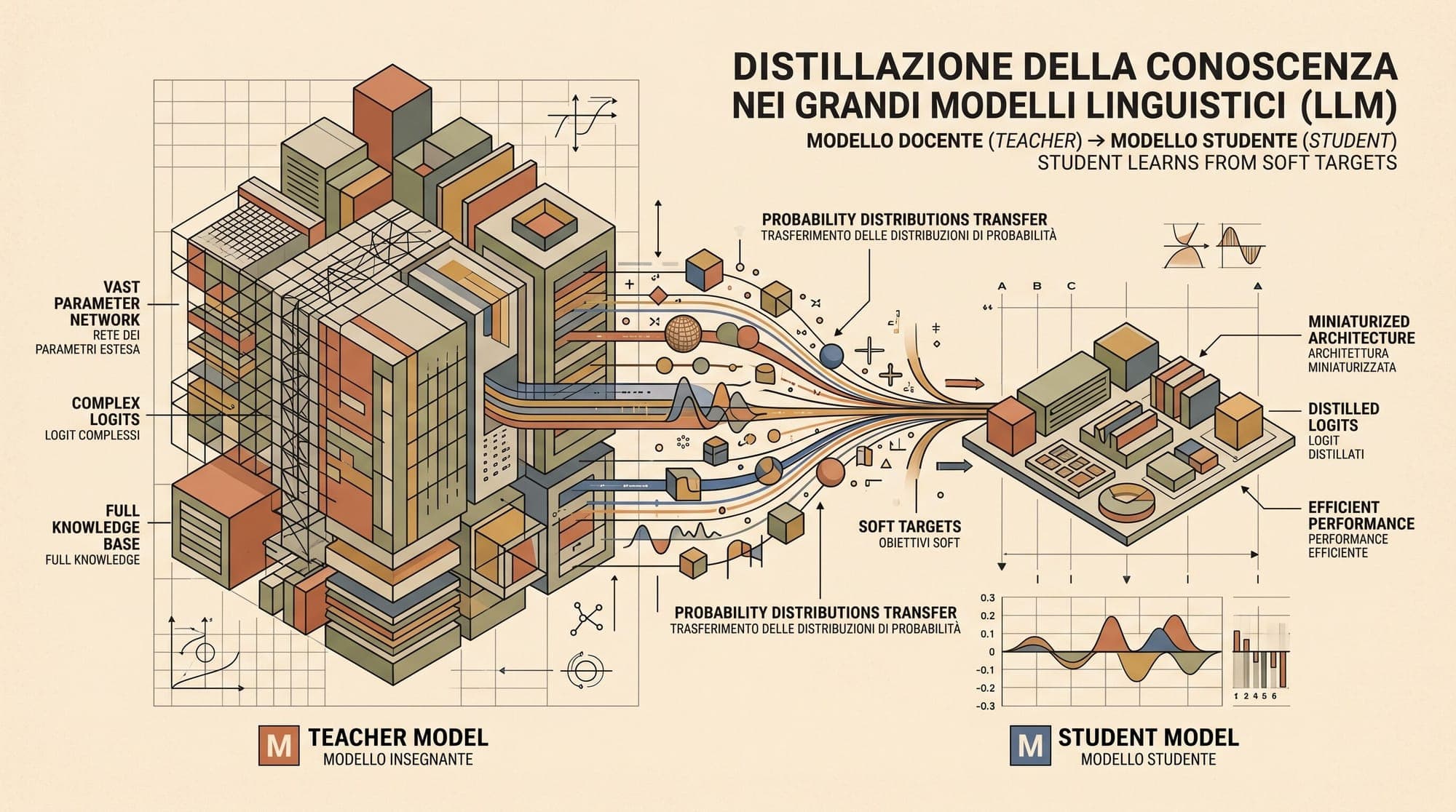
  10. Knowledge Distillation in Large Language Models: Mathematical Foundations of Forward vs. Reverse KL Divergence, Sequence-Level Distillation (SeqKD), and On-Policy Mode-Seeking Objectives

    Deploying frontier large language models in latency-critical and compute-constrained environments remains an active challenge in artificial intelligence systems. While parameter scale correlates directly with downstream generalization and emergent reasoning capabilities, the memory footprint and FLOP intensity of dense multi-hundred-billion parameter architectures impose prohibitive operational costs. Post-training compression strategies such as quantization and structural pruning reduce precisi

    AI
    11 min read