Archive / page 102 of 123

Latest articles, page 102

  1. LLM Observability in Production: OpenTelemetry Semantic Conventions, Distributed Tracing, and Latency Profiling

    LLM Observability in Production: OpenTelemetry Semantic Conventions, Distributed Tracing, and Latency Profiling Deploying large language models into production introduces failure modes that traditional application performance monitoring (APM) tools were never designed to diagnose. Standard web services fail with discrete HTTP error codes, predictable database timeouts, or memory leaks. In contrast, LLM applications fail through silent semantic drift, hallucinated tool parameters, unbounded prom

    AI
    6 min read
  2. In-Context Learning in Large Language Models: How Induction Heads and Attention Circuits Learn Without Weight Updates

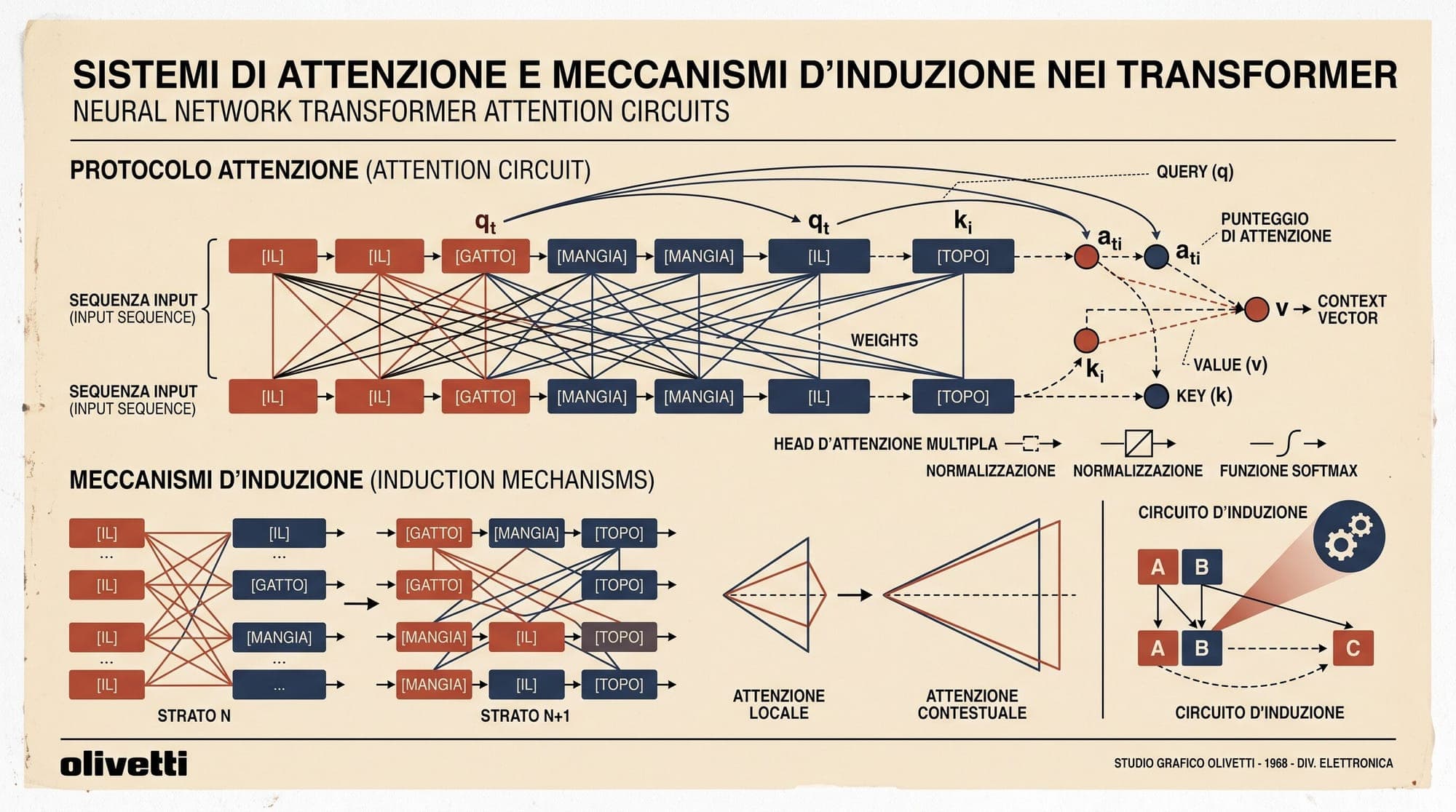
    Autoregressive large language models demonstrate the ability to adapt to new tasks, follow few-shot demonstrations, and execute algorithmic patterns entirely within their context windows. Unlike traditional fine-tuning, in-context learning occurs at inference time with frozen model parameters, leaving weights completely unchanged ($\Delta \theta = 0$). For several years following the scaling demonstrations in GPT-3, the internal mechanism governing in-context learning remained an empirical blac

    AI
    6 min read
  3. LG Partners with Nvidia on 10,000-Square-Meter Robot Data Factory Targeting 100,000 Training Hours

    LG Electronics hosted senior Nvidia leadership at its Yangjae R&D Campus in Seoul on August 18, 2026, advancing a joint initiative to build physical AI training pipelines and target 100,000 hours of embodied robotics data by the end of the year. The site review took place five days after LG Group and Nvidia signed a strategic memorandum of understanding at Nvidia headquarters in Santa Clara on August 13. The accelerated timeline reflects LG's effort to convert its industrial manufacturing infra

    Robotics
    2 min read
  4. AI Guardrails in Production: Multi-Stage Filtering, Classification Models, and the Latency Tax

    AI Guardrails in Production: Multi-Stage Filtering, Classification Models, and the Latency Tax Production deployments of large language models cannot rely solely on system prompt instructions to maintain safety, prevent prompt injection, or restrict domain scope. System prompt alignment is inherently susceptible to adversarial bypasses, context dilution, and non-deterministic instruction following. To enforce strict security, compliance, and topic boundaries, engineering teams increasingly depl

    AI
    4 min read
  5. Multi-Head Latent Attention: How Low-Rank KV Compression Scales LLM Serving

    Autoregressive transformer inference faces a fundamental hardware constraint during text generation: memory bandwidth saturation. While prefill (processing prompt tokens) is compute-bound and saturates GPU tensor cores, token-by-token generation is memory-bandwidth bound. To generate each subsequent token, the inference engine must load all prior Key and Value vectors from High Bandwidth Memory (HBM) into SRAM. As sequence lengths reach 32k, 64k, or 128k tokens and batch sizes scale, the Key-Va

    AI
    6 min read
  6. Lost in Compaction: LLM Context Compression Drops 83% of User Constraints, Penn State Study Finds

    As large language models take on longer multi-turn workflows and agentic tasks, systems increasingly rely on context compaction to summarize past conversation histories and keep prompt lengths within memory budgets. However, this compression comes at a severe cost to user control. A new study by Pennsylvania State University researchers Zhiqi Wang, Yichi Zhang, Dongwon Lee, and Yuchen Yang reveals that standard context compaction drops an average of 83 percent of user-defined operational constr

    AI
    2 min read
  7. LLM Gateways in Production: Multi-Provider Failover, Rate Limiting, and Spend Governance

    LLM Gateways in Production: Multi-Provider Failover, Rate Limiting, and Spend Governance As generative AI workloads transition from experimental prototypes to mission-critical infrastructure, direct client-to-provider API calls introduce substantial operational risk. Relying on hardcoded SDK connections to a single model provider exposes production services to unexpected rate limits, regional outages, silent breaking changes, and uncontrolled token costs. To solve these reliability and governa

    AI
    5 min read
  8. State Space Models in Large Language Models: How Mamba, S4, and Selective Recurrence Challenge Transformer Attention

    Modern large language models rely almost universally on the Transformer architecture. However, the core mechanism powering Transformers, softmax multi-head self-attention, exhibits fundamental scaling limitations. Specifically, standard self-attention requires quadratic time and memory complexity relative to sequence length during prefilling, alongside a linear memory expansion for the key-value (KV) cache during autoregressive token generation. To circumvent these computational bottlenecks, re

    AI
    6 min read
  9. Tencent Releases UI-Mate: Open-Weight Foundation GUI Agents with In-Context Demonstration Learning

    Tencent's HY Frontier team has released UI-Mate, an open-weight foundation GUI agent designed for autonomous computer operation across desktop environments. Available in 27-billion and 9-billion parameter configurations, the models pair environment-grounded reinforcement learning with an in-context demonstration pipeline that allows agents to reference structured human workflows during execution. Alongside model weights on Hugging Face, Tencent published a technical report, code repository, and

    AI
    2 min read
  10. Multi-Agent Orchestration in Production: State Machines, Swarms, and Error Cascades

    Moving large language model applications from isolated prompts to multi-agent architectures introduces distinct systemic complexities. While single-agent systems face localized points of failure, multi-agent topologies exhibit emergent dynamics such as cascading hallucinations, coordination deadlocks, and severe context bloat. Designing multi-agent systems for production environments requires selecting explicit orchestration paradigms, bounding error propagation, and enforcing durable state per

    AI
    5 min read