
Moving large language model applications from isolated prompts to multi-agent architectures introduces distinct systemic complexities. While single-agent systems face localized points of failure, multi-agent topologies exhibit emergent dynamics such as cascading hallucinations, coordination deadlocks, and severe context bloat.
Designing multi-agent systems for production environments requires selecting explicit orchestration paradigms, bounding error propagation, and enforcing durable state persistence.
Four Multi-Agent Architectural Topologies
Production multi-agent frameworks generally implement one of four core design patterns, each offering different balances between determinism and flexibility.
1. Explicit Graph State Machines
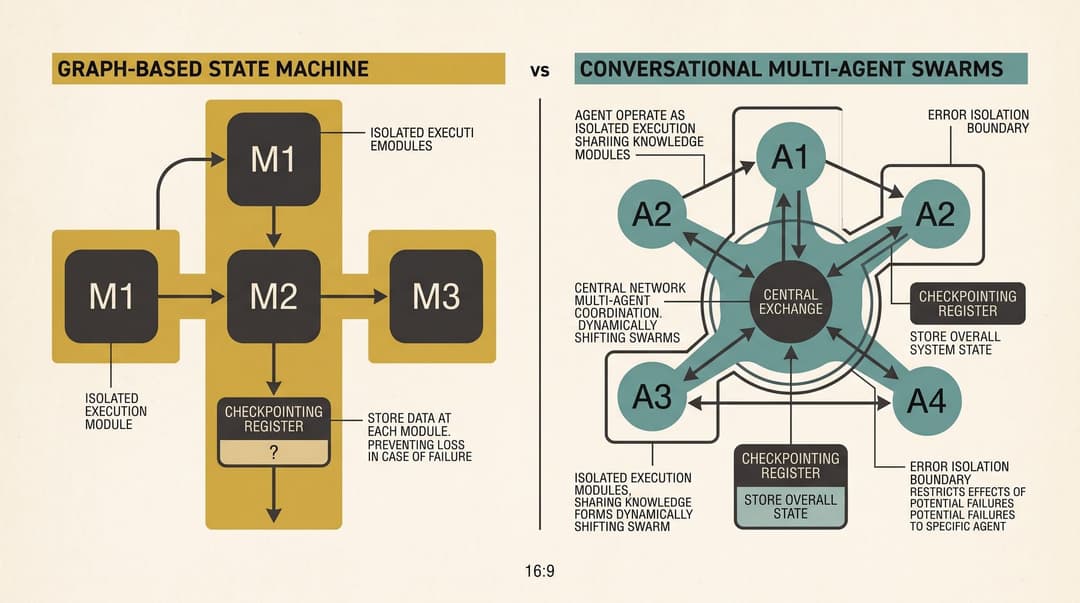
Graph-based state machines, popularized by frameworks such as LangGraph, model agent workflows as directed cyclic graphs. Every step represents a discrete computational node (an LLM invocation, data transformation, or tool execution), while edges govern control flow.
- State Schema: State is defined explicitly via typed schemas (such as TypedDict or Pydantic models). Updates are applied incrementally using predefined reducer functions rather than rewriting full conversational strings.
- Control Flow: Edges determine execution order conditionally based on node output. This enables deterministic branching, loops, and termination criteria.
- Trade-Off: Graph state machines require substantial upfront schema declaration and boilerplate code, but they offer maximum determinism and straightforward trace auditing.
2. Functional Handoff Swarms
Lightweight swarm architectures, represented by the OpenAI Agents SDK and OpenAI Swarm, treat multi-agent handoffs as functional routing calls. Instead of maintaining an overarching state graph, agents delegate tasks dynamically by returning another agent instance as a function execution result.
- State Schema: Context is typically stateless or passed directly through minimal execution routines and conversation turns.
- Control Flow: Dynamic, peer-to-peer delegation where any agent can hand control to any other agent configured within its toolset.
- Trade-Off: Minimal abstraction and fast execution latency, but susceptible to circular routing loops and lack of centralized governance.
3. Hierarchical Orchestrator-Worker
In hierarchical systems, a central supervisor agent receives user requests, breaks them down into subtasks, and assigns them to specialized leaf workers. The leaf agents execute isolated subtasks (such as document retrieval or code execution) and return structured outputs back to the supervisor.
- State Schema: Isolated execution contexts per subagent. The supervisor aggregates structured summaries without polluting leaf agents with full conversation histories.
- Control Flow: Strictly vertical. Leaf agents cannot communicate directly with one another and must pass results back through the root coordinator.
- Trade-Off: Clean domain boundaries and modular testing, but the central supervisor presents a throughput bottleneck and single point of cognitive failure.
4. Autonomous Conversational Teams
Chat-based multi-agent frameworks, such as Microsoft AutoGen and CrewAI, model collaboration as multi-party group chats. Agents possess distinct personas, backstories, and operational instructions, broadcasting messages across a shared channel overseen by a group chat manager.
- State Schema: Append-only conversational dialogue histories shared across all participants.
- Control Flow: Autonomous speaker selection based on LLM arbitration or round-robin rotation.
- Trade-Off: High adaptability for exploratory problem-solving, but high token overhead and low operational determinism.
The Anatomy of Multi-Agent Failure Modes
Deploying autonomous agents in production exposes architectural failure modes rarely encountered in single-prompt deployments.
1. Error Cascades and False Consensus
A primary operational hazard in multi-agent workflows is the snowballing of minor inaccuracies into systemic failure. Research by Xie et al. (2026) in From Spark to Fire: Modeling and Mitigating Error Cascades in LLM-Based Multi-Agent Collaboration formalizes multi-agent interactions as directed dependency graphs.
Their findings demonstrate that when an atomic error seed is introduced by an upstream agent, downstream agents tend to accept the faulty premise as ground truth. In centralized supervisor topologies, an error originating at a central hub produced a 100% downstream failure rate across multiple commercial frameworks. Once an error enters the context window as a collaborative premise, peer agents exhibit consensus inertia, validating and compounding the falsehood rather than correcting it.
2. Context Bloat and Token Inflation
Conversational multi-agent patterns that broadcast full message histories across all participants create quadratic token growth. In comparative production benchmarks, a focused research task executed in a typed state machine required approximately 2,000 tokens per run. The identical workflow in an unstructured conversational chat consumed over 8,000 tokens due to back-and-forth conversational pleasantries, role reenactments, and redundant context passing.
Unmanaged token expansion increases API costs by an order of magnitude and degrades model reasoning as key task instructions are pushed out of the model attention window.
3. Delegation Deadlocks and Infinite Handoffs
In swarm and dynamic handoff architectures, agents with ambiguous role definitions frequently enter infinite delegation ping-pong. Agent A delegates a query to Agent B, which determines it lacks specific tooling and passes it back to Agent A. Without hard recursion limits or state-level progress counters, the system consumes its rate limits without producing an answer.
4. Non-Idempotent Tool Execution
Multi-agent pipelines executing external API calls (such as writing database records or dispatching payments) face severe data corruption risks during retries. If a downstream worker fails to serialize its state or times out, uncoordinated retry loops can re-execute non-idempotent actions multiple times.
Production Hardening Guidelines
Building resilient multi-agent infrastructure requires strict architectural constraints at both the messaging and execution layers.
1. Implement Bounded Execution Budgets
Every multi-agent execution thread must enforce strict operational constraints:
- Recursion Limits: Configure explicit invocation caps (for example, setting
recursion_limit: 25in state graphs ormax_turnsin handoff frameworks). - Timeouts and Fallbacks: Set per-node wall-clock timeouts and define fallback policies when a subagent fails or returns malformed schemas.
- Total Token Caps: Implement hard token budgets at the graph runtime layer to abort runaway loops automatically.
2. Adopt Typed State and Message-Layer Governance
Rather than allowing unconstrained string dialogues, production architectures should enforce typed state schemas:
- Structured Diffs: Nodes should emit structured data patches (such as document IDs or specific JSON objects) instead of appending raw conversational text.
- Genealogy Tracking: Implement message-layer filters to verify assertions before they are broadcast downstream, as proposed in error-mitigation research.
- Context Pruning: Run deterministic summarization or extraction nodes between major sub-steps to clear transient scratchpad tokens before state persistence.
3. Deploy Durable Checkpointing
Relying on in-memory state persistence causes catastrophic session loss during process restarts or container evictions. Production deployments should use durable backends (such as PostgreSQL, Redis, or SQLite) to snapshot graph state at every super-step. Durable checkpoints provide:
- Crash Recovery: In-flight agent runs can resume from their exact last valid state snapshot after infrastructure disruptions.
- Human-in-the-Loop Interventions: Execution can pause indefinitely at predefined breakpoints, allowing human operators to inspect state variables, provide approvals, or edit payloads before execution resumes.
- Deterministic Time Travel: Engineers can roll back an agent execution to a previous checkpoint to replay, debug, or fork failed branches.
Architectural Decision Framework
When selecting an orchestration framework for production systems:
- Choose Graph State Machines when workflows require strict determinism, auditable compliance trails, complex cyclical logic, and robust human-in-the-loop oversight.
- Choose Functional Handoffs when building lightweight triage systems with narrow routing paths and low latency requirements.
- Choose Hierarchical Supervisors for complex research or coding pipelines where task decomposition into isolated sandboxes prevents context cross-contamination.
- Avoid Unbounded Conversational Chats in high-throughput production environments where predictable unit economics, low latency, and deterministic execution are mandatory.
