
LLM Gateways in Production: Multi-Provider Failover, Rate Limiting, and Spend Governance
As generative AI workloads transition from experimental prototypes to mission-critical infrastructure, direct client-to-provider API calls introduce substantial operational risk. Relying on hardcoded SDK connections to a single model provider exposes production services to unexpected rate limits, regional outages, silent breaking changes, and uncontrolled token costs.
To solve these reliability and governance challenges, engineering teams deploy centralized LLM gateways (also known as AI proxies). Siting between internal applications and external model providers, an LLM gateway provides a unified control plane for routing, resiliency, security, and financial governance.
Why Traditional Reverse Proxies Fall Short
Standard Layer 7 reverse proxies like Nginx, HAProxy, and standard Envoy deployments excel at routing static assets and REST microservices. However, they lack the protocol and domain awareness required for large language model workloads:
- Dual-Dimensional Rate Limiting: Standard proxies throttle traffic based on Requests Per Second (RPS). LLM providers enforce rate limits on both Requests Per Minute (RPM) and Tokens Per Minute (TPM). A single request can consume 50 tokens or 100,000 tokens, rendering request-count throttling ineffective at preventing upstream HTTP 429 errors.
- Streaming and Latency Asymmetry: LLM inference is characterized by long-lived Server-Sent Events (SSE) connections. Time-to-First-Token (TTFT) and Inter-Token Latency (ITL) behave differently from traditional round-trip latency. Proxies must stream chunks without buffering while simultaneously tracking token metrics on completed streams.
- Payload Heterogeneity: Providers use divergent request and response schemas. Anthropic Messages API, OpenAI Chat Completions, Google Gemini REST, and Amazon Bedrock Converse API each require specific serialization. Traditional proxies do not translate JSON schemas on the fly.
- Context Length Failures: Traditional HTTP backends do not fail due to cumulative token length. When a prompt exceeds a model context window, the gateway must distinguish between an unrecoverable payload error and a transient failure that warrants fallback to a larger-context model.
Data Plane Architecture and the Hot Path
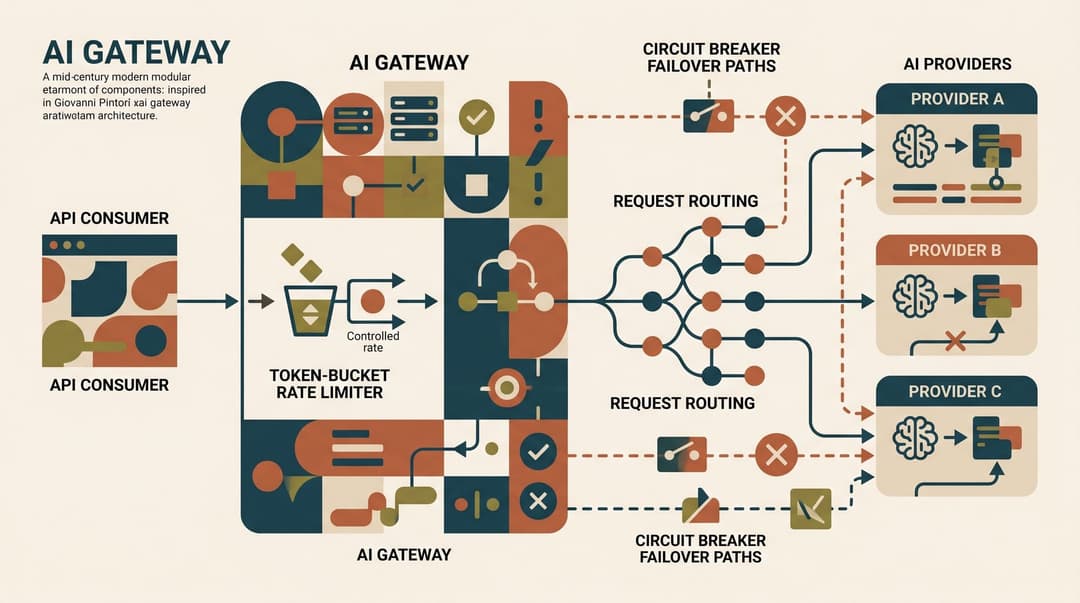
High-performance LLM gateways such as LiteLLM Proxy, Portkey, Kong AI Gateway, and Envoy AI Gateway maintain strict separation between the data plane (hot path) and control plane (background tasks).
[ Client Apps / Microservices ]
               │
               ▼  (Virtual Key Auth, OpenAI Schema)
┌─────────────────────────────────────────────────────────┐
│                    LLM Gateway Plane                    │
│                                                         │
│  1. In-Memory Virtual Key & Token Bucket Validation    │
│  2. Cache Lookup (Exact Match / Semantic Vector)        │
│  3. Routing Engine & Circuit Breaker Evaluation         │
│  4. Schema Normalization & Egress Transformation        │
└────────────────┬───────────────────┬────────────────────┘
                 │                   │
                 ▼                   ▼
    ┌───────────────────────┐  ┌───────────────────────┐
    │  Upstream Provider A  │  │  Upstream Provider B  │
    │   (Primary Target)    │  │       (Fallback)      │
    └───────────────────────┘  └───────────────────────┘
                 │                   │
                 └─────────┬─────────┘
                           │ (SSE Stream Pass-Through)
                           ▼
┌─────────────────────────────────────────────────────────┐
│              Asynchronous Background Plane              │
│  - Token Usage Aggregation  - Spend Ledger Updates      │
│  - OpenTelemetry Spans      - Async Audit Logs          │
└─────────────────────────────────────────────────────────┘
To avoid adding latency to real-time completions, modern gateways keep the hot path completely non-blocking:
- In-Memory Policy Evaluation: Virtual key authentication, tenant rate limits, and routing decisions are computed locally in memory using shared state stores like Redis or local sync rings.
- Asynchronous Telemetry: Logging, audit traces, token ledger accounting, and OpenTelemetry GenAI spans are dispatched asynchronously via background queues rather than blocking the response stream.
- Streaming Pass-Through: For SSE streams, the gateway pipes chunks directly to the downstream client as they arrive, parsing usage headers or stream delimiters without incurring full payload reassembly overhead.
Resilient Traffic Engineering and Failover Patterns
The core operational benefit of an LLM gateway is automated mitigation of upstream degradation. Production gateway architectures implement several coordinated resiliency mechanisms.
Granular Error Classification
Gateways classify upstream HTTP error codes into actionable retry categories:
- 429 (Rate Limit Exceeded): Triggers immediate failover to a configured secondary provider or alternate API key pool without exhausting client retry timeouts.
- 500/502/503/504 (Server Errors and Timeouts): Dispatches immediate fallback to a redundant model endpoint.
- 400 Context Window Exceeded: Routes the request to a fallback model tier supporting longer context windows, such as escalating from an 8k context model to a 128k or 1M context model.
- 400 Invalid Schema or Content Moderation: Bypasses retry loops and surfaces the error directly to the client to avoid wasting compute budget.
Circuit Breakers and Cooldown Windows
To prevent retry storms from overwhelming a recovering upstream service, gateways maintain isolated circuit breakers per provider and model combination.
When error rates or 429 response frequencies cross a defined threshold (such as greater than 50% failures over a 30-second sliding window), the gateway opens the circuit breaker. Incoming traffic for that model is routed immediately to a designated fallback target. The gateway periodically dispatches half-open health probe requests; once the provider demonstrates sustained recovery, traffic shifts back to the primary deployment.
Latency-Based Dynamic Load Balancing
Beyond static fallback chains, advanced gateways implement Exponentially Weighted Moving Average (EWMA) tracking of Time-to-First-Token across available inference regions. If an upstream US-East region suffers GPU cluster congestion, the gateway shifts dynamic traffic allocations to US-West or European endpoints with lower real-time TTFT.
Spend Governance and Multi-Tenant Controls
Centralizing inference traffic allows organizations to manage infrastructure spending across departments and projects.
Virtual API Keys
Instead of distributing raw provider API keys across microservices, developers authenticate against the gateway using virtual keys. This architecture provides several security and management advantages:
- Raw upstream credentials remain secured in enterprise key vaults.
- Virtual keys can be revoked, rotated, or scoped to specific models instantly without redeploying downstream applications.
- Permissions can restrict specific teams to designated model families or cost tiers.
Dual-Token Rate Limiting and Budgets
LLM gateways implement dual-dimensional token buckets in distributed storage:
- RPM and TPM Quotas: Enforces maximum request and token throughput per consumer, preventing single noisy tenants from exhausting organizational quotas.
- Hard Dollar Ceilings: Automatically rejects requests or downgrades models once a virtual key reaches its assigned daily or monthly budget cap.
- Dynamic Model Downgrades: When a non-critical tenant consumes 80% of their allocated monthly budget, the gateway can automatically rewrite routing rules to substitute cost-effective compact models for expensive frontier reasoning models.
Security, Guardrails, and Observability
Placing a gateway in the inference path creates a centralized enforcement point for data governance and telemetry:
- PII Redaction and Data Masking: Regex-based filters and lightweight named-entity recognition (NER) engines inspect incoming prompts, stripping sensitive data before the payload crosses the network perimeter to third-party providers.
- Semantic Caching: Exact-match and vector-based semantic caches store previously generated responses. Cache hits return instantly from local storage, bypassing external API calls, reducing latency to single-digit milliseconds, and eliminating redundant spend.
- Standardized Observability: Gateways emit standardized OpenTelemetry metrics, standardizing fields such as
gen_ai.usage.input_tokens,gen_ai.usage.output_tokens,gen_ai.response.model, and request latency across all providers into unified monitoring dashboards.
Self-Hosted vs Managed Deployment Models
Engineering organizations evaluate two primary deployment models when rolling out an AI gateway layer:
- Self-Hosted Data Planes (LiteLLM Proxy, Kong AI Gateway, Envoy AI Gateway): Keeps all prompt payloads and completion tokens inside private VPC boundaries. Eliminates third-party data processing risks and introduces minimal intra-cluster network latency (typically 2 to 5 milliseconds). Requires operational overhead for maintaining Redis state clusters, ingress controllers, and high availability.
- Managed Control Planes (Portkey, Cloudflare AI Gateway, TrueFoundry): Provides immediate turnkey features including global routing dashboards, automated key rotations, analytics, and managed guardrail integrations without maintaining dedicated proxy infrastructure. Introduces an external SaaS network hop and requires strict vendor compliance validation for data residency.
For enterprises subject to strict regulatory compliance, self-hosted proxy deployments inside private VPCs ensure sensitive data remains within internal trust boundaries. For high-velocity product teams, managed gateways provide instant cross-provider observability, failover routing, and spend alerts with zero infrastructure maintenance.
