

AI Guardrails in Production: Multi-Stage Filtering, Classification Models, and the Latency Tax
Production deployments of large language models cannot rely solely on system prompt instructions to maintain safety, prevent prompt injection, or restrict domain scope. System prompt alignment is inherently susceptible to adversarial bypasses, context dilution, and non-deterministic instruction following. To enforce strict security, compliance, and topic boundaries, engineering teams increasingly deploy external guardrail architectures that intercept requests before they reach the foundation model and inspect responses before they return to the user.
However, adding runtime moderation introduces a significant systems engineering challenge: the latency tax. Running multi-stage safety checks can easily double or triple time-to-first-token (TTFT) and overall request latency if not designed with tiered execution topologies.
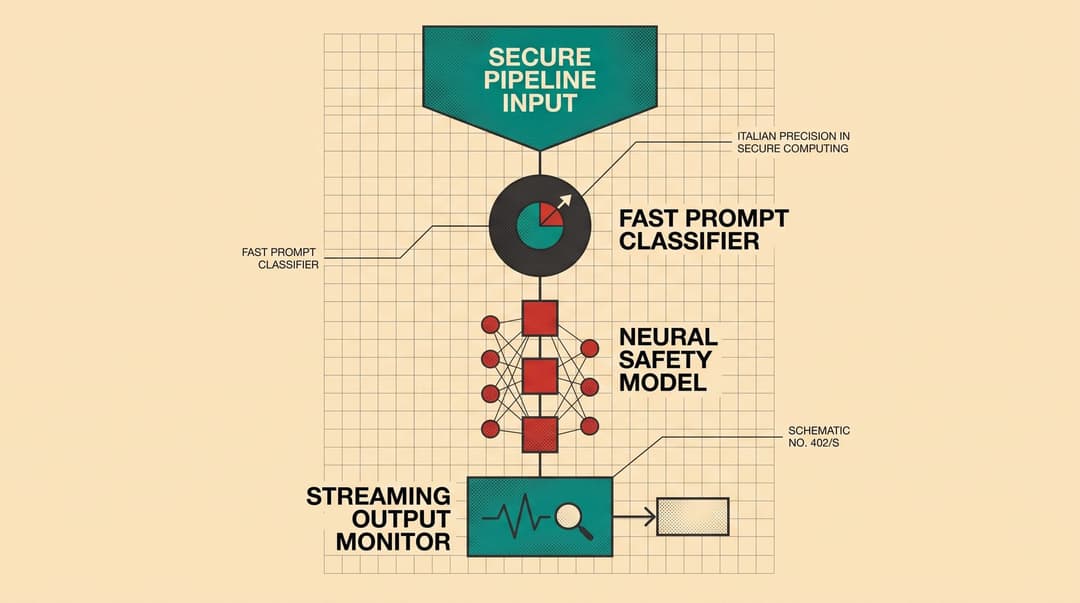
The Multi-Stage Guardrail Pipeline
Modern guardrail architectures divide request processing into discrete validation layers, ordered by computational cost and latency impact. By applying a fail-fast strategy, low-overhead heuristics filter out obvious threats before expensive neural models are invoked.
Incoming Request
       │
       ▼
[ Tier 1: Deterministic Filtering ] ───► Blocked (< 5ms)
  • Regex matching
  • PII masking (e.g., Presidio)
  • Token budget / rate limits
       │ (Pass)
       ▼
[ Tier 2: Lightweight Neural Classification ] ───► Blocked (15–90ms)
  • Small encoder models (e.g., Llama Prompt Guard 2 22M/86M)
  • Vector similarity on known jailbreak embeddings
       │ (Pass)
       ▼
[ Primary Foundation Model / Agent Loop ] ───► Generation
  • Tool boundary checks (Execution Rails)
  • Dialog state tracking (e.g., Colang flows)
       │ (Stream Output)
       ▼
[ Tier 3: Output Safety & Groundedness ] ───► Blocked / Rewritten (150–400ms)
  • Classifier LLMs (e.g., Llama Guard 3 1B/8B)
  • Hallucination / NLI context verification
       │ (Pass)
       ▼
Final Response to Client
1. Input Rails
Input rails inspect raw user prompts before invoking the primary LLM:
- Deterministic Checks: String pattern matching, keyword denylists, and Personally Identifiable Information (PII) detection via engines like Microsoft Presidio. These run on CPU with latency under 5ms.
- Adversarial Injection Detection: Small transformer classifiers trained specifically on prompt injection and jailbreak datasets. Meta's Llama Prompt Guard 2 provides lightweight classification checkpoints: a 22M parameter model (built on
deberta-v3-xsmall) operating at approximately 19.3ms per inference on an A100 GPU, and an 86M parameter model operating at roughly 92.4ms.
2. Dialog and Execution Rails
For agentic systems, guardrails must govern multi-turn state and external tool invocations:
- Dialog Flow Management: Frameworks like NVIDIA NeMo Guardrails utilize domain-specific languages (such as Colang) to enforce deterministic state machines, ensuring the model cannot deviate from supported user journeys.
- Execution Boundary Gating: Inspecting tool calls and parameters before execution to prevent SQL injection, unauthorized API access, or excessive resource consumption.
3. Output Rails
Output rails evaluate generated text for policy violations, toxic content, and factual consistency:
- Hazard Classification: Dedicated safety models evaluate text against standardized taxonomies, such as the MLCommons AI Safety standard. Models like Meta's Llama Guard 3 (available in 1B and 8B parameter variants) perform structured safety classification across multiple hazard categories.
- Groundedness and Hallucination Verification: In retrieval-augmented generation (RAG) pipelines, Natural Language Inference (NLI) models or secondary LLM evaluators verify that every factual claim in the output is supported by retrieved context chunks.
Latency Profiles and Serving Topologies
The primary friction in guardrail adoption is the latency overhead added to the request path. In interactive applications, adding sequential evaluation steps compounds the overall response time.
| Validation Stage | Typical Implementation | Compute Target | Latency Impact |
|---|---|---|---|
| Heuristics & Regex | Exact matching, blocklists | CPU | < 5ms |
| PII Redaction | Microsoft Presidio / SpaCy | CPU | 10–30ms |
| Prompt Injection | Llama Prompt Guard 2 (22M) | GPU | ~20ms |
| Prompt Injection | Llama Prompt Guard 2 (86M) | GPU | ~90ms |
| Safety Classifier | Llama Guard 3 (1B) | GPU | ~165ms |
| Safety Classifier | Llama Guard 3 (8B) | GPU | 200–400ms |
| NLI Groundedness | DeBERTa-v3-large / Small LLM | GPU | 100–300ms |
Sequential Blocking vs. Optimistic Streaming
A naive implementation executes input rails sequentially, waits for the primary LLM to complete full generation, and then executes output rails before sending data to the client. This approach destroys streaming user experience.
Production systems adopt optimistic streaming:
- Input Fast-Path: Only sub-100ms input classifiers (such as Prompt Guard 2) block generation start.
- Concurrent Chunk Evaluation: As the primary LLM generates tokens, output is buffered into sentence-level chunks.
- Pipelined Verification: Output classification models evaluate buffered chunks concurrently with ongoing generation. If a policy violation or toxic output is detected mid-stream, the server terminates the Server-Sent Events (SSE) stream, issues a client-side rollback event, and replaces the message with a fallback refusal.
Co-Located vs. Dedicated Model Serving
Running guardrail models on the same GPU cluster as the main inference engine requires careful memory allocation:
- Lightweight Classifiers (1B and below): Models like Llama Guard 3 1B or Prompt Guard can be co-hosted on existing worker nodes or packaged in optimized runtimes like ONNX Runtime / TensorRT-LLM without consuming substantial VRAM.
- 8B+ Moderation Models: Larger safety models require dedicated serving instances (e.g., hosted via vLLM or SGLang in FP8 precision) to prevent Key-Value (KV) cache contention with the primary model.
Ecosystem Comparison: NeMo, Llama Guard, and Guardrails AI
Different open-source frameworks target distinct layers of the safety stack:
- NVIDIA NeMo Guardrails: An orchestration framework providing programmable dialog control via Colang scripts. It excels at multi-turn conversational steering, RAG context filtering, and multi-rail lifecycle orchestration.
- Meta Llama Guard Suite: Specialized open-weight classifier models fine-tuned purely for safety scoring against standardized risk categories, designed to be dropped into existing inference pipelines.
- Guardrails AI: A Python validation library centered on structured output verification, regex checks, and PII management through an extensible hub of modular validators.
Over-Refusal and Compounding Error Rates
A persistent operational risk in multi-stage guardrail pipelines is compound false-positive rates. If an input gate, an intent classifier, and an output validator each exhibit a 2% false-positive rate on benign domain-specific queries, the cumulative false-rejection rate across the pipeline rises to approximately 5.9%:
In domain-specific applications (such as medical, legal, or cybersecurity tooling), generic safety models frequently misclassify benign technical jargon as hazardous. Mitigating over-refusal requires:
- Taxonomy Customization: Disabling irrelevant hazard categories in Llama Guard configurations.
- Embedding Whitelists: Bypassing neural classifiers for authenticated administrative queries or pre-approved templates.
- Threshold Calibration: Tuning classification probability thresholds per category rather than relying on default binary safe/unsafe outputs.
Sources
- Meta Llama Prompt Guard 2 Model Card
- Meta Llama Guard 3 8B Model Card
- Meta Llama Guard 3 1B Model Card
- NeMo Guardrails: A Toolkit for Controllable and Safe LLM Applications (arXiv:2310.10501)
- Benchmarking Llama Model Security Against OWASP Top 10 for LLM Applications (arXiv:2601.19970)
- OWASP Top 10 for Large Language Model Applications
