
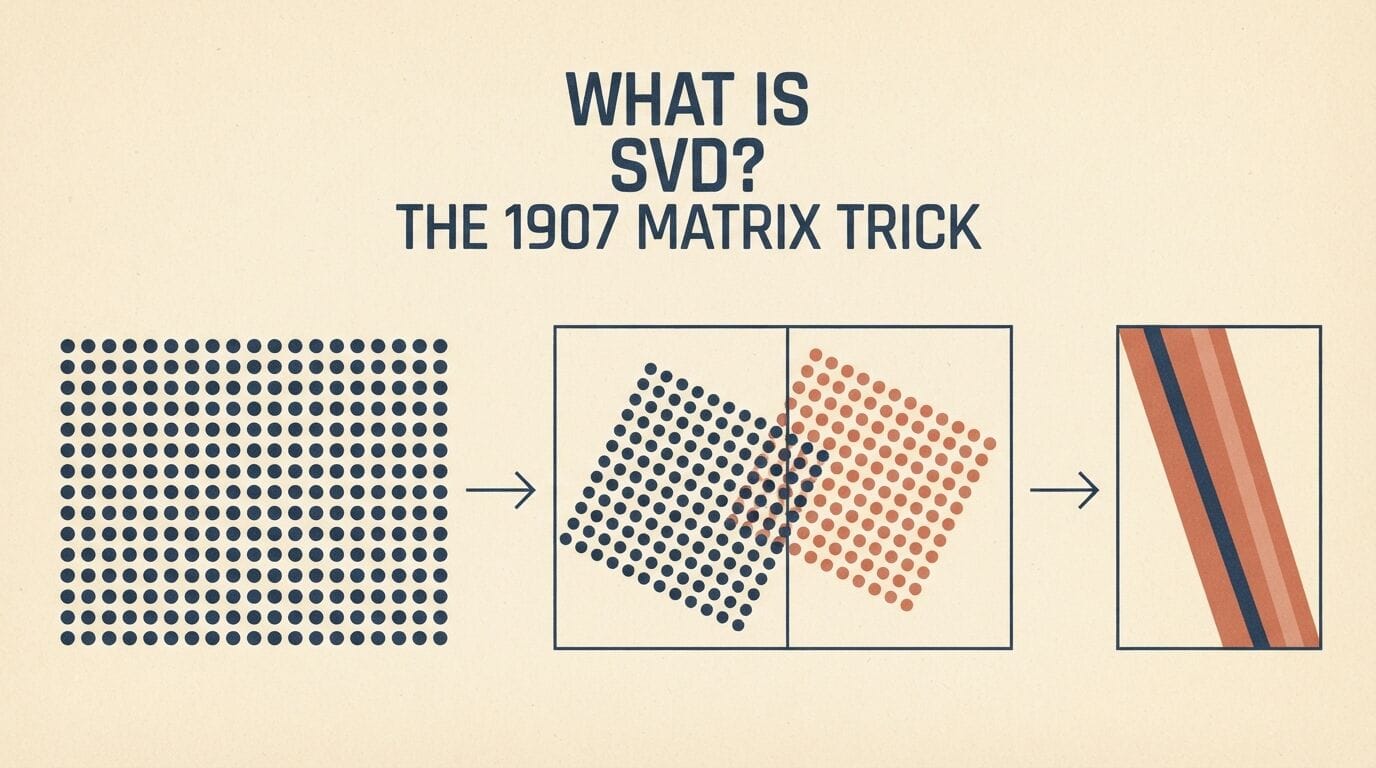
There is one operation that shows up, almost unchanged, underneath a surprising share of modern AI: take a big matrix, factor it into two rotations and a diagonal stretch, and keep only the largest few stretches. Latent semantic indexing used it to retrieve documents in 1990. word2vec turns out to be doing an approximation of it implicitly. LoRA adapters for GPT-class models are built as small products of matrices because fine-tuned updates seem to live in low-rank space. DeepSeek's MLA compresses the KV cache the same conceptual way. Even the softmax layer at the output of every language model can be described as fitting, at rank d, a matrix that wants to be full rank.
The operation is the singular value decomposition, and understanding it explains a lot of vocabulary that AI writing throws around: low rank, latent factors, compression, bottleneck.
What the decomposition says
Every real matrix A, square or rectangular, can be written as
A = U Σ Vᵀ
where U and V are orthogonal (rotation-like) matrices and Σ is a diagonal matrix of non-negative numbers called the singular values, conventionally sorted from largest to smallest. The columns of U are the left singular vectors, the columns of V the right singular vectors. Geometrically: any linear map is a rotation, followed by axis-wise stretching by the singular values, followed by another rotation.
The part that makes SVD useful rather than ornamental is a theorem about truncation. If you zero out all but the k largest singular values, you get the best possible rank-k approximation of A, in the least-squares sense. Formally this was proved by Carl Eckart and Gale Young in a 1936 Psychometrika paper titled The Approximation of One Matrix by Another of Lower Rank (the same result for integral operators goes back to Erhard Schmidt in 1907, and Leonid Mirsky later generalized it to a wide family of matrix norms). The discarded error is readable directly from the spectrum: in the Frobenius norm it is the square root of the sum of the dropped singular values squared.
So an m-by-n data matrix with a rapidly decaying spectrum can be stored approximately as two thin matrices instead of a full grid. If the first 50 singular values capture 95 percent of the energy, the other thousands of directions are, in a precise sense, noise.
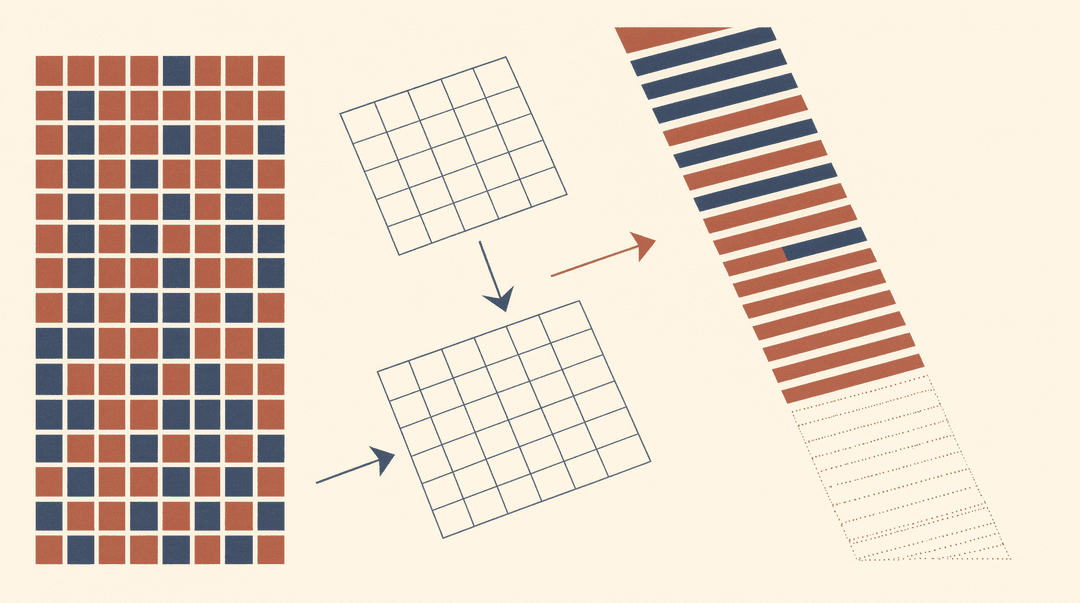
Two numerical footnotes. Roger Penrose's 1955 paper A Generalized Inverse for Matrices defined the pseudoinverse, which for a rectangular or rank-deficient matrix is computed cleanly from the SVD and gives the least-squares solution to an overdetermined system. And the reason SVD is in every numerical library is the 1970 algorithm by Gene Golub and Christian Reinsch, Singular Value Decomposition and Least Squares Solutions, the direct ancestor of routines like LAPACK's; today it is one function call, numpy.linalg.svd.
The pre-history of embeddings
The first famous AI use predates neural embeddings by more than two decades. In 1990, Deerwester, Dumais, Furnas, Landauer and Harshman published Indexing by Latent Semantic Analysis in the Journal of the American Society for Information Science: build a term-by-document count matrix, decompose it with SVD, keep roughly 100 orthogonal factors, and represent both documents and queries as vectors in that factor space, matching them by cosine. Synonymy and polysemy were picked up not from a thesaurus but from the statistical structure of co-occurrence, which is exactly the bet every embedding model since has made.
The line runs directly into word2vec. Levy and Goldberg showed at NIPS 2014 that skip-gram with negative sampling, the training objective behind word2vec, is implicitly factorizing a word-context matrix whose entries are shifted pointwise mutual information. Their experiments made the comparison honest: a plain sparse SVD of that matrix matched or beat the trained vectors on word-similarity tasks, while SGNS stayed better on analogy questions, which they attributed to its weighted factorization. Translation: gradient descent on co-occurrence is doing an approximate, weighted SVD, and sometimes a matrix factorization gets you most of the way there.
The same factorization ran the other half of 2000s machine learning. Koren, Bell and Volinsky described matrix factorization techniques for recommender systems in IEEE Computer in 2009, the family of methods that won the Netflix Prize: the user-by-item ratings table is low-rank, so factor it and you have user vectors and item vectors whose dot products predict unseen ratings.
Why LLMs still care about rank
Three places SVD logic shows up in large language models, in their own words from the papers.
First, the bottleneck claim. The ICLR 2018 paper by Yang, Dai, Salakhutdinov and Cohen on breaking the softmax bottleneck observes that a softmax language model over a d-dimensional hidden state can produce at most rank-d log-probability matrices, while the true matrix of next-word probabilities given contexts has rank on the order of the vocabulary. Their sentence for what training does: "Softmax is effectively learning a low-rank approximation" of the real distribution. Model the world as matrices and the output layer becomes an Eckart-Young truncation with a loss function.
Second, adaptation. The LoRA paper by Hu et al. (arXiv 2106.09685) freezes pretrained weights and injects "trainable rank decomposition matrices" into each Transformer layer, motivated by the hypothesis that fine-tuning updates have low intrinsic rank. Against full fine-tuning of GPT-3 175B, LoRA cuts trainable parameters by up to 10,000x and GPU memory requirements by 3x, with on-par quality on many tasks. LoRA is Eckart-Young applied to optimization: if the update is secretly rank 8, do not store a 175-billion grid to hold it.
Third, inference memory. DeepSeek-V2 (arXiv 2405.04434) introduced Multi-head Latent Attention, which the paper says "guarantees efficient inference through significantly compressing the Key-Value (KV) cache into a latent vector." The attention KV projections are again treated as low-rank, so the cache stores a small latent per token instead of full per-head keys and values. Every technique in the long KV-compression lineage reads as an attempt to find a smaller sigma-diagonal that still reconstructs attention acceptably.
How to think about it
The practical mental model has three parts. One: real data matrices (term-document, user-item, weight-difference) usually have steeply decaying singular value spectra, so a rank-k sketch recovers most of the Frobenius energy. Two: keeping the top-k truncation is provably optimal, and the (k+1)-th singular value exactly measures the residual error, which is why spectra double as a "how much is left" gauge.

Three: whenever an AI system says latent, compressed, low-rank or intrinsic dimension, someone is approximating a matrix with a smaller one, and SVD defines what "best" means.
The cautionary half is just as useful. Eckart-Young optimality is with respect to squared reconstruction error, which is rarely the loss your model or your users care about. Levy and Goldberg's results are the clean example: SVD matched word2vec on similarity but lost on analogy, because SGD re-weights the objective in ways the flat matrix does not see. And the softmax-bottleneck paper exists precisely because truncation losses are real: a rank-d approximation of a rank-100,000 table throws something away. Low rank is the right default hypothesis for AI matrices, not a guarantee.
Ninety years of AI technique, from psychometric factor analysis to retrieval to adapters to KV caches, keeps landing on the same linear algebra: factor, truncate, keep what is left. That is the whole trick, and it is worth knowing the name on the theorem.
Sources
- Eckart & Young, "The Approximation of One Matrix by Another of Lower Rank," Psychometrika, 1936. https://link.springer.com/article/10.1007/BF02288367
- Erhard Schmidt, "Zur Theorie der linearen und nichtlinearen Integralgleichungen," Mathematische Annalen, 1907. https://doi.org/10.1007/BF01449770
- Penrose, "A Generalized Inverse for Matrices," Mathematical Proceedings of the Cambridge Philosophical Society, 1955. https://www.semanticscholar.org/paper/A-generalized-inverse-for-matrices-Penrose/1bfc0c8ea0c71c308c11743c060ef3a972e4314c
- Golub & Reinsch, "Singular Value Decomposition and Least Squares Solutions," Numerische Mathematik, 1970. https://doi.org/10.1007/BF02163027
- numpy.linalg.svd documentation. https://numpy.org/doc/stable/reference/generated/numpy.linalg.svd.html
- Deerwester et al., "Indexing by Latent Semantic Analysis," JASIS, 1990. https://ideas.repec.org/a/bla/jamest/v41y1990i6p391-407.html
- Levy & Goldberg, "Neural Word Embedding as Implicit Matrix Factorization," NIPS 2014. https://papers.nips.cc/paper/5477-neural-word-embedding-as-implicit-matrix-factorization
- Koren, Bell & Volinsky, "Matrix Factorization Techniques for Recommender Systems," IEEE Computer, 2009. https://doi.org/10.1109/MC.2009.263
- Yang et al., "Breaking the Softmax Bottleneck: A High-Rank RNN Language Model," ICLR 2018. https://arxiv.org/abs/1711.03953
- Hu et al., "LoRA: Low-Rank Adaptation of Large Language Models." https://arxiv.org/abs/2106.09685
- DeepSeek-AI, "DeepSeek-V2: A Strong, Economical, and Efficient Mixture-of-Experts Language Model." https://arxiv.org/abs/2405.04434
