Latest / page 22

The latest stories

1230 articles

Articles, page 22

421-440 of 1230
  1. South Korea's Wrtn Raises $72.2M Series C at $722M Valuation

    South Korean AI platform operator Wrtn Technologies has secured approximately 100 billion won ($72.2 million) in a Series C funding round, pushing the startup's valuation above 1 trillion won ($722 million). The new capital brings Wrtn's cumulative funding to roughly 230 billion won ($166 million) as the company expands its consumer and enterprise generative AI offerings across Asian markets. Expanding Beyond Domestic Aggregation Founded in Seoul in 2021, Wrtn built its initial user base as


    AI
    1 min read
  2. Activation Addition and Representation Engineering: Mathematical Foundations, Linear Subspace Projections, and Inference-Time Steering in Large Language Models

    Large language models encode vast linguistic, factual, and behavioral properties within their internal hidden representations. While traditional alignment and behavioral modification rely on Supervised Fine-Tuning (SFT) or Reinforcement Learning from Human Feedback (RLHF), these gradient-based techniques modify billions of parameter weights, require substantial compute, and frequently suffer from catastrophic forgetting or alignment tax. An alternative paradigm grounded in mechanistic interpret

    AI
    6 min read
  3. Synthetic Data Pipelines in Production LLM Post-Training: Architecture, Prompt Evolution, Quality Filtering, and Contamination Control

    Scaling supervised fine-tuning (SFT) and preference alignment (DPO, PPO, GRPO) through human annotation faces severe economic and operational constraints. Human annotation costs between $5.00 and $50.00 per complex instruction-response trajectory, exhibits significant variance across labeler cohorts, and scales linearly with dataset volume. The LIMA study by Zhou et al. (2023) showed that post-training requires strict data quality rather than raw volume, yet modern frontier models demand million

    AI
    6 min read
  4. Anthropic Outlines $30 Trillion Total Addressable Market in Pre-IPO Pitch

    Anthropic is preparing to pitch prospective initial public offering investors on a total addressable market exceeding $30 trillion, according to a report from The Wall Street Journal. The projection relies on estimating the total monetary value of human labor and enterprise workflows that advanced AI models and autonomous agents could potentially automate or augment across the global economy. If presented in formal registration filings, the $30 trillion figure would surpass the previous record

    Anthropic
    2 min read
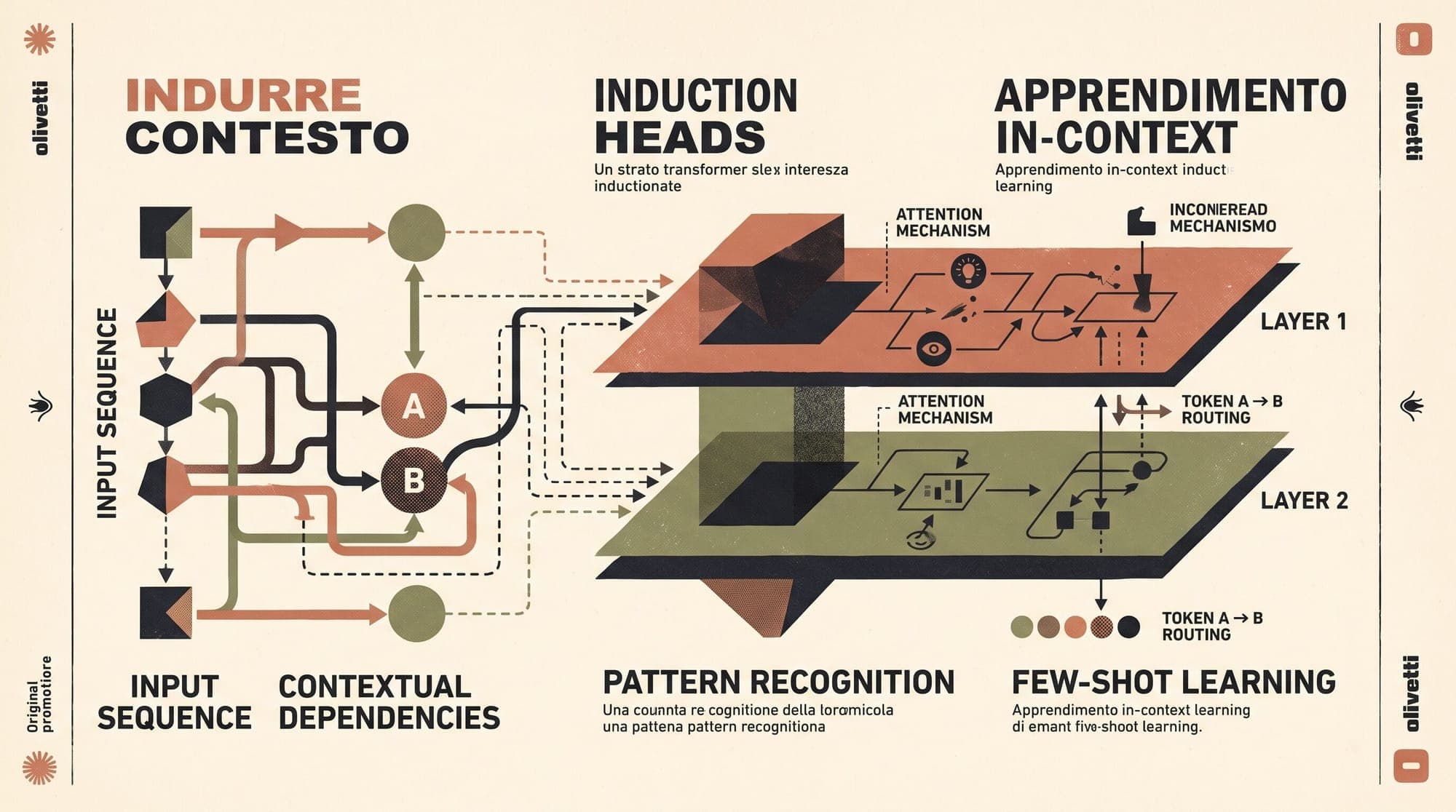
  5. Induction Heads: Mathematical Foundations, Two-Layer Circuit Composition, and the Emergence of In-Context Learning in Transformers

    Induction Heads: Mathematical Foundations, Two-Layer Circuit Composition, and the Emergence of In-Context Learning in Transformers One of the defining capabilities of modern autoregressive large language models is in-context learning: the ability to infer rules, adapt to task formats, and execute complex few-shot instructions purely from prompt context without updating neural network weights. For years, in-context learning was treated as an enigmatic, emergent property of large-scale autoregres

    AI
    13 min read
  6. Continuous Batching and Request Scheduling in Production LLM Serving: Comparing Orca, FastServe, Sarathi-Serve, and vLLM Architecture, Preemption Policies, Chunked Prefill Interleaving, and TTFT-TBT Trade-Offs

    Autoregressive large language model serving exhibits a fundamental architectural tension between compute utilization and latency guarantees. Standard deep learning inference pipelines rely on static request-level batching, where incoming queries are grouped into a fixed tensor, executed across forward passes until all sequences finish, and evicted simultaneously. In transformer-based text generation, static batching collapses serving efficiency. Because sequence lengths vary widely and token gen

    AI
    7 min read
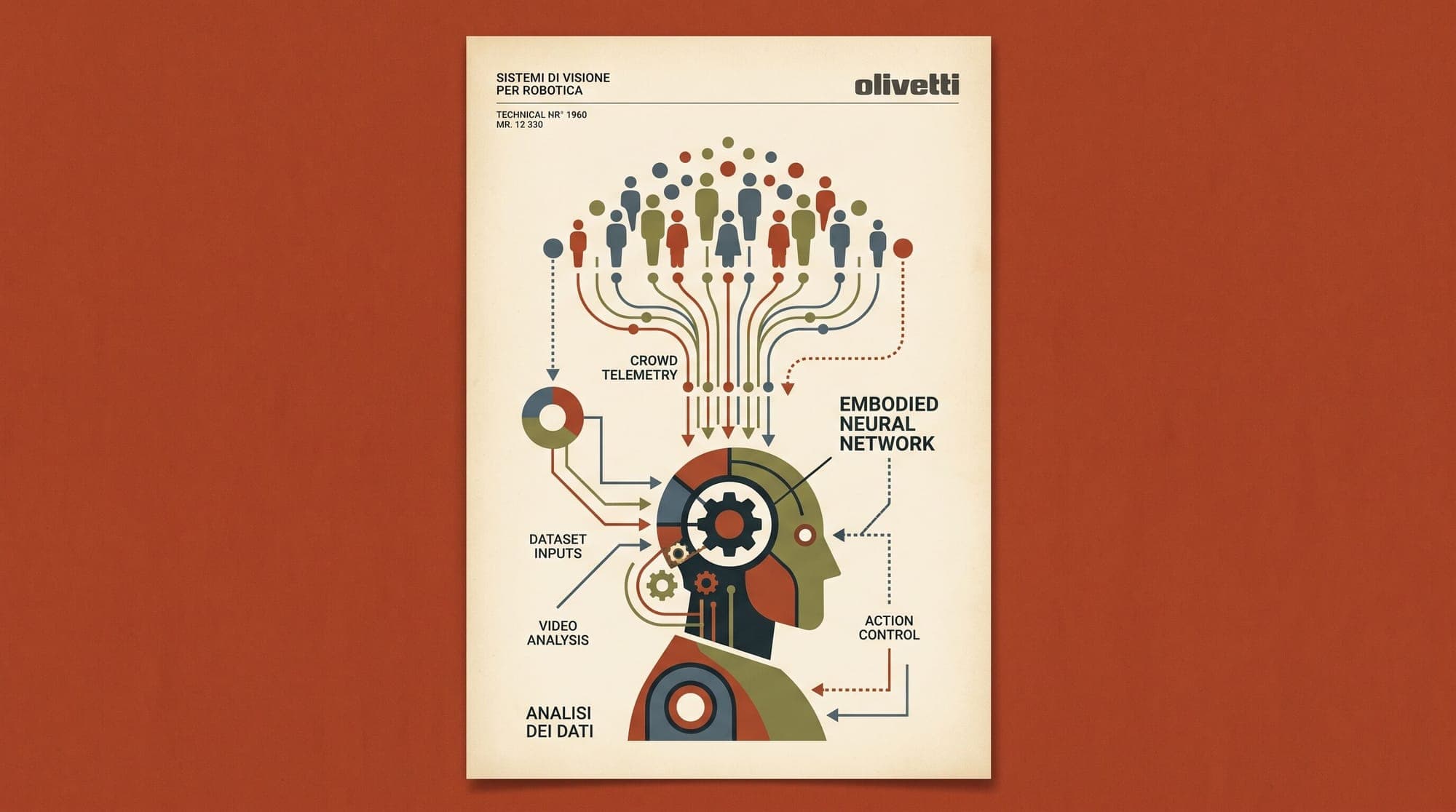
  7. Figure AI Unveils Index Platform with 16 Million Crowdsourced Videos for Robot Foundation Models

    Humanoid robotics startup Figure AI has launched Index, a global crowdsourced data collection platform engineered to capture real-world human task demonstrations at scale. Operating in stealth for four months prior to its public unveiling, the platform has compiled 16 million video demonstrations from contributors across 108 countries, generating embodied training data for Figure's physical AI foundation models. The initiative directly targets the primary bottleneck in scaling embodied AI: the

    AI
    2 min read
  8. Anthropic Claude Autonomously Designs Validated Protein Binders Across 14 Targets

    Anthropic has released results from an autonomous de novo protein binder design campaign run by its Claude models, with wet-lab validation from two outside evaluators. Claude designed binders against 15 targets and succeeded against 14 of them, according to Anthropic. Across all campaigns, 27% of designs bound, and 49% of the designs Claude ranked first for each target bound, according to Anthropic's technical report. The campaign used Claude Opus 4.8 and Claude Mythos Preview inside Claude Sci

    AI
    3 min read
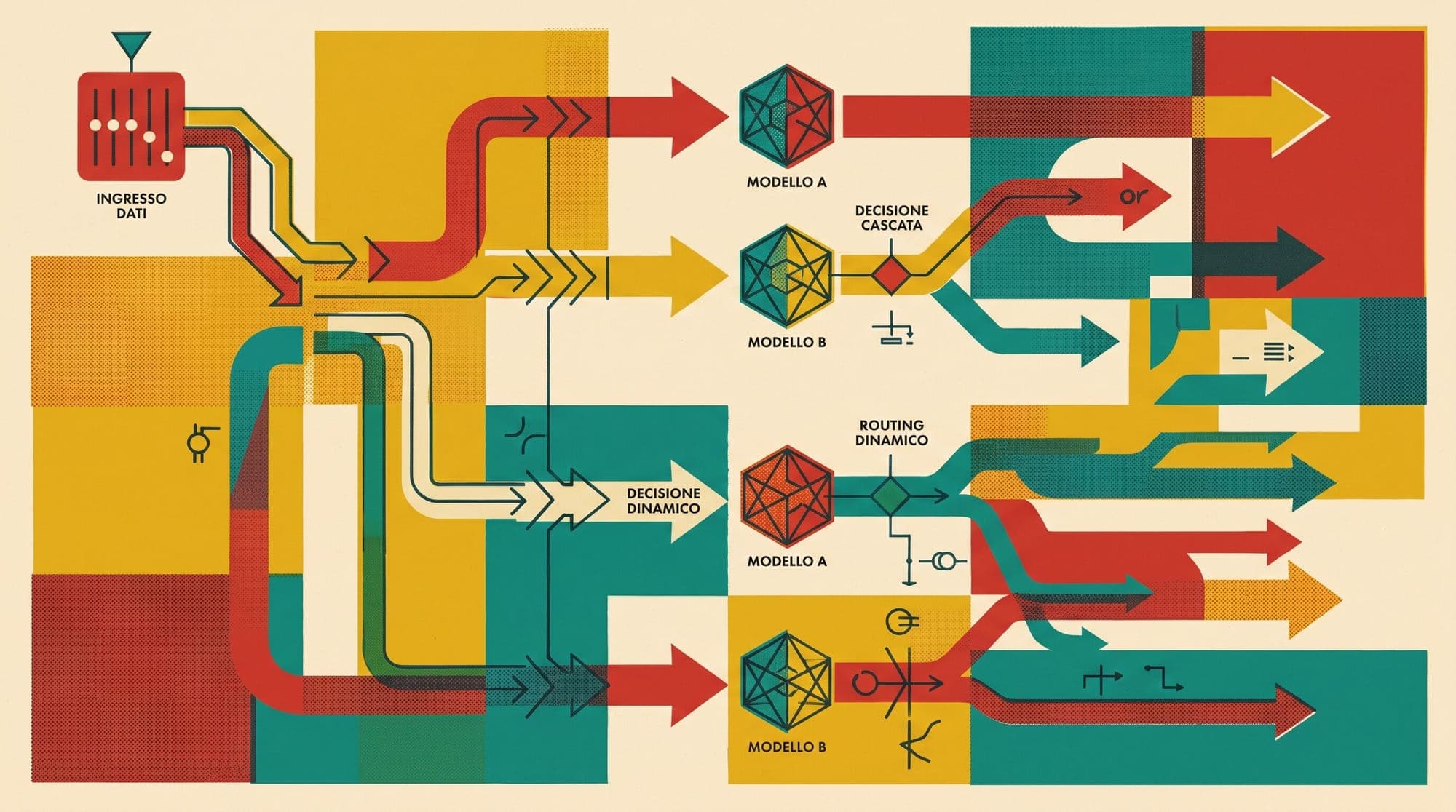
  9. Model Routing and Cascades in Production: Comparing RouteLLM, FrugalGPT, Embedding Classifiers, and Verifier Cascades

    Model Routing and Cascades in Production: Comparing RouteLLM, FrugalGPT, Embedding Classifiers, and Verifier Cascades Enterprise LLM deployments face a persistent structural inefficiency: the uniform routing of all incoming queries to flagship frontier models. Commercial API pricing and self-hosted GPU infrastructure costs span two orders of magnitude between lightweight models (such as Llama 3.1 8B, GPT-4o-mini, and Claude 3.5 Haiku at $0.15 to $0.30 per million tokens) and frontier reasoning

    Inference
    9 min read
  10. Skild AI Introduces S1 Robotics Foundation Model with In-Context Video Prompting

    Robotics foundation model startup Skild AI has unveiled S1, a foundation model capable of learning physical manipulation tasks unseen during pretraining directly from a single video demonstration prompt without fine-tuning. Traditional robotic adaptation typically requires extensive task-specific teleoperation data, domain randomization, and model fine-tuning before a system can reliably execute novel actions. S1 employs in-context prompting to translate visual demonstrations directly into real

    Robotics
    1 min read
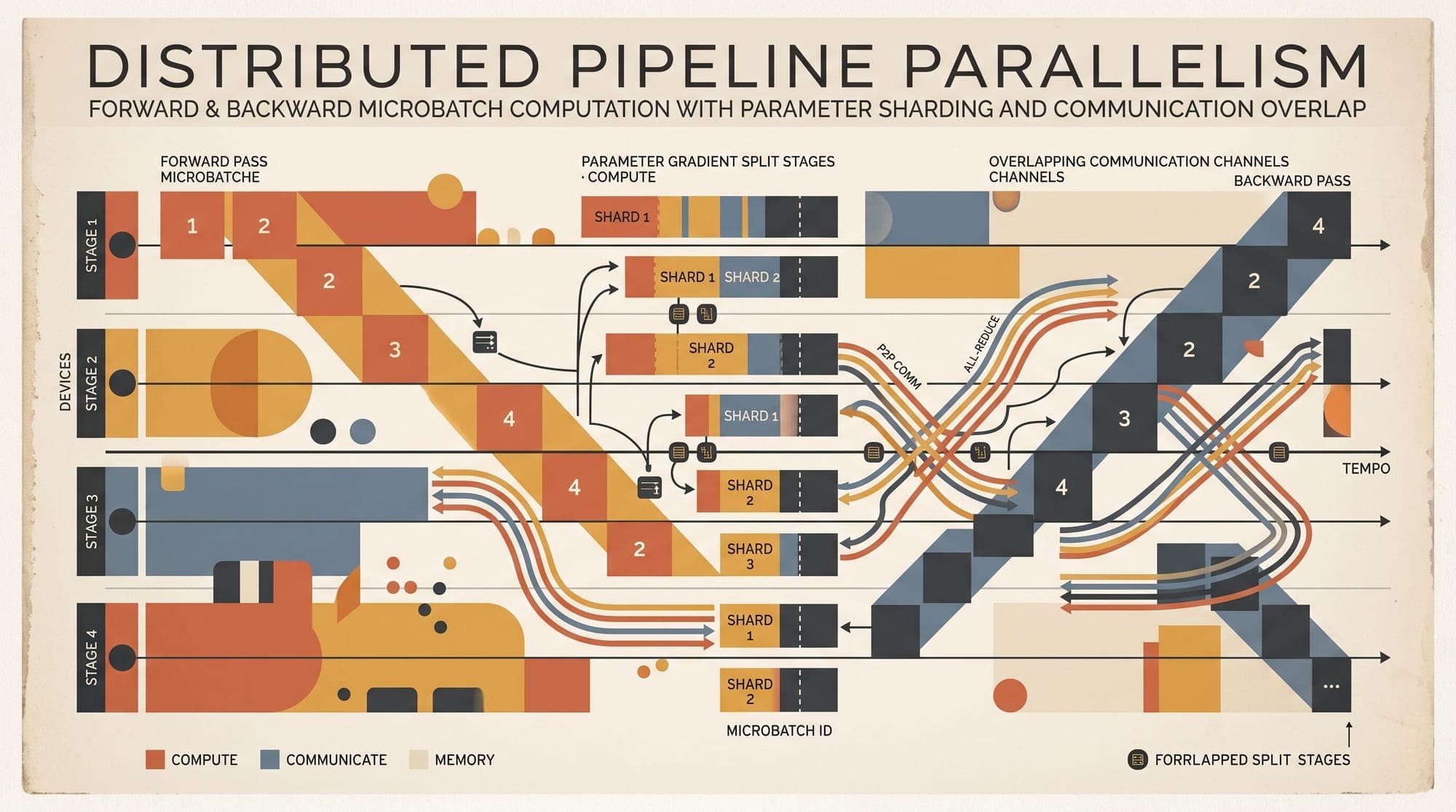
  11. Pipeline Parallelism in Production LLM Training: Comparing 1F1B, Interleaved 1F1B, Zero-Bubble, and DualPipe Schedules

    Pipeline Parallelism in Production LLM Training: Comparing 1F1B, Interleaved 1F1B, Zero-Bubble, and DualPipe Schedules Training modern large language models spanning hundreds of billions of parameters requires distributing model layers across multiple compute nodes. While Tensor Parallelism (TP) partitions individual matrix multiplications across GPUs within a single node, its reliance on high-frequency, all-reduce communications limits its practical scaling to the high-bandwidth domain of NVLi

    AI
    8 min read
  12. Anthropic Launches $5M Grant Program to Fund AI Wellbeing Evaluations and Benchmarks

    Anthropic has launched a $5 million grant initiative to support independent development of open-source benchmarks and evaluation harnesses measuring the impact of artificial intelligence systems on user wellbeing. The program will supply research teams with direct financial grants, subsidized API access to Claude models, and technical support from Anthropic's Safeguards team. All evaluation frameworks, datasets, and grading methodology developed under the grant program will be released publicly

    Anthropic
    2 min read
  13. OpenAI Introduces Admin Plugin for ChatGPT Work and Codex to Automate Workspace Governance

    OpenAI has released the Admin plugin for ChatGPT Work and Codex, embedding enterprise workspace management, user provisioning, permission audits, and spending controls directly into chat conversations. The plugin exposes Admin Console functionality through permission-scoped tools, allowing administrators to execute diagnostic queries and administrative actions without toggling across external consoles or building bespoke scripting pipelines. Conversational Workspace Administration Managing en

    OpenAI
    2 min read
  14. BitNet b1.58: Mathematical Foundations of 1.58-Bit Ternary Quantization, Absmean Scaling, and Multiplication-Free LLM Architectures

    Standard Large Language Models (LLMs) rely on 16-bit floating-point (FP16 or BF16) matrix multiplications for both pre-training and autoregressive inference. While post-training quantization techniques (such as GPTQ, AWQ, and dynamic FP8/INT4 scaling) compress weights after training, they often introduce perplexity degradation at ultra-low bitwidths ($<4$ bits) or still require floating-point dequantization at runtime. Quantization-aware pre-training architectures directly tackle this computati

    AI
    6 min read
  15. Test-Time Compute and Inference Search in Production: Comparing Best-of-N, Monte Carlo Tree Search, PRM-Guided Beam Search, and Dynamic Budget Allocation Architecture, Token Economics, and Serving Latency

    In standard production Large Language Model (LLM) deployments, generation compute is fixed: a prompt is processed during prefill, and the model generates an answer via greedy autoregressive decoding or low-temperature sampling. Under this paradigm, accuracy on complex reasoning, mathematical derivation, theorem proving, and code synthesis is bounded by the model parameter count and training data distributions. Recent empirical work demonstrates that scaling inference-time compute can achieve pe

    AI
    11 min read
  16. Gatik Raises $200M Series D to Scale Autonomous Middle-Mile Trucking Fleet

    Autonomous middle-mile logistics startup Gatik has raised $200 million in a Series D funding round to accelerate the deployment of its driverless commercial freight fleet. The capital brings Gatik's total institutional funding to approximately $500 million since its founding in 2019. The funding round was co-led by Qatar Investment Authority (QIA) and Koch Disruptive Technologies (KDT), with participation from Millennium Management, ARK Invest, and Intact Private Capital. Gatik did not disclose

    Autonomous Vehicles
    2 min read
  17. Gamma Acquires AI Design Startup Lica to Establish Multimodal Research Lab

    AI presentation platform Gamma has acquired design startup Lica to establish an internal research division focused on multimodal communication and automated layout models. The deal brings Lica co-founders Priyaa Kalyanaraman and Purvanshi Mehta to Gamma to head the new research laboratory. Gamma reached a $2.1 billion valuation in November 2025 following a $68 million funding round, scaling its user base to more than 100 million accounts. The platform allows users to generate presentations, doc

    AI
    1 min read
  18. Context Parallelism in Production: Comparing DeepSpeed Ulysses, Megatron Sequence Parallelism, Ring Attention, and Unified Sequence Parallelism (USP) Architecture, Communication Overhead, and Scale-Out Economics

    Scaling context windows in Large Language Models (LLMs) from 8,192 tokens to 128k, 256k, and 1M tokens introduces severe memory and compute constraints. Standard Data Parallelism (DP) duplicates entire model activations per sequence, failing when a single sequence exceeds GPU VRAM. Tensor Parallelism (TP) splits weight matrices across GPUs, but scaling TP beyond a single 8-GPU node degrades throughput due to high-frequency, low-latency cross-GPU collective communications. Pipeline Parallelism (P

    AI
    10 min read
  19. Anthropic Unifies Memory Across Claude Chat and Cowork Sessions

    Anthropic has updated its architecture to unify the memory systems powering Claude chat and Claude Cowork, allowing context and user preferences established during conversational sessions to persist directly into workspace tasks. The update addresses a common friction point in AI workflow orchestration, where users previously had to manually rebrief agentic workspaces on project context already established in conversational threads. Real-Time In-Session Memory Extraction Prior iterations of C

    AI
    2 min read
  20. LLM Observability in Production: OpenTelemetry GenAI Semantic Conventions vs. OpenInference, Distributed Trace Propagation Across Multi-Agent Graphs, and High-Throughput Sampling Economics

    Production large language model (LLM) architectures have transitioned from isolated completion endpoints to complex, distributed directed acyclic graphs (DAGs). Modern AI systems incorporate multi-agent orchestration, iterative tool execution, vector retrieval pipelines, and speculative decoding loops. Operating these workloads at enterprise scale exposes critical observability gaps that traditional application performance monitoring (APM) tools cannot address. Standard request-response APM metr

    AI
    7 min read