
Women have caught up with men in trying AI chatbots, but men still use them more often. That is the headline from a Pew Research Center analysis published October 16, drawn from Pew's larger June 2026 report on Americans and AI.
Pew surveyed 5,119 U.S. adults from February 17 to 23, 2026, all members of its American Trends Panel. The report's methodology gives a margin of sampling error of plus or minus 1.6 percentage points for the full sample, 2.3 points for men, and 2.1 points for women.
The gap in "ever use" is gone
Asked whether they ever use AI chatbots like ChatGPT, Gemini, or Copilot, 50% of men and 47% of women said yes. Across all U.S. adults the figure was 49%.
In Pew's 2024 survey, the numbers were 39% of men, 28% of women, and 33% of all adults. Pew says men were then 11 percentage points more likely than women to report using a chatbot, and that women "saw a steeper increase since 2024." Women's rate rose 19 points over that period; men's rose 11.
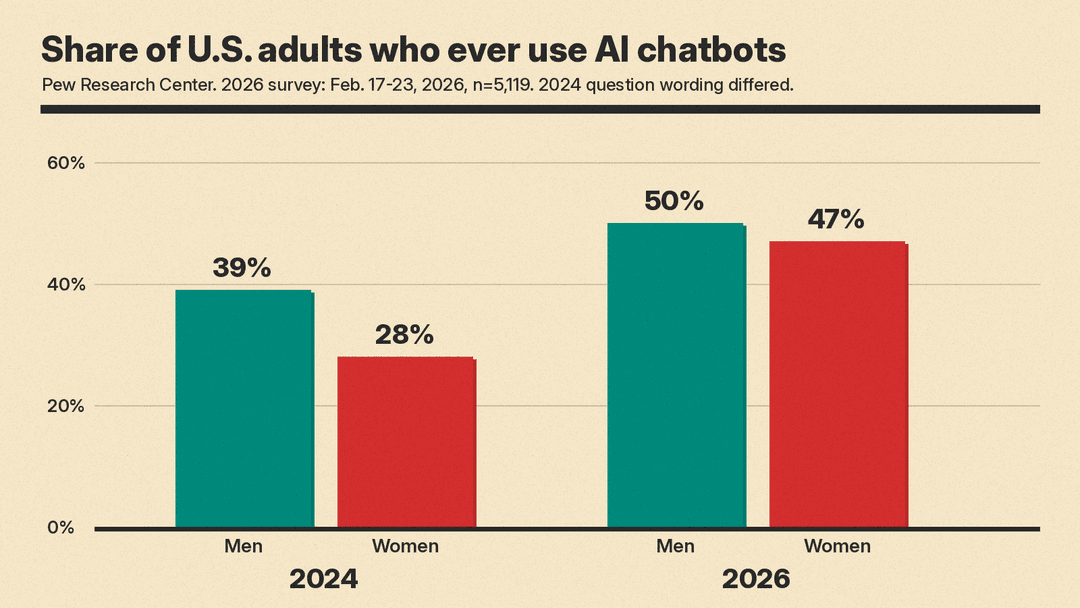
One caveat that Pew flags itself: the question changed. In 2024 Pew asked "Have you ever used an artificial intelligence (AI) chatbot like ChatGPT, Gemini, or Copilot?" and asked it only of people who had heard at least a little about chatbots. So the two years are not a perfect like-for-like comparison.
Who uses them every day
Using a chatbot once is not the same as building it into your routine, and this is where the gender gap remains. Pew found 27% of men say they use chatbots daily, compared with 20% of women.
For the whole population, the June report says about a quarter of Americans use chatbots daily. That includes 12% who use them several times a day and 4% who say they use them "almost constantly." Another quarter use them several times a week or less, and about half of adults do not use chatbots at all. Daily use skews younger: a third of adults under 50 say they use these tools every day, and fewer older adults say the same.
ChatGPT is even; other brands lean male
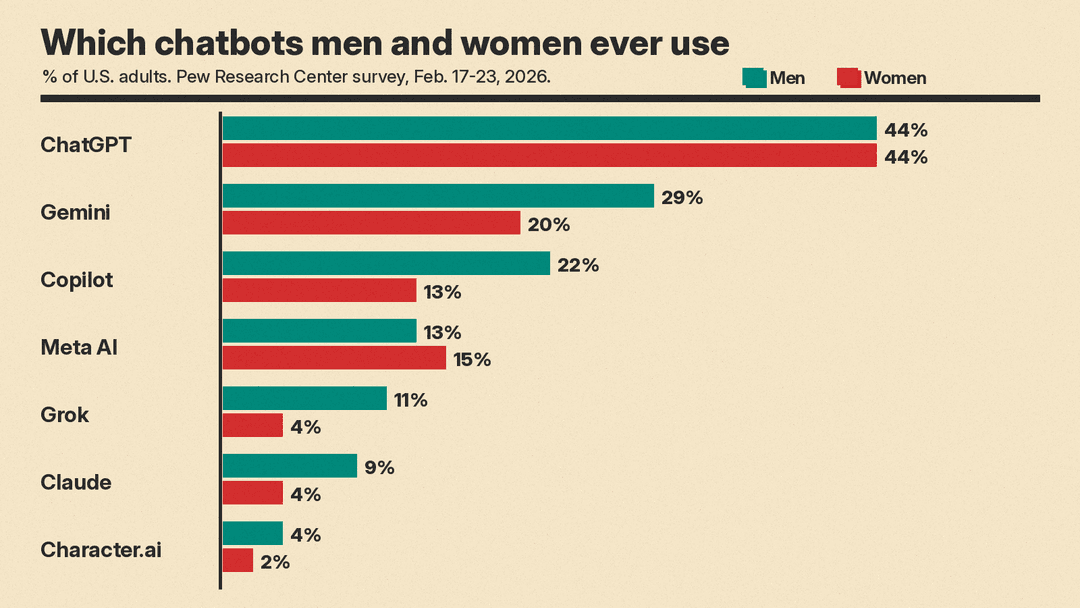
ChatGPT is the most widely used chatbot in Pew's survey, and it is used by identical shares of men and women: 44% each.
The other brands show bigger splits. The share of men and women who say they ever use each:
- Gemini: 29% of men, 20% of women
- Copilot: 22% of men, 13% of women
- Meta AI: 13% of men, 15% of women
- Grok: 11% of men, 4% of women
- Claude: 9% of men, 4% of women
- Character.ai: 4% of men, 2% of women
Pew says men are more likely than women to use Copilot, Gemini, Grok, and Claude. It does not single out Meta AI or Character.ai as gender differences in its text.
What people use them for
Men and women mostly use chatbots for the same things, with search and work at the top of both lists. The modest differences Pew reports:
- Searching for information: 45% of men, 39% of women
- Tasks at work (employed adults only): 40% of men, 35% of women
- Fun or entertainment: 28% of men, 22% of women
- Getting news: 15% of men, 12% of women
- Emotional support or advice: 8% of men, 11% of women
- Companionship: 4% of each
Men are also more likely to say chatbots help their productivity (35% vs. 25%). On creativity, happiness, and relationships, Pew found modest or no differences.
Women are more skeptical
The usage gap has narrowed faster than the attitude gap. Women are more likely than men to say AI is advancing too quickly (68% vs. 58%). Women are about twice as likely to expect AI to affect them negatively over the next 20 years as positively (33% vs. 17%), while men are roughly split (29% positive, 27% negative).
Men are also more likely to say they have heard a lot about AI chatbots (48% vs. 38%) and to say they are extremely or very confident using them (22% vs. 15%).
Why it matters
For anyone building or marketing consumer AI, the takeaway is that the audience for chatbots is now roughly half of U.S. adults and close to evenly split by gender at the "ever used" level. The remaining gaps are in habit, confidence, and trust. ChatGPT has reached parity; Gemini, Copilot, Grok, and Claude have not. Pew's numbers show women using chatbots almost as widely as men while remaining more doubtful about where AI is heading.
