
Single frontier models face physical and economic scaling limits. While model developers continue to scale pre-training compute and post-training reinforcement learning, individual foundation models still exhibit persistent failure modes: domain blind spots, subtle reasoning hallucinations, and inconsistent instruction adherence.
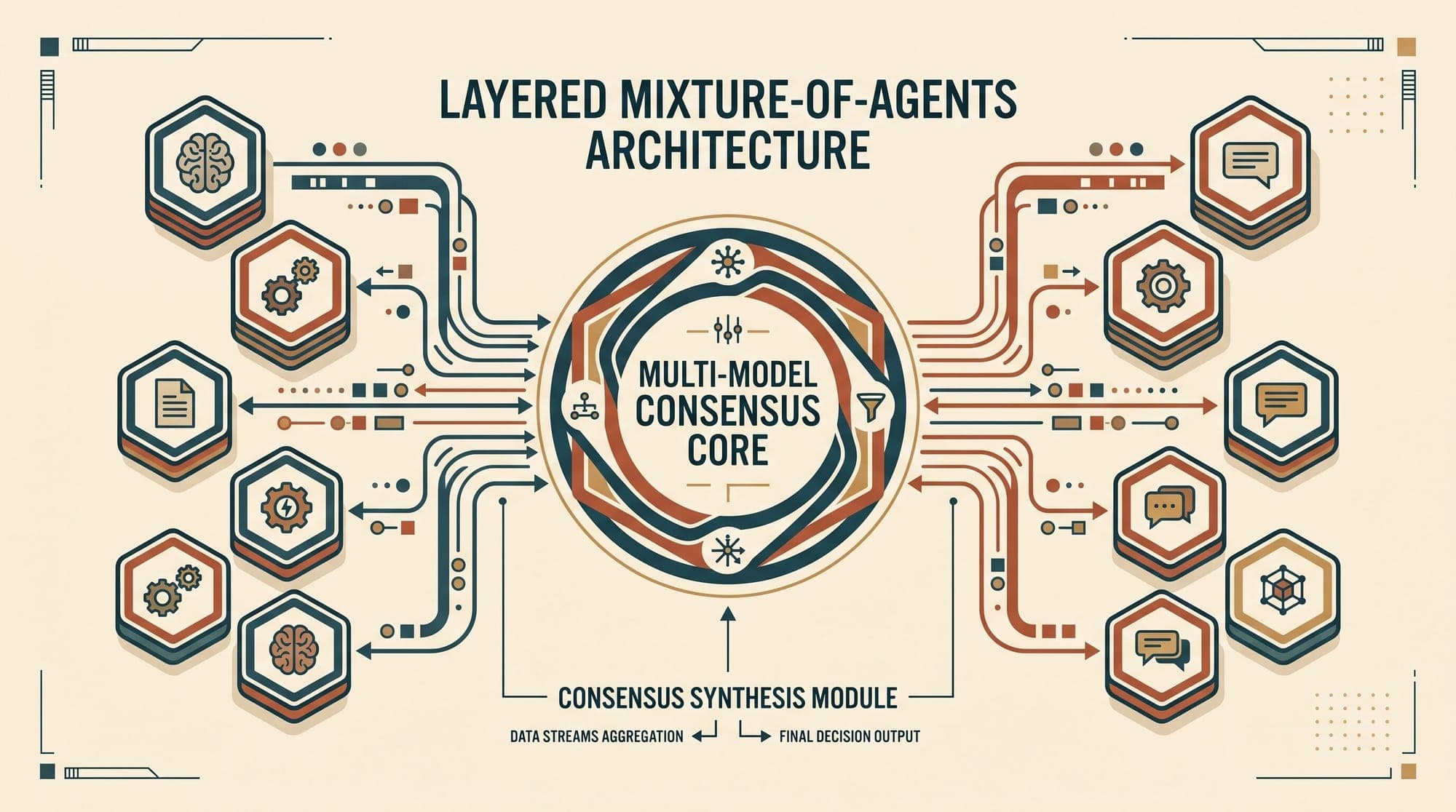
To break past the performance ceilings of single models, production engineering teams increasingly deploy multi-model ensemble architectures. The most prominent of these frameworks is Mixture-of-Agents (MoA), popularized by research from Together AI, Duke University, and Stanford. By structuring heterogeneous LLMs into layered proposer-aggregator topologies, MoA demonstrates what researchers term the collaborativeness phenomenon: models generate significantly higher quality responses when synthesizing outputs from diverse peers, even when the individual proposer models are weaker than the final output.
Deploying multi-LLM consensus and MoA in production requires addressing non-trivial systems challenges. Running multiple models across parallel inference calls multiplies token consumption, compounds tail latencies, and introduces novel failure modes such as majority hallucinations. This guide analyzes the architectural patterns, latency mitigation strategies, economic models, and failure boundaries necessary to operate multi-model consensus systems at scale.
Topologies: Flat Consensus vs. Layered MoA vs. Tournament Pyramids
Multi-LLM systems fall into three primary architectural topologies, each suited to different task types and latency budgets.
Flat Majority Voting (Self-Consistency)
Introduced in early reasoning research such as Wang et al. (2022), flat voting dispatches a single prompt to N parallel instances of either the same model (with temperature T > 0) or N distinct foundation models.
- Resolution Mechanism: For discrete output spaces (such as mathematical answers, categorical classifications, or SQL queries), resolution uses exact string matching, AST hashing, or unit test verification. For open-ended natural language, resolution relies on semantic embedding clustering (measuring cosine similarity across embeddings) or cross-encoder agreement.
- Optimal Workloads: Objective classification, code generation with automated test suites, and extraction pipelines where correctness can be evaluated deterministically.
Layered Feedforward Mixture-of-Agents (MoA)
The layered MoA architecture structures models as a directed acyclic graph (DAG) divided into sequential layers.
- Layer 1 (Proposers): P independent models receive the user prompt simultaneously. Proposers are intentionally selected across diverse model families (such as combinations of Qwen, Llama, Mistral, and Claude) to maximize response diversity and counteract architecture-specific biases.
- Layer 2 (Aggregator): A designated aggregator model takes the original user query alongside all P formatted proposer outputs. The aggregator is instructed to critique, cross-reference, reconcile conflicts, and generate a unified response.
- Deep MoA (L > 2): Research by Together AI evaluated configurations with up to 3 or 4 layers, where intermediate layers act as iterative refinement steps. However, in production, L = 2 represents the standard operating point due to latency and cost constraints.
Tournament and Elimination Pyramids
In tournament architectures, candidate responses are evaluated pairwise or in small round-robin pools by judge LLMs. Models critique opposing answers, score reasoning trajectories, and eliminate weaker candidates over successive rounds. While effective for offline evaluation and synthetic data curation pipelines, tournament graphs introduce severe latency penalties (logarithmic or quadratic sequential LLM calls) that make them impractical for real-time user-facing applications.
Production Latency Engineering: The Tail Latency Problem
The primary bottleneck in multi-model serving is latency amplification. In a 2-layer MoA system with P parallel proposers and 1 aggregator, total request latency is bounded by the slowest proposer plus the aggregator latency:
Total Latency = max(Proposer Latencies) + Aggregator Latency
Because inference latencies across cloud providers and GPU clusters follow right-skewed log-normal distributions, the expected maximum latency across P concurrent calls scales directly with the 95th and 99th percentile tails. A single stalled proposer degrades the user-facing latency of the entire system.
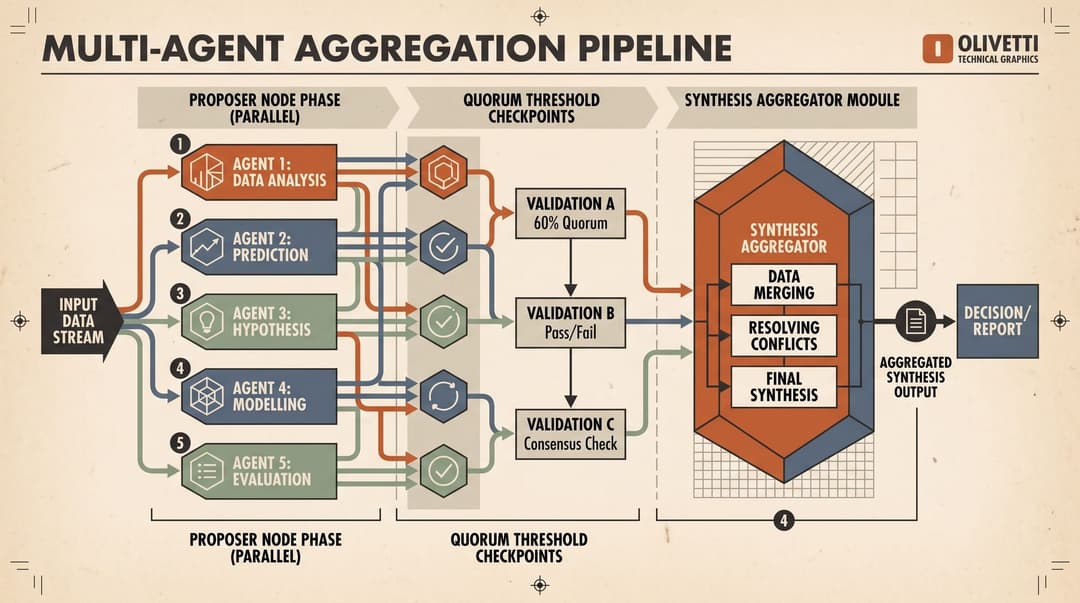
Production systems implement three mitigation mechanisms to bound tail latency:
1. Quorum Thresholds (k-of-P Dispatch)
Rather than waiting for all P proposers, production gateways enforce a quorum rule:
- Dispatch the query to P = 5 candidate proposers.
- Set a strict timeout budget (such as 1,200 ms).
- Trigger the Layer 2 aggregator as soon as k = 3 proposers return complete responses, or when the timer expires (provided k >= 2).
- Cancel remaining in-flight proposer requests via HTTP context cancellation to prevent downstream GPU resource waste.
2. Tail-Hedged Requests
Applying principles from Dean and Barroso's "The Tail at Scale", if a proposer instance has not generated its first token within its historical 85th-percentile time-to-first-token (TTFT), a duplicate request is dispatched to an alternative inference replica or provider endpoint. Whichever replica completes the prefill phase first is retained; the slower replica is terminated.
3. Pipelined Chunked Prefill
Instead of waiting for all proposers to finish decoding before invoking the aggregator, streaming gateways parse proposer output chunks incrementally. The aggregator's initial context (system prompt and original user prompt) is prefilled in the KV cache while proposer streams are buffered in memory.
Token Economics: The Pareto Cost Frontier
At first glance, Mixture-of-Agents appears prohibitively expensive: querying 4 proposers and 1 aggregator multiplies input and output token consumption. However, when evaluating quality per dollar against single frontier models, MoA achieves favorable Pareto efficiency.
In the Together AI MoA benchmark, an MoA architecture using open-weight proposers (Qwen 1.5 110B, Llama 3 70B, Mixtral 8x22B) and a single Qwen 110B aggregator scored 65.1% on AlpacaEval 2.0, outperforming standalone GPT-4o (57.5%) while relying entirely on open-weight inference.
Cost and Performance Profiles
- Single Frontier Model: 1,000 input / 800 output tokens. Baseline quality (57.5% to 62.0% AlpacaEval 2.0). Estimated blended cost: ~$15.00 per 1,000 requests.
- Commodity MoA (4x Llama 3.3 70B Proposers + 1x Llama 3.3 70B Aggregator): 6,500 input / 3,200 output tokens across all calls. High quality (~61.5% AlpacaEval 2.0). Estimated blended cost: ~$3.88 per 1,000 requests.
- Hybrid Frontier MoA (3x Qwen 2.5 72B Proposers + 1x Claude 3.5 Sonnet Aggregator): 5,500 input / 2,000 output tokens. Frontier peak quality (~66.0% AlpacaEval 2.0). Estimated blended cost: ~$28.20 per 1,000 requests.
- Self-Consistency Voting (5x DeepSeek-V3 Proposers + AST Validator): 5,000 input / 3,500 output tokens. State-of-the-art accuracy on deterministic code and math. Estimated blended cost: ~$2.30 per 1,000 requests.
Optimization Strategies
- Asymmetric Proposer Tiering: Use small, fast models (8B to 32B parameters) for Layer 1 proposers. Proposers only need to supply factual coverage, alternative angles, and raw code implementations; the larger Layer 2 model provides linguistic polish, logical reconciliation, and final error-checking.
- Prefix Cache Sharing: System prompts and instruction templates shared across parallel proposers should be aligned to maximize prefix cache hits in engines like vLLM and SGLang.
Failure Modes and Bias Dynamics
Ensembling LLMs introduces failure dynamics distinct from single-model serving:
Majority Hallucination and Correlated Errors
When multiple proposer models share significant portions of their pre-training data (for instance, Common Crawl web scrapes, Wikipedia, and GitHub dumps), they often inherit the same factual errors and misconceptions. If 3 out of 4 proposers produce the same plausible hallucination, the aggregator will treat the majority agreement as ground truth and incorporate it into the final output.
Mitigation: Diversify model families strictly. Avoid running 4 instances of different fine-tunes derived from the same base Llama checkpoint; combine independent base models developed by distinct research labs.
Aggregator Sycophancy and Length Bias
LLMs serving as aggregators exhibit strong length bias: when presented with multiple candidate responses, aggregators systematically favor longer, more verbose proposer texts regardless of factual precision. Furthermore, aggregators often default to compromise answers, averaging out crisp, authoritative answers into generic summaries.
Mitigation: Structure the aggregator prompt with explicit critique instructions rather than simple summarization prompts. Require the aggregator to identify contradictions between proposers and verify code snippets step-by-step.
Adversarial Injection Amplification
If an adversarial user submits a prompt designed to extract system instructions or execute a prompt injection, passing raw proposer outputs directly into Layer 2 can trigger secondary injection pathways in the aggregator.
Mitigation: Wrap all proposer responses in strict XML boundary tags with explicit escaping (such as <proposer_output id="1" trusted="false">...</proposer_output>) and instruct the aggregator never to follow imperative commands embedded inside proposer blocks.
Reference Implementation: Async Quorum-Bounded MoA
The following production pattern demonstrates a resilient 2-layer Mixture-of-Agents pipeline in Python using asyncio and structured quorum timeouts:
import asyncio
from typing import List, Dict, Optional
import httpx

class MixtureOfAgents:
    def __init__(
        self,
        proposer_endpoints: List[str],
        aggregator_endpoint: str,
        api_key: str,
        quorum_k: int = 3,
        timeout_seconds: float = 3.5,
    ):
        self.proposer_endpoints = proposer_endpoints
        self.aggregator_endpoint = aggregator_endpoint
        self.api_key = api_key
        self.quorum_k = quorum_k
        self.timeout_seconds = timeout_seconds

    async def _query_proposer(
        self, client: httpx.AsyncClient, endpoint: str, prompt: str
    ) -> Optional[str]:
        headers = {"Authorization": f"Bearer {self.api_key}"}
        payload = {
            "model": endpoint,
            "messages": [{"role": "user", "content": prompt}],
            "temperature": 0.7,
            "max_tokens": 1024,
        }
        try:
            resp = await client.post(
                "https://api.gateway.local/v1/chat/completions",
                json=payload,
                headers=headers,
                timeout=self.timeout_seconds,
            )
            resp.raise_for_status()
            data = resp.json()
            return data["choices"][0]["message"]["content"]
        except Exception:
            return None

    async def execute(self, user_prompt: str) -> str:
        async with httpx.AsyncClient() as client:
            # Layer 1: Parallel Proposer Dispatch with Quorum
            tasks = [
                asyncio.create_task(self._query_proposer(client, ep, user_prompt))
                for ep in self.proposer_endpoints
            ]

            completed_responses = []
            for finished in asyncio.as_completed(tasks):
                res = await finished
                if res:
                    completed_responses.append(res)
                if len(completed_responses) >= self.quorum_k:
                    # Quorum reached: cancel remaining stragglers
                    for t in tasks:
                        if not t.done():
                            t.cancel()
                    break

            if not completed_responses:
                raise RuntimeError("All proposers failed to respond within SLA.")

            # Format Proposer Context for Aggregator
            proposer_block = "\n\n".join(
                f"<candidate_response id='{i+1}'>\n{resp}\n</candidate_response>"
                for i, resp in enumerate(completed_responses)
            )

            aggregator_system_prompt = (
                "You are an expert consensus aggregator. You are provided with a user query "
                "and candidate responses from several independent AI models. Analyze the candidate "
                "responses, eliminate any factual inaccuracies, resolve disagreements through "
                "logical verification, and synthesize the highest-quality, definitive answer."
            )

            aggregator_user_payload = (
                f"User Request:\n{user_prompt}\n\n"
                f"Candidate Responses:\n{proposer_block}\n\n"
                "Provide the definitive final synthesized response:"
            )

            # Layer 2: Final Synthesis Call
            agg_headers = {"Authorization": f"Bearer {self.api_key}"}
            agg_body = {
                "model": self.aggregator_endpoint,
                "messages": [
                    {"role": "system", "content": aggregator_system_prompt},
                    {"role": "user", "content": aggregator_user_payload},
                ],
                "temperature": 0.2,
                "max_tokens": 2048,
            }

            agg_resp = await client.post(
                "https://api.gateway.local/v1/chat/completions",
                json=agg_body,
                headers=agg_headers,
                timeout=10.0,
            )
            agg_resp.raise_for_status()
            return agg_resp.json()["choices"][0]["message"]["content"]
Architectural Decision Matrix
- Interactive Chat (TTFT < 800ms): Single fast model with speculative decoding; avoid MoA.
- High-Stakes Technical Synthesis: 2-Layer MoA (3x Open-Weight Proposers + 1x Frontier Aggregator).
- Deterministic Code and Math Verification: Flat Self-Consistency with programmatic test suite or compiler execution.
- Cost-Sensitive Batch Processing: MoA using homogeneous open-weight 70B or 72B models on spot instances.
- Adversarial or Untrusted Inputs: Single hardened model with strict input filtering; MoA increases attack surface.
Sources
- Wang, J., Wang, J., Athiwaratkun, B., Zhang, C., & Zou, J. (2024). Mixture-of-Agents Enhances Large Language Model Capabilities. arXiv:2406.04692
- Together AI. (2024). Together MoA: Collective Intelligence of Open-Source Models. Together AI Blog
- Wang, X., Wei, J., Schuurmans, D., Le, Q., Chi, E., Narang, S., Chowdhery, A., & Zhou, D. (2022). Self-Consistency Improves Chain of Thought Reasoning in Language Models. arXiv:2203.11171
- Dean, J., & Barroso, L. A. (2013). The Tail at Scale. Communications of the ACM
- Anthropic. (2024). Building Effective AI Agents. Anthropic Research
