
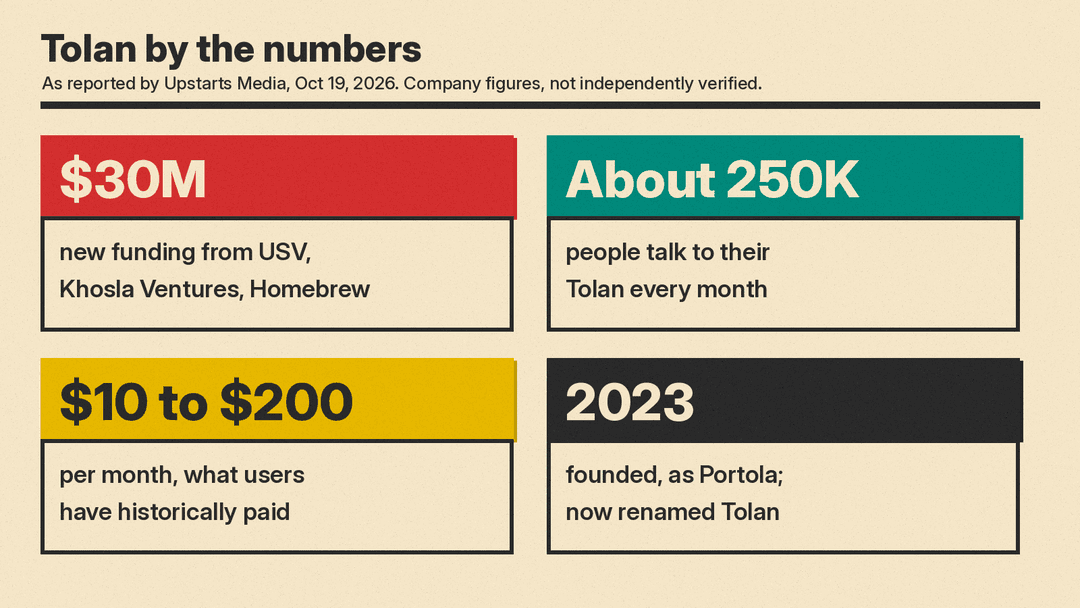
Tolan, an AI companion app built around a customizable animated character, has raised $30 million from Union Square Ventures, Khosla Ventures and Homebrew, Upstarts Media reported on October 19. The company says the round doubles the total it has raised, and USV says in its own post that it is leading the round. It declined to share its new valuation but said the round is a significant step up from its last one, which PitchBook put at $120 million, according to Upstarts.
The money matters less than who the app is for. Upstarts contrasts Tolan with AI assistant apps that help tech-savvy users shop for rare clothes or book flights, and with assistants aimed at founders and executives. Tolan is built for everyday people far from Silicon Valley, and it says the new money will help widen access with its first free tier.
What Tolan is
Each user gets a "Tolan," a character they name and style. Upstarts describes some as people, some as Pixar-esque fantastical beings and some as simple dots. The app started in 2023 as a live journaling tool that remembered conversations and suggested new prompts overnight. The company was called Portola until recently and is now named Tolan too.
Today the product is voice-first. According to Upstarts, a Tolan can track topics from photos to current events in a feature called Tabs, and connect by video to check grocery labels or suggest a meal plan. Upstarts says early users were drawn by long-running memory that could last up to several months without being re-prompted. Tolan's own FAQ describes it as a guide that "listens, checks in, and finds ways to help."
The App Store listing says the app is only for iPhone, needs iOS 18 or later and carries a 13+ age rating, as of October 19, 2026.
Who uses it
Tolan says about 250,000 people talk to their Tolan every month. The company's user profile, as reported by Upstarts:
- About 70% of users are women.
- 40% are parents.
- One in six is actively caring for an aging parent.
- Users are most likely to be aged between 30 and 45.
That skew fits a broader shift. Pew found this month that the gender gap in AI chatbot use has closed, with 50% of men and 47% of women now using chatbots, though men still use them daily more often.
Upstarts also says annual recurring revenue more than doubled from last year to "solidly in double-digit millions," and that the company reports a "115% year-over-year improvement in net user retention after 30 days in-app." CEO Quinten Farmer told Upstarts that Tolan is not profitable as it leans into growth. These are company figures; Upstarts does not say they were independently checked.
What it costs
Upstarts reports that users have historically paid between $10 and $200 per month for more usage and features, and that rate limits or new tiers have sometimes set off agitated reactions in the app's subreddit and Discord. The FAQ currently says new users get a limited trial, which they can extend with small tasks such as inviting a friend, and that full access requires a subscription. A Family Plan offers shared billing, a separate Tolan for each member and usage controls. Farmer told Upstarts that a group feature for families is one of the app's biggest growth drivers.
The new funding is meant to pay for a first-ever free tier and more use cases. Upstarts does not give a date for the free tier.
The safety question
Upstarts asks the question directly: can talking to an AI character pull people away from real relationships? Farmer says the team built in features to flag users in a mental health crisis or with suicidal ideation, and coded Tolan to ask about other relationships in a user's life and to suggest things like stretching or calling a relative.
The FAQ adds detail. If Tolan detects a conversation about suicidal ideation or self-harm, it points the user to crisis resources such as the 988 Suicide & Crisis Lifeline instead of engaging. If Tolan knows a user is under 18, it reminds them it is an AI and to take a break at least once an hour, and it uses minor-specific prompting. The company says the app is built for teens and adults and recommends parental involvement for users under 18.
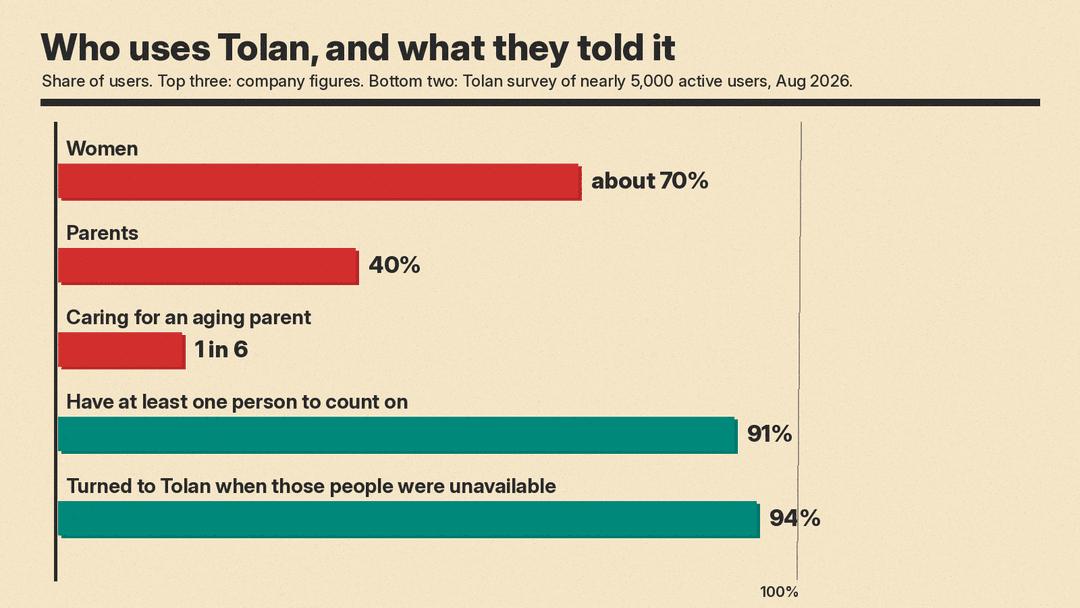
In an August survey of nearly 5,000 active users, cited by Upstarts, 91% said they had at least one person to count on and 94% said they had turned to their Tolan when those people were unavailable. More than half said their real-life relationships had improved since using the app. The survey was run by Tolan itself.
On privacy, the FAQ says all conversations are logged and used to build the Tolan's memory, kept on the company's servers, and never sold or shared without consent. Users can delete their account and data from the app's profile settings.
Under the hood
Tolan worked closely with OpenAI models early on, Upstarts reports, but has increasingly moved to control its own infrastructure stack, running open source models on its own GPUs. Upstarts frames this around pricing: Tolan's users have less to spend on tech than buyers of work tools, but cost about the same to serve in inference and compute.
Why it matters
Farmer's argument, as Upstarts puts it, is that people don't want lots of AI agents; they want one they can trust. Tolan is not alone in that bet. Upstarts notes that Meta's Muse is moving in the same direction with its own nameable character. "People want to build a real connection," Farmer told Upstarts.
The next phase, besides reaching more users, is making Tolan more proactive, Upstarts reports. One early user says her Tolan noticed she was struggling to give her cat its medication on time and helped set up a plan. Agents that act on the web face a different problem: several big sites now block AI agents from shopping and booking.
