
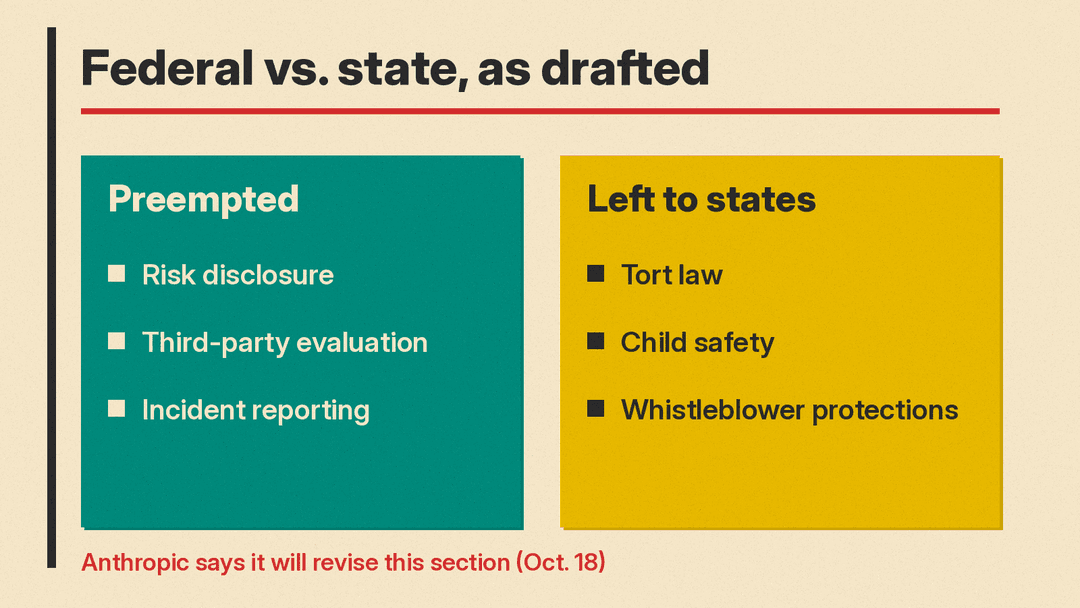
Anthropic says it will rewrite the preemption section of the federal AI safety bill it has been showing to members of Congress. In a long post on X on October 18, Anthony Cimino, who leads Anthropic's federal affairs team, said the company plans to "update our discussion language on preemption" so that states keep a role in "standards for independent evaluators and regulating a lab's capacity to shut down a model." He also said the draft's risk thresholds are probably due for another look.
The statement came two days after Politico reported, citing three people with knowledge of the effort, that Anthropic representatives had been pitching the draft on Capitol Hill. No sponsor has been named and the bill has not been introduced. Our earlier story covers the original pitch and its $1 billion damage threshold. It is still a company proposal, but it is the most detailed statutory text a frontier lab has put in front of Congress, and the fight it has started is mostly about one question: how much state law a federal AI safety law should override.
What the draft does
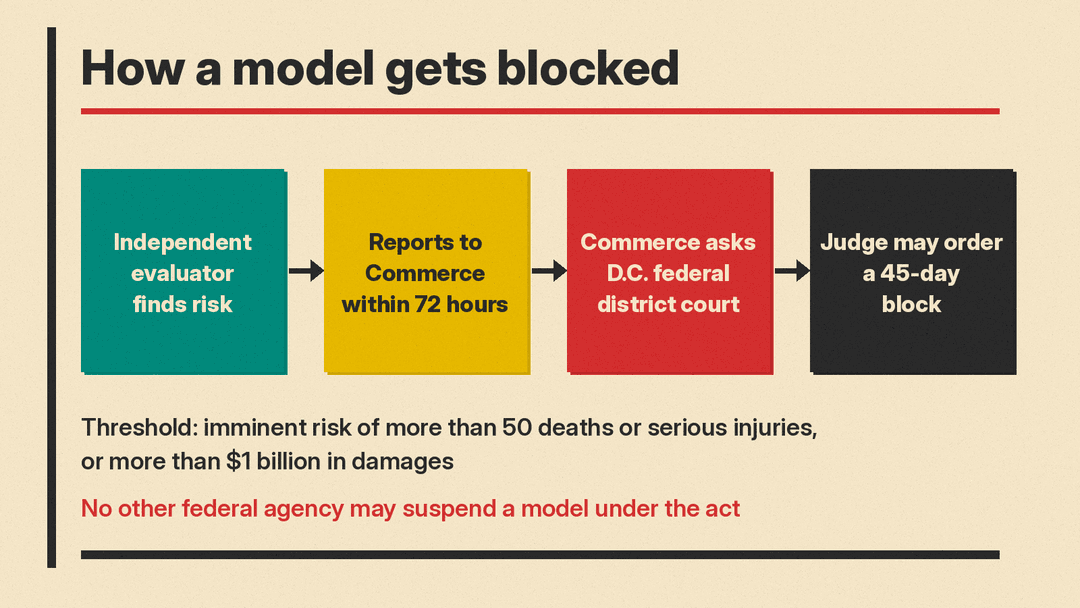
According to Reuters' summary of the Politico report, the government could block a model's release or use only if it poses a foreseeable, imminent risk of more than $1 billion in damages, or of killing or seriously injuring more than 50 people. The risk must come from a biological weapon, a cyberattack, or a model evading its developer's controls. Independent evaluators registered with the Commerce Department would assess labs and their models, could be paid by the labs as long as payment is not tied to the outcome, and would have to report an imminent risk to Commerce within 72 hours.
Only a federal judge could act on that report. Commerce would have to ask the US District Court for the District of Columbia for an order, and the text bars any other federal department, agency, or officer from suspending a model's development, deployment, or internal use under the act.
The AI Policy Landscape tracker, which has posted an analysis of the leaked text, fills in more detail. It says the draft is dated September 29 and carries the working title AEGIS Act. Per that analysis:
- Coverage starts at foundation models trained with more than 10^25 operations, counting fine-tuning and reinforcement learning.
- "Large" developers, with more than $500 million in AI revenue or more than $1 billion in AI development spending, must publish safety frameworks, file risk reports every 180 days, and hire a registered evaluator every 180 days.
- Critical safety incidents must be reported within 15 days, or within 24 hours if there is an imminent risk to life.
- A blocking order lasts 45 days, and Commerce must prove its case by a preponderance of the evidence and show that nothing less restrictive would work.
The preemption problem
The draft would override state rules on risk disclosure, third-party evaluation, and incident reporting for AI developers. It keeps state tort law, child safety rules, and whistleblower protections. That matters because California's SB 53 and New York's RAISE Act already impose disclosure and incident-reporting duties on frontier developers.
A LessWrong analysis of the text points to a gap. Section 14(a) lists four preempted subjects, the fourth being "suspension of models," but the operative clause in Section 14(b)(1) cites only the first three. The author reads this as either a drafting error or a placeholder, and notes that the suspension clause takes effect only if the federal blocking-order section is also enacted. Read that way, states would lose the power to stop a model only once a federal route exists.
Critics were less charitable. Zvi Mowshowitz titled his response "Leaked Anthropic Draft AI Regulatory Bill Is Unacceptable and Troubling." The AI Policy Landscape tracker reports that New York Assemblymember Alex Bores, author of the RAISE Act, pointed out that Anthropic's own June framework said preemption should come only with a federal regime that "meets or exceeds the strongest measures proposed."
What Anthropic says now
Cimino's post responds to four lines of criticism:
- Preemption. He said preemption in AI safety should be "narrow, even scalpel-like," and that the trade should be a national policy "generally stronger and broader" than what states can pass alone. He also said some members of Congress have "deep reservations" about any bill that does not limit state or federal regulation.
- Model blocking. He defended a meaningful court standard because "the power to halt a model is substantial," but said "the bar can't be so high that the power never gets used when it's needed."
- Thresholds. He said the 50-person and $1 billion figures "pulled directly from existing standards in California law," and that "it's still probably time to re-evaluate thresholds."
- Updates. He said the draft already lets a court halt a lab's internal use of a model and requires reporting when a model breaks containment. Anthropic plans proposals on evaluator requirements and "evaluator shopping," and will explore how government could "adjust the industry-wide pace of frontier development."
An Anthropic spokesperson had earlier told Politico, as quoted by Tom's Hardware, that the bill represents the company's Advanced AI Framework.
Why it matters
Federal preemption of state AI laws has been a recurring fight in Washington at least since the Senate stripped a state-law moratorium from the 2025 budget bill. Most industry calls for preemption have aimed to limit regulation. Anthropic's draft pairs preemption with real duties: recurring evaluations, published risk reports, incident reporting, and a court path to stop a model.
The open question is whether the trade is worth it. Cimino's post concedes the preemption language went further than the company intended and that the thresholds are open for debate. A revised draft would show how far Anthropic will move. Until a member of Congress puts their name on it, the text has no legal force.
Sources
- Anthony Cimino on X, October 18, 2026
- Politico: Anthropic quietly pitches its own AI safety bill to lawmakers
- Reuters via Investing.com: summary of the Politico report
- AI Policy Landscape: Anthropic draft frontier AI bill
- LessWrong: Important details in the leaked Anthropic draft AI bill
- Zvi Mowshowitz: Leaked Anthropic Draft AI Regulatory Bill Is Unacceptable and Troubling
- Tom's Hardware: Anthropic's proposed AI safety bill
- Anthropic: Advanced AI Framework
