
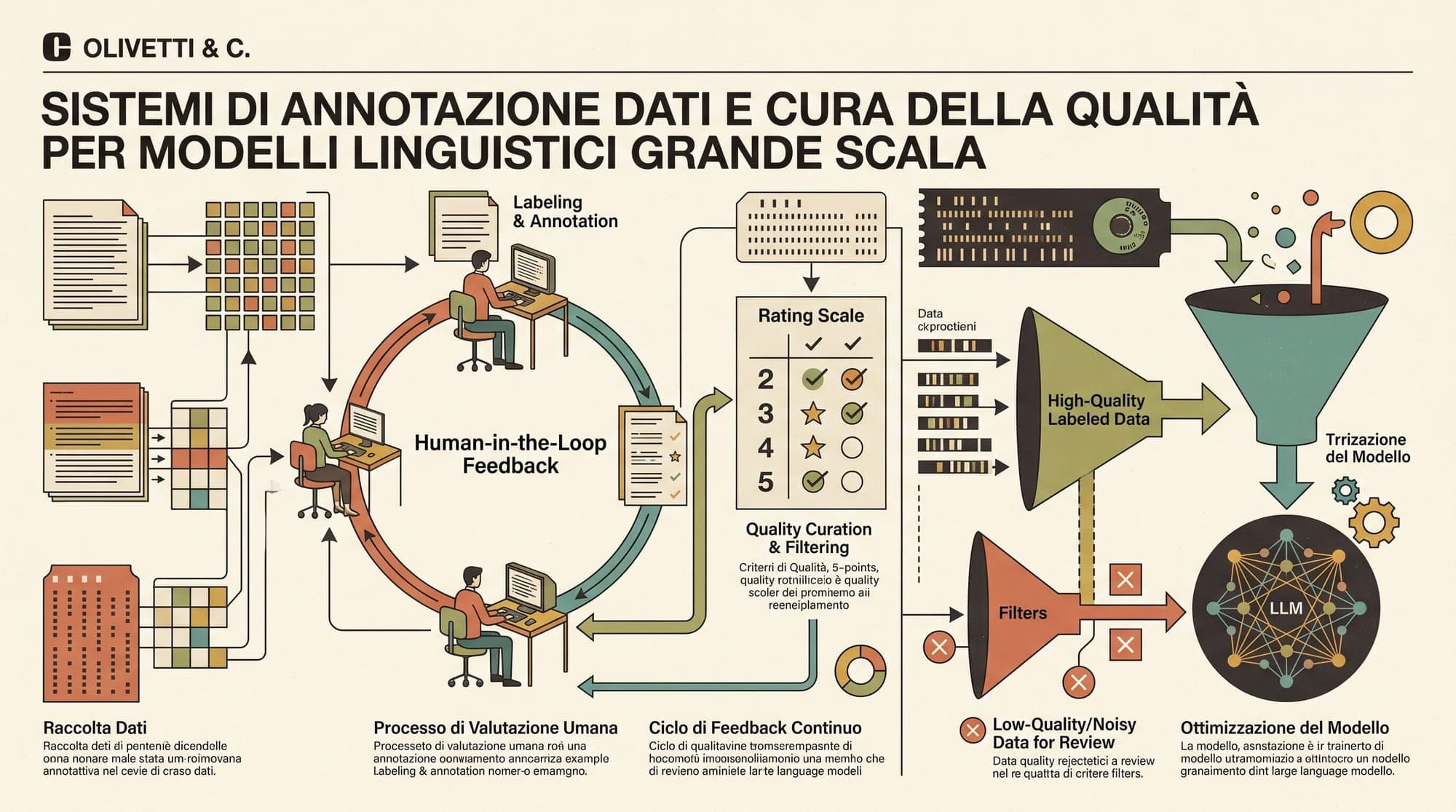
Modern frontier and open-weight large language models rely heavily on curated data pipelines across Supervised Fine-Tuning (SFT), Reinforcement Learning from Human Feedback (RLHF), and Direct Preference Optimization (DPO). While pre-training ingests trillions of uncurated tokens from the public web, post-training alignment requires high-precision preference rankings, instruction demonstrations, and safety boundary evaluations. Empirical research demonstrates that a few thousand meticulously curated demonstrations often outperform hundreds of thousands of noisy web scrapes.
Engineering teams building post-training alignment pipelines face distinct tooling trade-offs across data collection, human-in-the-loop active learning, and automated dataset quality assurance. Four frameworks represent the primary architectural patterns in production: Argilla, Label Studio, Prodigy, and Cleanlab.
Core Architectural Taxonomies and Data Models
Each framework reflects a different architectural philosophy regarding how data flows between human annotators, machine learning models, and storage layers.
Argilla: LLM-Centric Feedback Datasets
Argilla is built specifically for natural language processing and LLM alignment workflows. Its core abstraction is the FeedbackDataset, structured around records that map directly to multi-turn conversational trees, instruction-response pairs, and preference rankings.
- Data Model: Records contain arbitrary combinations of text fields, rating scales, label selections, ranking questions, and free-form text inputs.
- Ecosystem Integration: Native interoperability with Hugging Face datasets and the Distilabel synthetic data framework allows teams to combine human feedback with AI-assisted annotations (RLAIF).
- Storage and Indexing: Backed by a relational database (PostgreSQL or SQLite) and an OpenSearch/Elasticsearch vector and keyword index, enabling semantic search and similarity filtering across millions of prompt-response pairs.
Label Studio: Extensible Multi-Modal Task Graphs
Label Studio, maintained by HumanSignal, is a general-purpose, multi-modal annotation engine designed to handle text, audio, images, video, time-series, and document layouts within a unified web interface.
- Data Model: Configured via an XML-based declarative schema language defining visual components such as
<View>,<Text>,<Choices>, and<Pairwise>. - Task Pipeline: Imports data as JSON objects and exports standardized annotations across formats like COCO, Pascal VOC, CSV, and JSON-MIN.
- Storage Backend: Supports direct synchronization with object storage (Amazon S3, Google Cloud Storage, Azure Blob Storage) and local file systems, with database metadata stored in PostgreSQL.
Prodigy: Scriptable Active Learning Streams
Developed by Explosion AI (the creators of spaCy), Prodigy is a Python-first, local-process developer tool designed for rapid iteration by data scientists rather than outsourced annotation workforces.
- Data Model: Stateless JSONL streams processed through generator functions in Python recipes.
- Workflow Execution: Every annotation task is defined as a Python CLI command that binds custom data loaders, model inference routines, and web server endpoints.
- Storage Backend: SQLite or PostgreSQL stores annotated examples locally without complex external infrastructure dependencies.
Cleanlab: Algorithmic Quality Assurance via Confident Learning
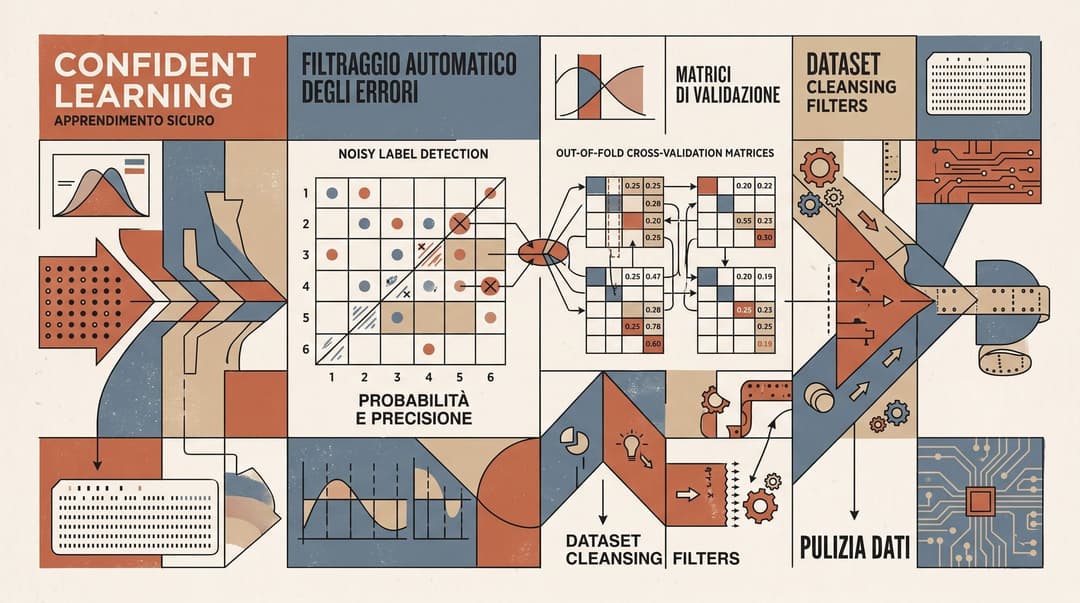
Cleanlab approaches the alignment problem from a data-centric automated perspective rather than a manual labeling interface. Based on the theory of Confident Learning formulated by Curtis Northcutt and researchers at MIT, Cleanlab identifies label errors, out-of-distribution samples, and noisy annotations algorithmically.
- Data Model: Consumes out-of-fold predicted probability matrices generated by any model alongside assigned nominal labels or preference pairs.
- Quality Metrics: Computes joint distribution estimates, label issue scores, and ranking consistency metrics to prune or correct corrupted datasets.
- Deployment: Available as an open-source Python library (
cleanlab) and a commercial automated platform (Cleanlab Studio).
Human Feedback Loops and Active Learning Mechanics
Collecting human preferences for RLHF or DPO requires structuring interfaces to capture subtle distinctions between model outputs while minimizing annotator fatigue and bias.
# Example: Defining an Argilla FeedbackDataset for DPO Pairwise Preferences
import argilla as rg

client = rg.Argilla(api_url="http://localhost:6900", api_key="admin.apikey")

settings = rg.Settings(
    fields=[
        rg.TextField(name="prompt", title="User Prompt"),
        rg.TextField(name="response_a", title="Candidate Response A"),
        rg.TextField(name="response_b", title="Candidate Response B"),
    ],
    questions=[
        rg.RatingQuestion(
            name="preference",
            title="Which response better follows instructions?",
            values=[1, 2],
            labels={"1": "Response A", "2": "Response B"},
        ),
        rg.TextQuestion(name="correction", title="Optional human correction", required=False),
    ],
)

dataset = rg.Dataset(name="dpo-preference-tuning", settings=settings)
dataset.create()
Active Learning Integration Topologies
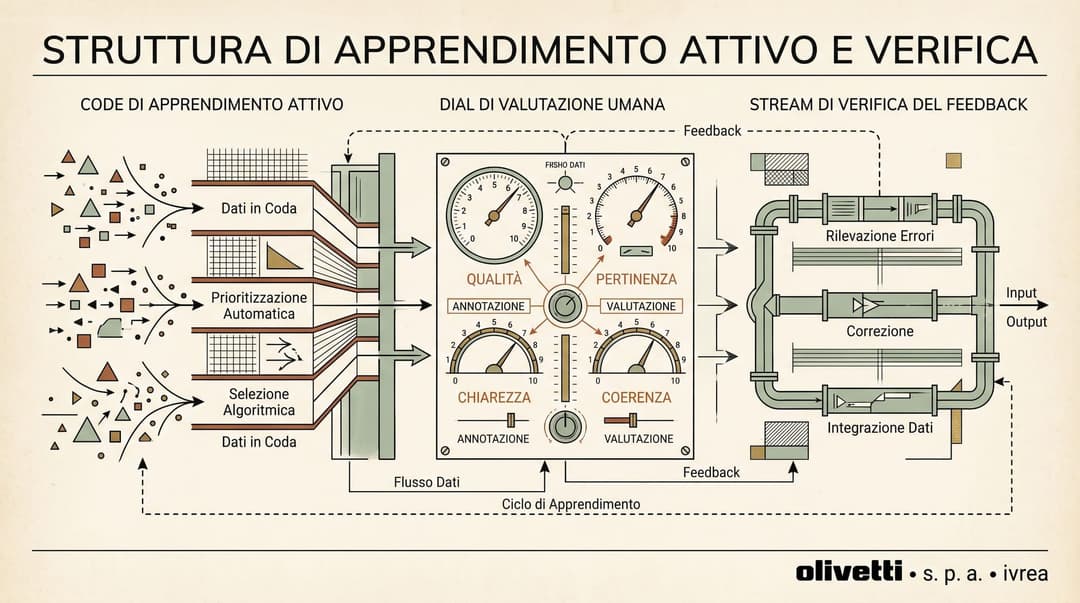
- Label Studio ML Backend: Label Studio connects external models via a standalone web server SDK. When annotators submit tasks, webhooks notify the backend service via HTTP. The service invokes a
fit()method to update model weights in background task queues (Redis Queue) and serves updated predictions through apredict()endpoint for pre-annotation. - Prodigy Dynamic Stream Generators: Prodigy executes active learning directly inside Python generators. The model scores candidate examples on the fly using uncertainty metrics (entropy, margin, or least confidence) and yields only the most informative instances to the browser UI. Annotator responses immediately adjust the stream sorting heuristics.
- Argilla Programmatic Curation: Argilla coordinates active learning through its Python client and vector similarity queries. Teams query records where reward models or judge LLMs exhibit high variance, routing contested examples to human expert queues while auto-accepting high-confidence consensus labels.
Algorithmic Quality Assurance and Confident Learning
Human annotators frequently introduce noise into alignment datasets. In public pairwise preference benchmarks such as Anthropic's hh-rlhf or instruction datasets like Databricks Dolly-15k, audits reveal that a non-trivial percentage of rejected outputs are objectively superior to chosen outputs due to annotator misunderstanding, subjective drift, or fatigue.
Confident Learning Theory
Cleanlab models dataset noise by estimating the joint probability distribution of the noisy observed labels and the unobserved true latent labels $y^$, denoted as $P(\tilde{y}, y^)$.
Given an -class classification task or a binary preference choice, let be the out-of-fold predicted class probability for instance . Confident Learning establishes per-class confidence thresholds:
An instance observed with label is identified as belonging to true latent class when:
For pairwise preference datasets used in DPO and PPO reward modeling, this formulation detects flipped preference pairs where a model trained on cross-validation folds assigns overwhelmingly higher reward to the rejected candidate than the chosen candidate.
# Example: Detecting Label Issues in SFT Intent Classification with Cleanlab
import numpy as np
from cleanlab.filter import find_label_issues

# pred_probs: out-of-fold predicted probabilities shape (N, K)
# noisy_labels: assigned ground-truth labels shape (N,)
label_issues_mask = find_label_issues(
    labels=noisy_labels,
    pred_probs=pred_probs,
    return_indices_ranked_by="self_confidence",
)

print(f"Detected {np.sum(label_issues_mask)} suspicious annotation records.")
Architectural Comparison and Engineering Trade-Offs
Choosing an annotation or curation stack depends on team composition, modality requirements, automation goals, and compliance boundaries.
Modality and Task Scope
- Argilla: Highly specialized for text, chat hierarchies, token attribution, span-level editing, and LLM reward modeling. Inefficient for visual bounding boxes or audio segmentation.
- Label Studio: Multi-modal by design. Ideal for organizations managing computer vision, speech transcription, OCR layout parsing, and conversational text within a single administrative console.
- Prodigy: Tailored for rapid text classification, named entity recognition (NER), span categorization, and prompt-response comparisons. Includes basic image and audio support, but excels primarily in NLP pipelines.
- Cleanlab: Agnostic to modality. Evaluates feature embeddings and predicted probability distributions across tabular, text, image, and audio formats to clean upstream data.
Developer Ergonomics and Scriptability
- Argilla: Comprehensive Python SDK with explicit abstractions for data scientists. Seamlessly integrates with Hugging Face Hub, Datasets, and TRL (Transformer Reinforcement Learning).
- Label Studio: Configured primarily through a visual web interface and XML templates. Python SDK provides administrative CRUD operations, but daily configuration relies on UI schema editors.
- Prodigy: Entirely code-driven. Workflows, validation logic, custom HTML components, and data transformations are defined directly in Python scripts.
- Cleanlab: Operates as a computational pipeline step in standard scikit-learn, PyTorch, or Hugging Face training scripts without requiring manual web interface interaction.
Deployment Topologies and Governance
- Argilla: Distributed as an open-source Docker Compose / Kubernetes service under the Apache 2.0 license, with enterprise multi-tenancy and role-based access control.
- Label Studio: Open-source Community Edition (Apache 2.0) provides single-workspace deployments. Multi-project organizational roles, SSO, and advanced workforce management require Label Studio Enterprise.
- Prodigy: Distributed as a downloadable Python package via commercial per-developer perpetual licensing. Runs entirely on local machines or private VPCs without transmitting data to third-party endpoints.
- Cleanlab: Open-source core (
cleanlab) available under AGPL-3.0 for local execution. Cleanlab Studio provides enterprise SaaS and VPC deployments with automated LLM dataset curation connectors.
Summary Matrix
- Argilla: Best suited for dedicated LLM post-training teams curating SFT, DPO, and RLAIF preference datasets within Hugging Face pipelines.
- Label Studio: Best suited for cross-functional enterprise data teams managing multi-modal annotation programs across text, vision, and speech with non-technical labeling workforces.
- Prodigy: Best suited for machine learning engineers and data scientists requiring rapid, code-scripted active learning and iterative dataset creation.
- Cleanlab: Best suited for post-hoc automated dataset curation, identifying label errors, and pruning noisy training data from massive human-annotated corpora.
Sources
- Cleanlab: Confident Learning: Estimating Uncertainty in Dataset Labels (Journal of Artificial Intelligence Research)
- Cleanlab Blog: Detecting Errors in Human Feedback on the Anthropic RLHF Dataset
- Argilla Documentation: Collecting Feedback and Preference Datasets
- Argilla Distilabel Framework for AI Feedback
- Label Studio Documentation: Generative AI Pairwise Human Preference Template
- Label Studio Documentation: Integrating Machine Learning Backends
- Prodigy Documentation: Active Learning Annotation and NLP Workflows
