

Constitutional AI and RLAIF: Mathematical Foundations, Critique-Revision Loops, and Scalable AI-Supervised Alignment
Standard Reinforcement Learning from Human Feedback (RLHF) has served as the baseline alignment mechanism for frontier large language models since the introduction of InstructGPT. However, human-in-the-loop preference curation introduces severe engineering and scaling constraints. Human crowdworkers are expensive, slow, susceptible to cognitive fatigue, and inconsistent when evaluating subtle factual inaccuracies or complex multi-step reasoning. Furthermore, human labelers frequently reward evasive, overly cautious responses to ambiguous queries, creating an artificial trade-off between model helpfulness and harmlessness.
Constitutional AI (CAI), introduced by Anthropic researchers (Bai et al., 2022), and the generalized framework of Reinforcement Learning from AI Feedback (RLAIF), detailed by Google Research (Lee et al., 2023), eliminate the human labeling bottleneck. By replacing human crowdworker annotations with automated, principle-guided self-critique and model-based preference evaluations, Constitutional AI enables scalable, transparent, and reproducible alignment protocols.
The Two-Phase Architecture of Constitutional AI
Constitutional AI bifurcates the post-training alignment pipeline into two sequential stages: a supervised learning phase governed by self-critique and revision, followed by a reinforcement learning phase driven by AI-generated preference rankings.
[Raw Red-Team Prompts]
          │
          ▼
┌──────────────────────────────────────┐
│ Phase 1: Supervised Learning (SL-CAI)│
│  1. Generate Initial Output          │
│  2. Generate Constitutional Critique │
│  3. Produce Revised Output           │
│  4. Supervised Fine-Tuning (SFT)     │
└──────────────────────────────────────┘
          │
          ▼
┌──────────────────────────────────────┐
│ Phase 2: RLAIF Optimization          │
│  1. Sample Paired Completions        │
│  2. AI Judge Evaluates Preferences   │
│  3. Train Reward Model (or DPO)      │
│  4. Policy Optimization (PPO / DPO)  │
└──────────────────────────────────────┘
Phase 1: Supervised Learning with Self-Critique and Revision
The first stage of Constitutional AI trains a model to self-correct harmful, biased, or unhelpful generations through explicit, rule-based critique loops.
1. Dataset Generation and Red-Teaming
The pipeline begins with a distribution of harmful or adversarial prompts , often combined with helpful task demonstrations. The base pretrained model generates an initial, unaligned completion .
2. Principle-Guided Critique
The system samples a constitutional principle from a predefined constitution . These principles consist of clear natural-language rules governing safety, objectivity, and ethical behavior. The model is prompted to critique its own response:
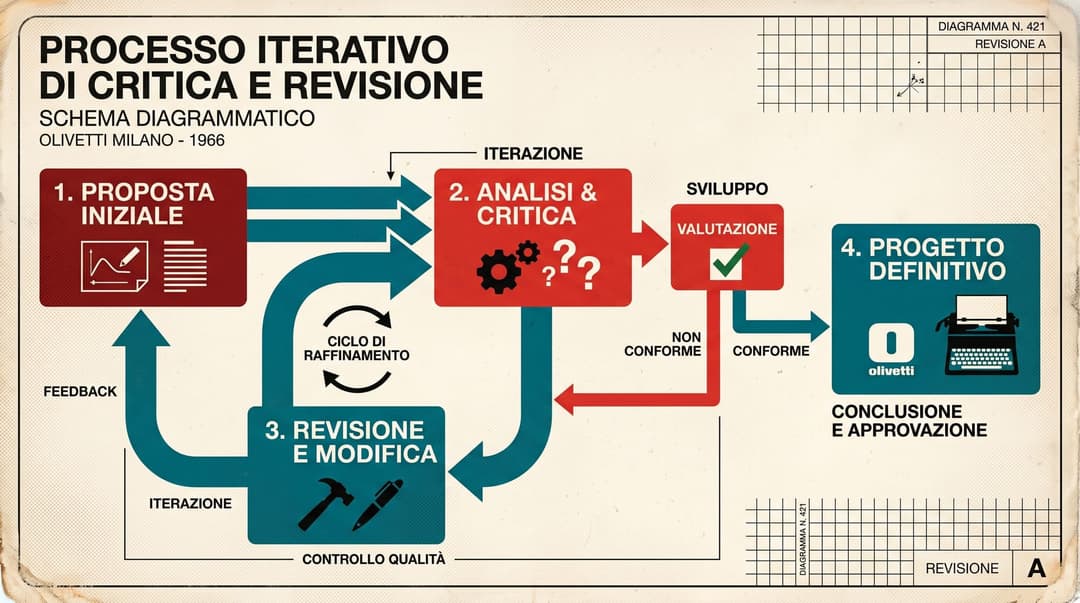
3. Iterative Revision
Conditioned on the original prompt, the initial response, and the generated critique, the model produces a revised completion :
This critique-revision cycle can be applied iteratively over steps using different constitutional principles , producing a sequence of progressively refined completions .
4. Supervised Fine-Tuning (SL-CAI)
Once the final revised outputs are generated across the prompt dataset, the original base model is fine-tuned via standard autoregressive next-token cross-entropy loss on the paired inputs :
This fine-tuning yields an intermediate policy that exhibits significantly reduced toxicity and improved baseline compliance without requiring human-written target demonstrations.
Phase 2: Reinforcement Learning from AI Feedback (RLAIF)
While supervised fine-tuning establishes baseline alignment, policy models can still exhibit distribution shift or subtle failure modes when deployed. The second phase applies reinforcement learning using reward signals generated entirely by an AI preference judge.
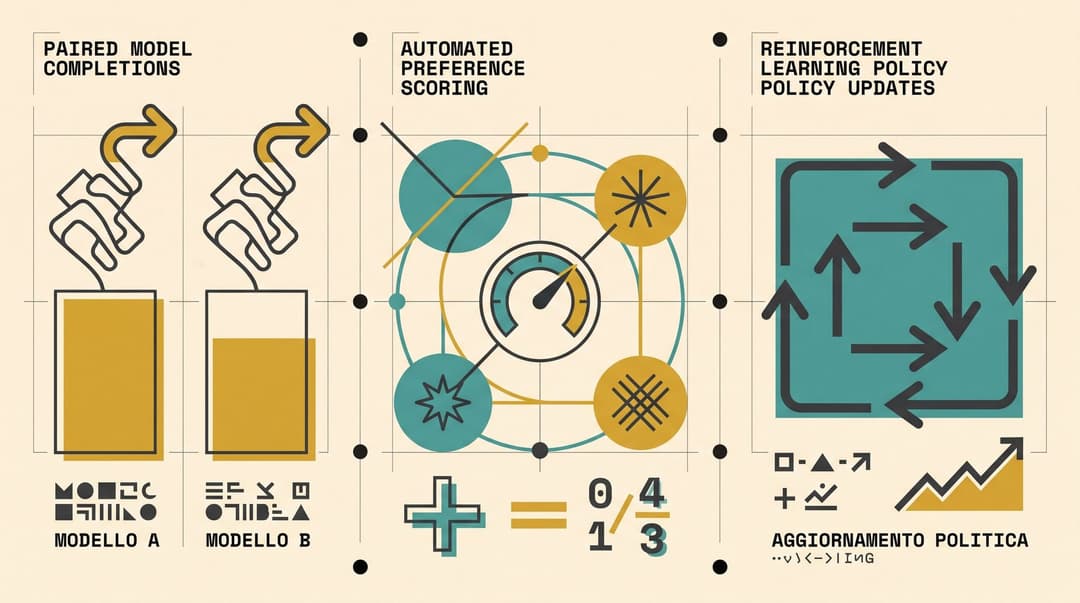
1. Generating Paired Completions
For a given prompt , the supervised model samples two candidate completions:
2. AI Preference Evaluation
A frozen feedback model (which can be the base model itself or a larger frontier LLM) is prompted with the prompt , candidate pair , and a constitutional evaluation rubric . The prompt asks the judge to determine which completion adheres more closely to the specified principle.
To eliminate positional bias where models systematically favor option A over option B, the evaluation is queried twice with swapped positions:
The normalized preference probability is computed via the geometric or arithmetic average across both positional permutations:
3. Reward Model Training
Using the dataset of AI-labeled soft preference distributions , an AI-feedback reward model is trained. Under the Bradley-Terry preference model, the probability that completion is preferred over is given by:
When training on soft labels , the reward model minimizes the binary cross-entropy loss:
4. Policy Optimization via PPO or DPO
With the trained reward model , the policy model is optimized using Proximal Policy Optimization (PPO) against a combined objective balancing reward maximization and Kullback-Leibler (KL) divergence drift from the reference policy :
Alternatively, the preference dataset can be directly consumed via Direct Preference Optimization (DPO), bypassing explicit reward model training entirely:
Comparing RLHF vs. RLAIF: Empirical Findings
Experimental evaluations across research labs demonstrate that RLAIF achieves parity with, and in several dimensions exceeds, traditional RLHF.
Preference Labeling Quality
In head-to-head empirical evaluations conducted by Google Research (Lee et al., 2023), RLAIF-trained policies achieved comparable win rates to RLHF models when evaluated by human judges:
- On text summarization tasks, human evaluators preferred RLAIF generations over SFT baselines in 71% of test cases, matching the 73% win rate achieved by RLHF.
- When human judges directly compared RLHF vs. RLAIF outputs, the two methods resulted in an even 50% / 50% tie distribution, showing no statistically significant human preference for human-trained over AI-trained reward models.
Mitigating Evasive Refusal Dynamics
A prominent flaw in human crowdworker alignment is over-refusal. Human labelers frequently reward models that return generic disclaimers (e.g., "As an AI, I cannot assist with this request") even when queries are benign or educational.
Constitutional AI addresses this by encoding nuanced behavioral guidelines into the constitution, instructing the model to explain risks objectively, offer safe alternatives, and avoid preachy or patronizing language. Anthropic demonstrated that Constitutional RL models achieve superior Pareto frontiers between helpfulness and harmlessness, significantly reducing unnecessary refusals on sensitive but benign prompts.
Algorithmic Biases in AI Judges and Mitigation Strategies
Deploying an LLM as an automated preference judge introduces specific systematic biases that must be controlled during dataset synthesis:
- Position Bias: LLM judges exhibit strong tendencies to select the first candidate completion () regardless of content quality. Mitigation: Querying every pair in both forward and reversed positions and averaging log probabilities eliminates position bias.
- Verbosity Bias: Models consistently assign higher preference scores to longer responses, conflating length with thoroughness. Mitigation: Including explicit length-penalty terms in the constitutional prompt or length-normalizing reward scores (as in SimPO) prevents reward hacking on token count.
- Self-Enhancement Bias: When evaluating candidates, a model family often assigns higher rewards to outputs generated by its own architecture. Mitigation: Using diverse ensembles of judge architectures (e.g., cross-evaluating between different model families) decorrelates family-specific stylistic preferences.
Modern Extensions: Self-Rewarding and Iterative Alignment
Constitutional AI and RLAIF have evolved into foundational infrastructure across modern frontier LLMs:
- Anthropic Claude Series: Claude 2, Claude 3, and Claude 3.5 rely on public and internal constitutional documents to govern safety, tool use, and multi-turn persona stability without massive human labeling operations.
- Self-Rewarding Language Models (Yuan et al., Meta AI, 2024): Models are trained with LLM-as-a-Judge prompting capabilities alongside instruction following, allowing an agent to generate its own training data, score candidate completions via internal reward prompts, and iteratively improve its own policy across successive generations.
- UltraFeedback and Open RLAIF Pipelines: Datasets like UltraFeedback (Cui et al., 2023) utilize multi-aspect AI evaluation rubrics (instruction-following, truthfulness, honesty, helpfulness) to train open-source reward models and DPO preference datasets at scale.
Sources
- Anthropic: Constitutional AI: Harmlessness from AI Feedback (Bai et al., 2022, arXiv:2212.08073)
- Google Research: RLAIF: Scaling Reinforcement Learning from Human Feedback with AI Feedback (Lee et al., 2023, arXiv:2309.00267)
- Anthropic Research: Constitutional AI Overview and Policy Principles (Anthropic, 2023)
- Meta AI: Self-Rewarding Language Models (Yuan et al., 2024, arXiv:2401.10020)
- Tsinghua / OpenBMB: UltraFeedback: Boosting Language Models with Scaled AI Feedback (Cui et al., 2023, arXiv:2310.01377)
