
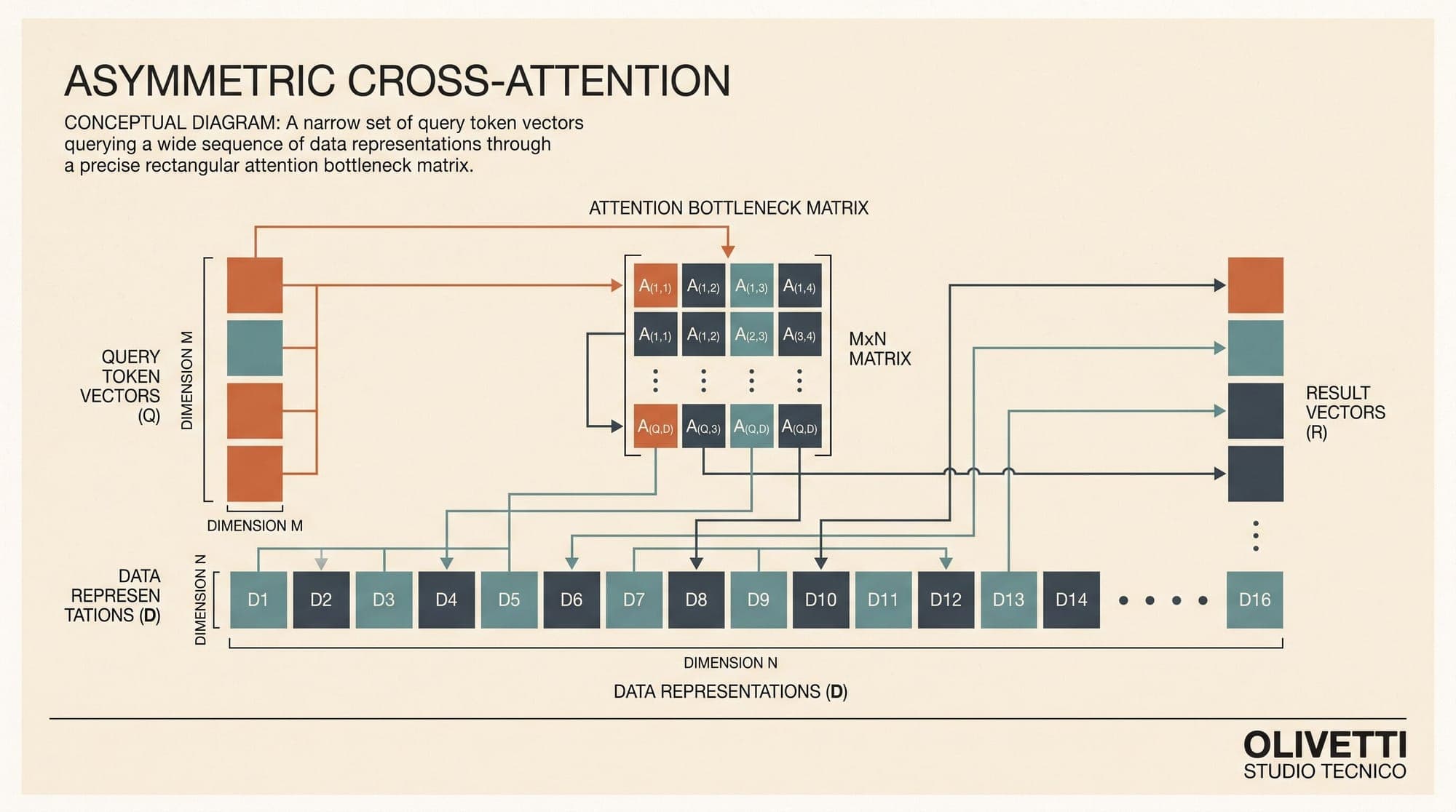
Standard self-attention mechanisms in Transformer architectures process tokens symmetrically: every token in a sequence queries every other token within the same sequence. While this symmetric formulation drives autoregressive sequence generation and dense contextual representations, it exhibits a quadratic compute and memory profile of O(N^2) relative to sequence length. When scaling to high-resolution sensory inputs (such as raw video frames, high-density audio waveforms, or millions of point cloud coordinates) or conditioning language models on massive external contexts, symmetric self-attention becomes computationally intractable.
Cross-attention and latent bottleneck architectures resolve this constraint by decoupling query representations from source representations. By projecting queries from a compact target sequence and keys and values from an uncompressed conditioning sequence, cross-attention achieves asymmetric information routing with linear complexity relative to source sequence length. This architectural primitive forms the backbone of multimodal foundation models, perception networks, and text-guided diffusion systems.
Mathematical Formulation of Cross-Attention
In the original Transformer architecture introduced by Vaswani et al. (2017), cross-attention was deployed in the encoder-decoder translation interface to allow the autoregressive decoder to attend to representations generated by the bidirectional encoder.
Mathematically, given a target sequence X_tgt with length M and hidden dimension d_model, and a source sequence X_src with length N and hidden dimension d_src:
Q = X_tgt W_Q,    where W_Q in R^(d_model x d_k) -> Q in R^(M x d_k)
K = X_src W_K,    where W_K in R^(d_src x d_k)   -> K in R^(N x d_k)
V = X_src W_V,    where W_V in R^(d_src x d_v)   -> V in R^(N x d_v)
The multi-head scaled dot-product cross-attention is computed as:
Attention(Q, K, V) = softmax((Q K^T) / sqrt(d_k)) VThe intermediate attention weight matrix A = softmax((Q K^T) / sqrt(d_k)) has dimensions M x N. Each row i in A represents a discrete probability distribution over all N source tokens for the corresponding target token i. Multiplying this weight matrix by V yields an output tensor of shape M x d_v, which is then projected through output matrix W_O back to the target sequence dimension d_model.
The computational complexity of this operation is O(M * N * d_k) for the dot-product and value aggregation steps, with peak memory consumption driven by the M x N attention matrix. When the target sequence length M is fixed and substantially smaller than the source sequence length N (i.e., M << N), compute scales strictly linearly with N rather than quadratically.
The Latent Bottleneck: Perceiver and Perceiver IO
Processing raw, uncurated sensory inputs poses severe computational hurdles for standard Transformers. An uncompressed 224x224 image contains 50,176 individual pixels; one second of high-fidelity audio sampled at 48 kHz produces 48,000 discrete time steps. Passing these sequences through a 24-layer self-attention network would require computing attention matrices exceeding 2.5 billion elements per layer.
To eliminate domain-specific inductive biases (such as 2D convolutions in computer vision or 1D convolutions in audio) while retaining tractable compute, Jaegle et al. (2021) introduced the Perceiver.
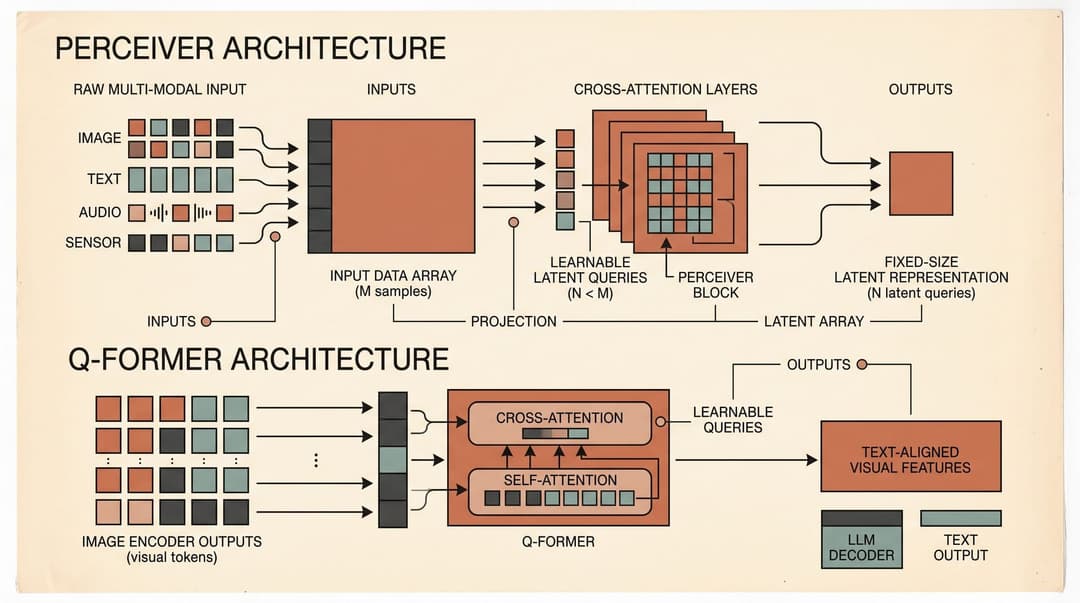
The Perceiver architecture introduces a fixed set of M learnable latent query vectors, denoted Z in R^(M x d_latent), where M is typically small (e.g., 512) and independent of the input size N. The model operates in two distinct phases:
- Asymmetric Cross-Attention: The latent array Z acts as the query Q, while the raw high-dimensional input array X_input in R^(N x d_input) provides keys K and values V. This single cross-attention step distills the N input features into M latent vectors with O(M * N) complexity.
- Latent Self-Attention Backbone: The compressed latent representations Z are processed through a deep stack of standard Transformer self-attention blocks. Because self-attention occurs exclusively within the latent space, the computational cost across L layers is O(L * M^2), completely decoupled from the input dimension N.
To refresh the latent representations across deep architectures, Perceiver models can interleave occasional cross-attention layers throughout the network, allowing the latent states to re-query the input sequence at varying levels of abstraction.
Jaegle et al. (2021) extended this paradigm with Perceiver IO, introducing symmetric cross-attention at the output layer. By defining task-specific output queries (e.g., optical flow coordinates or vocabulary indices), the model uses cross-attention from output queries to final latent states, enabling structured predictions of arbitrary shape without altering the core processing backbone.
Bridging Pre-Trained Foundation Models: Q-Former in BLIP-2
As pre-trained foundation models scaled, end-to-end multimodal training from scratch became cost-prohibitive. However, naive projection of frozen vision encoder representations directly into frozen language models creates context window saturation: high-resolution Vision Transformers produce hundreds or thousands of patch tokens per image, diluting LLM prompt capacity.
To solve this modality gap efficiently, Li et al. (2023) developed BLIP-2, centered around a lightweight Querying Transformer (Q-Former).
The Q-Former employs a set of 32 learnable query embeddings in R^(32 x d). These queries interact through two distinct attention mechanisms within the same block:
- Self-Attention Layers: The 32 query tokens attend to one another and, during multi-task pre-training, share attention with input text tokens.
- Cross-Attention Layers: The query tokens cross-attend to the visual features output by a frozen Vision Transformer (such as EVA-CLIP ViT-g).
The Q-Former is pre-trained in two stages:
- Vision-Language Representation Learning: The queries learn to extract visual representations that align with text through three joint objectives: Image-Text Contrastive Learning (aligning query representations with text representations), Image-Grounded Text Generation (using queries as visual context to decode captions), and Image-Text Matching (binary classification of cross-modal alignment).
- Vision-Language Generative Learning: The output representations of the 32 queries are projected through a linear layer directly into the input embedding space of a frozen LLM (such as Flan-T5 or OPT).
By enforcing a 32-token latent bottleneck, Q-Former filters out visual redundancy, extracting only text-relevant visual semantic features while consuming a fixed, negligible fraction of the downstream LLM context window.
Gated Cross-Attention in Autoregressive LLMs: Flamingo
While Q-Former and Perceiver use latent bottlenecks before feeding features into language models, Alayrac et al. (2022) developed Flamingo to interleave cross-attention directly into pre-trained autoregressive language model layers.
To incorporate multi-image and video conditioning without destabilizing pre-trained language weights, Flamingo introduces two key architectural components:
The Perceiver Resampler
Visual features extracted from a frozen vision backbone vary in length depending on image resolution and video frame counts (often thousands of visual tokens). Flamingo passes these spatio-temporal features through a Perceiver Resampler: a fixed grid of 64 learnable latent queries that cross-attend to the raw visual features, producing a standardized 64-token visual representation per image or video frame.
Gated Cross-Attention Dense Blocks
Flamingo inserts newly initialized cross-attention and feed-forward layers between the frozen layers of a pre-trained language model. To prevent random initialization from degrading the language model's pre-trained distribution at the start of training, the cross-attention blocks employ tanh gating:
y = x + tanh(alpha) * CrossAttention(LayerNorm(x), VisualTokens)
z = y + tanh(beta) * FFN(LayerNorm(y))
The gating parameters alpha and beta are initialized to zero (alpha = 0, beta = 0). Since tanh(0) = 0, the newly inserted layers initially act as identity mappings. During training, backpropagation smoothly scales alpha and beta away from zero, allowing the language model to gradually incorporate visual conditioning features without experiencing catastrophic forgetting of text distributions.
The open-source replication OpenFlamingo (Awadalla et al., 2023) confirmed that zero-initialized gated cross-attention stabilizes large-scale multimodal pre-training across diverse open-weight backbones.
Spatial-Semantic Conditioning in Latent Diffusion Models
Cross-attention is equally fundamental to generative diffusion architectures. In text-to-image synthesis, a spatial denoising network must modulate visual noise predictions based on descriptive natural language prompts.
In Latent Diffusion Models (LDMs) by Rombach et al. (2022), the foundational architecture behind Stable Diffusion, cross-attention connects spatial UNet or Diffusion Transformer intermediate feature maps with text encoder outputs.
Given an intermediate spatial feature map z_t in R^(H x W x C) representing an image at diffusion step t, the tensor is flattened along spatial dimensions into a sequence of length M = H * W. A text prompt is encoded via a frozen CLIP or T5 text encoder into a sequence of token representations X_text in R^(N x d_text).
The cross-attention layer is constructed as:
Q = Flatten(z_t) W_Q,    where Q in R^( (H*W) x d_k )
K = X_text W_K,          where K in R^( N x d_k )
V = X_text W_V,          where V in R^( N x d_v )
The resulting attention matrix A in R^((H*W) x N) maps spatial coordinates directly to semantic text tokens. Each spatial location (h, w) evaluates attention scores across all N words in the text prompt, dynamically gathering relevant attribute and subject features to guide local pixel denoising.
This explicit spatial-to-semantic attention mapping forms the basis for downstream controllable generation frameworks, including prompt-to-prompt editing and spatial condition adapters like ControlNet.
Inference Economics and the Asymmetric KV Cache
In production serving environments, the operational economics of cross-attention differ substantially from autoregressive self-attention.
In standard autoregressive language generation, self-attention requires updating the Key-Value (KV) cache on every single decoding step. As generated sequence length t increases, the KV cache grows by one entry per layer, and memory bandwidth consumption scales with O(t).
In cross-attention architectures, the source conditioning sequence X_src (e.g., visual tokens, document embeddings, or audio representations) is static throughout generation. Consequently, the cross-attention KV cache exhibits unique runtime characteristics:
- Static Precomputation: K_src and V_src are computed exactly once during the prefill phase and stored in GPU High Bandwidth Memory (HBM).
- Zero Cache Growth: During subsequent autoregressive decoding steps, the cross-attention KV cache never expands. The query sequence length for each decode step is strictly M = 1.
- Constant Step Latency: The computational cost of cross-attention during generation is strictly O(1 * N * d_k) per decoding step, eliminating memory reallocation and fragmentation overheads associated with dynamic self-attention KV caches.
Architectural Trade-Offs: Early Fusion vs. Cross-Attention
Modern multimodal systems select between two primary architectural paradigms:
- Early Fusion (Prefix Concatenation): Visual or external tokens are projected linearly and prepended directly to the language model's input token sequence (used in LLaVA and GPT-4V-style architectures). All tokens interact through unified causal self-attention.
- Advantages: Simpler architecture, zero additional parameters, native full self-attention across multimodal contexts.
- Drawbacks: Consumes significant LLM context window capacity; self-attention KV cache scales quadratically with total multimodal token count; higher memory bandwidth consumption during generation.
- Late / Interleaved Cross-Attention: Visual or external features bypass the primary sequence context and are queried exclusively via dedicated cross-attention layers (used in Flamingo and Perceiver).
- Advantages: Decouples input sequence length from LLM context limits; static cross-attention KV cache; preserves exact native language distribution via zero-gated initialization.
- Drawbacks: Introduces additional non-causal attention parameters; requires specialized interleaved training regimes.
Understanding the mathematical constraints and cache behavior of asymmetric cross-attention allows system architects to select optimal fusion strategies based on sequence length, context window constraints, and GPU serving budgets.
Sources
- Attention Is All You Need (Vaswani et al., 2017)
- Perceiver: General Perception with Iterative Attention (Jaegle et al., 2021)
- Perceiver IO: A General Architecture for Structured Inputs & Outputs (Jaegle et al., 2021)
- BLIP-2: Bootstrapping Language-Image Pre-training with Frozen Image Encoders and Large Language Models (Li et al., 2023)
- Flamingo: a Visual Language Model for Few-Shot Learning (Alayrac et al., 2022)
- OpenFlamingo: An Open-Source Framework for Training Large Autoregressive Vision-Language Models (Awadalla et al., 2023)
- High-Resolution Image Synthesis with Latent Diffusion Models (Rombach et al., 2022)
