Archive / page 96 of 123

Latest articles, page 96

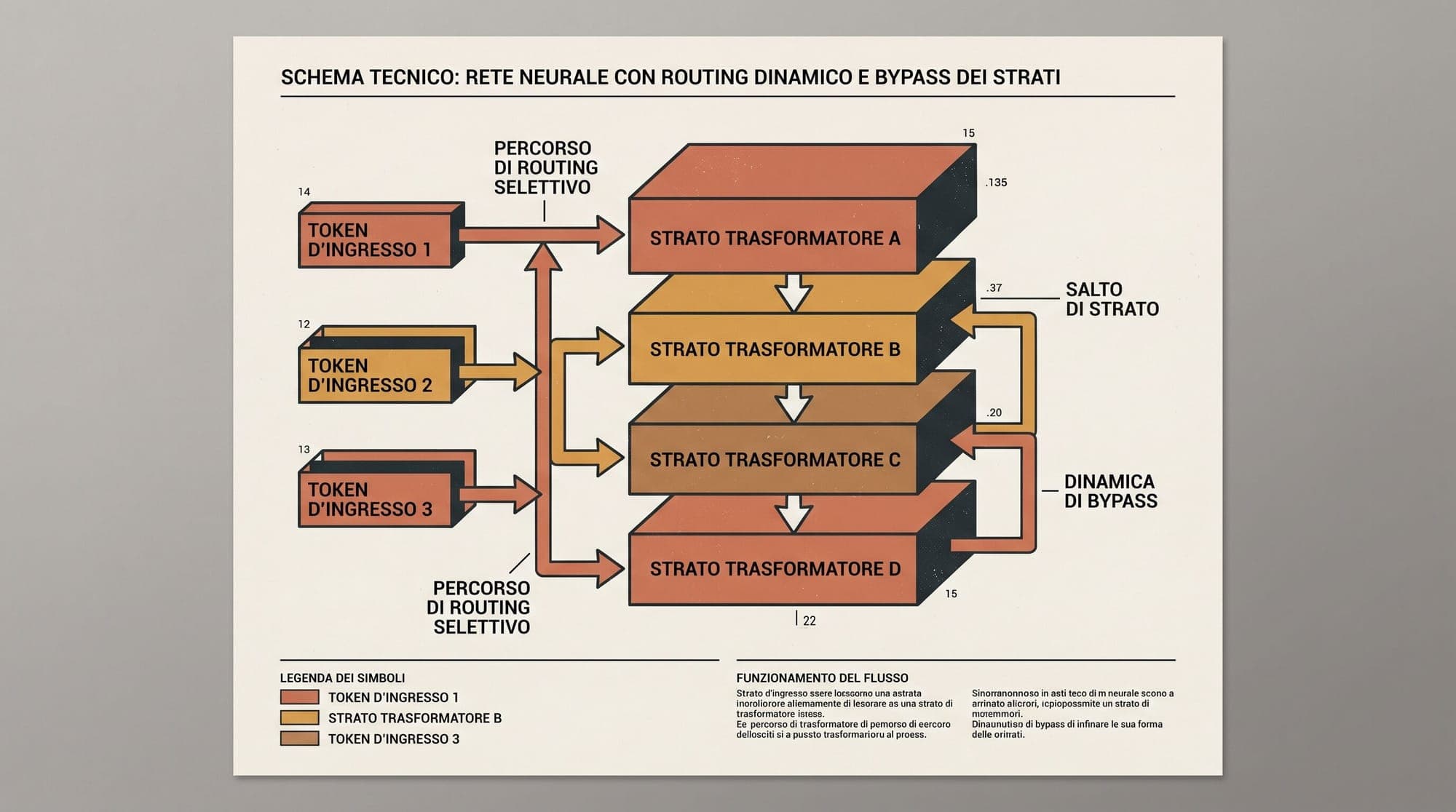
  1. Mixture-of-Depths: How Dynamic Compute Allocation and Layer Skipping Scale LLM Efficiency

    Standard transformer architectures allocate a uniform computational budget to every token in a sequence. Regardless of whether a model is processing a predictable punctuation mark, a common grammatical connective, or a mathematically dense reasoning step, every token undergoes an identical sequence of matrix multiplications across every multi-head attention and multilayer perceptron (MLP) block throughout the network's depth. This static compute distribution is computationally inefficient. Whil

    AI
    6 min read
  2. Smack Technologies Raises $61M Series B to Scale Tactical Edge AI for the Joint Force

    Austin-based defense AI startup Smack Technologies has raised $61 million in a Series B funding round to accelerate deployment of its tactical edge decision systems across the U.S. military. The round was co-led by Costanoa Ventures and First In, with participation from Point72 Ventures, Geodesic Capital, Nomi Capital, Felicis, Sapphire Ventures, Scribble Ventures, Fortitude Ventures, Bloomberg Beta, and Palumni VC. The financing brings Smack's total capital raised to over $90 million and follo

    Defense AI
    2 min read
  3. Defending AI Agents Against Indirect Prompt Injection: Dual-LLM Architectures, Privilege Boundaries, and Information Flow Control

    Autonomous AI agents are increasingly entrusted with system privileges, including terminal execution, API invocation, internal database queries, and automated communications. As agents transition from isolated conversational sandboxes to interconnected tools, they encounter an inherent architectural vulnerability: indirect prompt injection (IPI). When an agent reads untrusted data from the web, an inbound email, an enterprise ticketing system, or a database record, any instructions embedded wit

    AI
    7 min read
  4. Tree-Structured Speculative Decoding: How Multi-Candidate Trees and Tree Attention Accelerate LLM Serving

    Tree-Structured Speculative Decoding: How Multi-Candidate Trees and Tree Attention Accelerate LLM Serving Large language model inference is fundamentally constrained by memory bandwidth during the auto-regressive decoding phase. Because each token generation step requires loading billions of model parameters from high-bandwidth memory (HBM) to compute units for a single token, standard auto-regressive generation operates at low arithmetic intensity. Speculative decoding addresses this bottlene

    Speculative Decoding
    7 min read
  5. Beijing Clears Initial Shipments of 10,000 Nvidia H200 Chips to ByteDance and Tencent

    Chinese regulators have authorized the delivery of initial batches of Nvidia H200 artificial intelligence processors to mainland tech giants, marking a pivotal development in Beijing's management of high-performance compute access. According to reporting from the Financial Times, ByteDance and Tencent have each received roughly 10,000 H200 accelerators at their mainland data center facilities in recent weeks. Several additional domestic technology companies are currently awaiting clearance for

    AI
    1 min read
  6. Durable Execution for AI Agents: Architecture, State Checkpointing, and Failure Recovery

    Autonomous AI agents deployed in production environments frequently fail due to infrastructural instability rather than model reasoning flaws. Standard agent control loops, often structured as in-memory while-loops operating on transient servers or containerized pods, lack persistence across network blips, pod evictions, process restarts, or rate-limit timeouts. When an unhandled process failure occurs mid-task, standard agent architectures restart from scratch. This introduces three severe oper

    AI
    6 min read
  7. FlashDecoding: How Sequence Partitioning Solved the Memory Bandwidth Bottleneck in LLM Generation

    FlashDecoding: How Sequence Partitioning Solved the Memory Bandwidth Bottleneck in LLM Generation In large language model serving, execution divides into two distinct operational regimes: prompt prefill and autoregressive token generation (decoding). While FlashAttention transformed prefill throughput by eliminating High Bandwidth Memory (HBM) round-trips for intermediate attention matrices, standard FlashAttention algorithms encounter a severe hardware utilization bottleneck during decoding.

    AI
    7 min read
  8. Z.ai Opens GLM-5.3 API Access at $1.40/$4.40 per Million Tokens with Prompt Caching

    Chinese foundation model developer Z.ai (Zhipu AI) has opened public API access to GLM-5.3, offering developers direct endpoint integration following the model's initial release. The company kept base token rates aligned with the prior generation while introducing discounted prompt caching. GLM-5.3 is priced at $1.40 per million input tokens and $4.40 per million output tokens on the Z.ai platform. For workloads utilizing prompt caching, cached input tokens are billed at $0.26 per million, an 8

    LLM
    2 min read
  9. Chinese Humanoid Robot Maker Unitree Surges 629% in $904M Shanghai IPO Debut

    Chinese humanoid and quadruped robotics manufacturer Unitree Robotics made its public debut on the Shanghai Stock Exchange STAR Market on Wednesday, August 19, 2026, with shares surging 629% in early morning trading. The listing marks the first pure-play embodied artificial intelligence and humanoid robotics IPO on China's mainland A-share exchange. Unitree priced its initial public offering at 150.80 yuan ($22.36) per share, issuing 40.4 million shares to raise approximately $904 million (4.2

    Robotics
    2 min read