
Autonomous AI agents deployed in production environments frequently fail due to infrastructural instability rather than model reasoning flaws. Standard agent control loops, often structured as in-memory while-loops operating on transient servers or containerized pods, lack persistence across network blips, pod evictions, process restarts, or rate-limit timeouts. When an unhandled process failure occurs mid-task, standard agent architectures restart from scratch. This introduces three severe operational penalties: duplicated LLM inference costs across repeated prefill and completion tokens, accidental execution of non-idempotent side effects such as duplicate API writes or customer communications, and abandoned state in long-running human-in-the-loop workflows.
To eliminate these vulnerabilities, engineering teams are adopting durable execution runtimes. By replacing transient loops with deterministic replay journals, step checkpointing, and durable virtual state, platforms such as Temporal, DBOS, Restate, and Inngest guarantee that multi-step agent trajectories recover from crashes at the exact point of interruption without duplicating executed side effects.
The Failure Modes of Naive Agent Loops
A baseline AI agent loop typically executes a sequential chain of steps: receiving user intent, querying an LLM with accumulated history, parsing tool calls, invoking external APIs, appending tool observations to the context window, and iterating until a completion criterion is satisfied.
In production deployments, this architecture suffers from fundamental reliability defects:
- Compounding Inference Recomputation: Long-running agent tasks involving iterative coding, research, or multi-step data pipelines often take 10 to 45 minutes and consume hundreds of thousands of tokens. If a worker container crashes at step 15 of a 20-step pipeline, restarting from step 1 re-executes 14 expensive LLM calls.
- Non-Idempotent Tool Execution: Agent tools interact with external state through database insertions, webhook deliveries, cloud infrastructure provisioning, and payment gateways. If an agent crashes immediately after dispatching an external mutation but before recording the response in local memory, a restarted loop will re-execute the identical mutation, creating data duplication or corrupt state.
- Suspended Execution Decay: Human-in-the-loop oversight requires agents to halt execution while awaiting human approval, code review, or credential entry. Holding execution state in an active runtime thread or memory buffer across hours or days wastes compute resources and guarantees state loss during routine deployments and container rolling restarts.
Durable execution addresses these issues by decoupling program execution from process lifecycle. The runtime captures every completed step and external interaction in a durable journal, allowing arbitrary worker processes to reconstruct identical state upon recovery.
Core Primitives of Durable Agent Execution
Durable execution runtimes rely on several foundational architectural primitives tailored for distributed systems and asynchronous orchestration:
1. Deterministic Replay vs. Step Journaling
Durable execution systems record execution progress through two primary mechanisms:
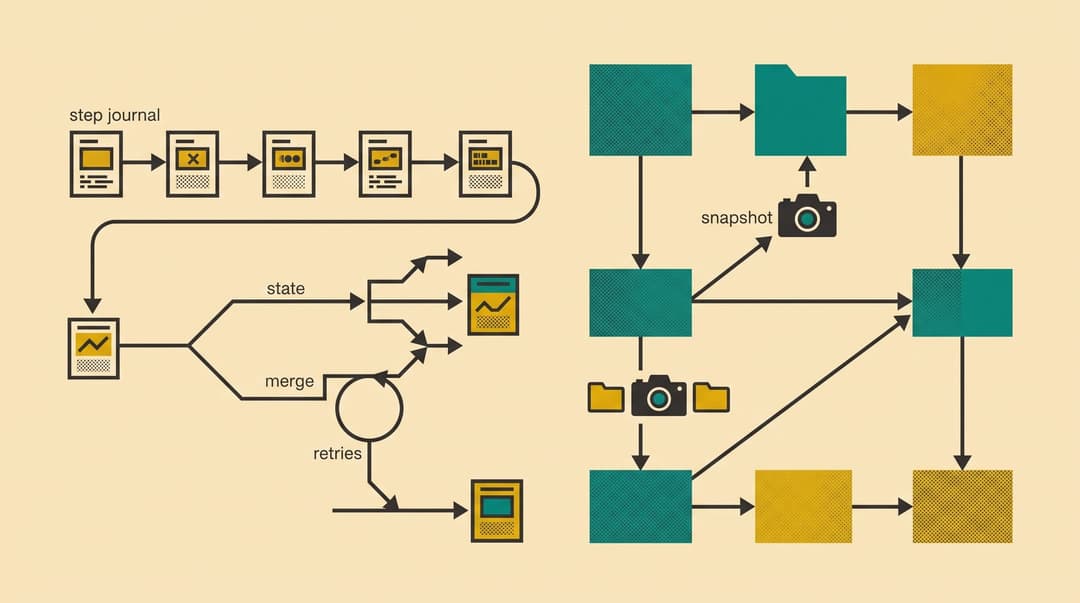
- Event-Sourced Deterministic Replay: Frameworks like Temporal record every external input and activity completion in an immutable event history log. When a worker recovers from a crash, it re-executes the workflow function from the beginning. During replay, calls to previously completed external tasks (activities) are intercepted by the runtime, which returns the recorded output from the event history instead of re-executing the code. This requires workflow orchestration code to be strictly deterministic; any non-deterministic logic, such as random number generation, system time lookups, or direct network requests, must be isolated within activities.
- Explicit Step Checkpointing: Libraries such as DBOS Transact and Restate record step completions directly in transactional relational tables or distributed logs. When a step function completes, its output is committed alongside the execution pointer. On recovery, the runtime jumps directly to the last uncommitted step, eliminating the need to replay preceding code blocks.
2. Side-Effect Memoization and Exactly-Once Tool Semantics
Because LLM completions are non-deterministic, LLM API calls must always be wrapped in durable step boundaries. In durable runtimes, external tool executions and model queries are isolated inside atomic activities or step closures. The runtime assigns an idempotency key to each step based on the workflow identity and sequence position. Once a step succeeds, its serialized return value is stored in the persistent journal. Subsequent executions within the same workflow instance bypass execution and read directly from the journal.
3. Durable Timers and Suspended Promises
Durable runtimes provide native primitives for long-duration waiting. When an agent requires human validation, it creates a durable promise or waits on an external signal. The engine suspends the execution, persists the current step index to disk, and completely unloads the agent from active memory. When the approval arrives via webhook or API signal days later, the runtime re-hydrates the workflow and resumes execution seamlessly.
4. Large Payload Offloading via Content-Addressed Storage
A critical constraint in durable execution is payload size management. Traditional workflow engines enforce strict message size limits across internal gRPC transports and event stores. For example, Temporal enforces a default 2 MB payload size limit and 4 MB gRPC message limit.
Modern LLM workflows frequently handle multi-megabyte payloads, including large codebase extracts, 128k-token conversation histories, and raw tool outputs. Passing these directly through workflow state logs triggers serialization timeouts and message size rejections.
To resolve this bottleneck, production architectures deploy a Large Payload Codec using Content-Addressed Storage (CAS). Payloads exceeding a threshold (typically 128 KB) are transparently intercepted by SDK data converters, uploaded to cloud object storage (such as Amazon S3, Google Cloud Storage, or Redis), and replaced in the workflow event history with a lightweight metadata pointer containing the object SHA-256 hash and URI. When downstream activities or replay loops read the payload, the codec server fetches and reconstitutes the object transparently.
Architectural Comparison of Durable Runtimes
Engineering teams have four primary runtime options for implementing durable agent workflows, each representing distinct operational trade-offs:
Temporal: Clustered Event Sourcing
Temporal provides an enterprise-grade orchestration platform built around event-sourced replay and strict activity separation. Workflows are sandboxed to enforce determinism, while activities handle external network I/O and LLM queries.
- Storage & Infrastructure: Requires a dedicated Temporal Cluster (backed by Cassandra, PostgreSQL, or MySQL) or managed Temporal Cloud.
- Strengths: Robust support for long-running workflows spanning months, granular retry policies, child workflow hierarchies, and comprehensive distributed tracing.
- Weaknesses: Significant operational overhead when self-hosting, strict determinism rules that complicate arbitrary Python or TypeScript scripting, and mandatory payload codec integration for large context windows.
DBOS Transact: Lightweight Postgres-Native Durability
Originating from MIT and Stanford database systems research, DBOS Transact operates as an embedded code library that persists workflow state and step checkpoints directly into an existing PostgreSQL database.
- Storage & Infrastructure: Zero dedicated orchestration servers; relies entirely on standard PostgreSQL tables.
- Strengths: Seamless transactional boundaries where application database updates and agent step checkpoints commit in the same ACID transaction. Low operational barrier for teams already running PostgreSQL.
- Weaknesses: Lacks dedicated visual orchestration consoles of standalone workflow clusters; throughput is bounded by PostgreSQL write capacity on high-frequency step commits.
Restate: Event-Driven Durable RPC and Virtual Objects
Restate combines durable execution with a stateful actor model through Virtual Objects. Each agent session or user interaction can be modeled as a distinct virtual object with an isolated key, providing automatic request serialization and transactional state management.
- Storage & Infrastructure: Deployed as a single lightweight Go binary or consumed via managed cloud.
- Strengths: Native support for conversational agent sessions, exactly-once tool semantics through
ctx.run()journaling, built-in concurrency controls, and seamless deployment across serverless and Kubernetes environments. - Weaknesses: Relatively new ecosystem with a smaller integration catalog than legacy workflow orchestration engines.
Inngest: Serverless Event-Driven Orchestration
Inngest provides event-driven step execution designed specifically for serverless architectures, such as Next.js, AWS Lambda, and Cloudflare Workers.
- Storage & Infrastructure: Managed cloud coordinator with SDK endpoints embedded directly in serverless routes.
- Strengths: Minimal configuration required; steps are defined inline with standard async TypeScript or Python functions. Automatic step retries and flow control without running daemon workers.
- Weaknesses: Dependent on external synchronization infrastructure; higher latency per step transition compared to co-located single-binary engines.
Architectural Trade-Off Matrix
When selecting a durable execution framework for AI agents, teams must balance operational complexity, storage locality, and programming ergonomics:
- Temporal: Best for large-scale enterprise agent swarms requiring multi-language support, complex sub-agent trees, and multi-week lifecycles. Requires external payload storage and dedicated cluster administration.
- DBOS Transact: Best for backend teams with existing PostgreSQL infrastructure who want durable agent execution without maintaining separate orchestration clusters. Ideal for data pipelines and database-centric agent operations.
- Restate: Best for low-latency conversational agents, multi-agent virtual actors, and microservice architectures requiring per-session state serialization and single-binary simplicity.
- Inngest: Best for web applications and serverless architectures where developer velocity and frictionless setup take precedence over low-level infrastructure control.
Production Implementation Guidelines
Deploying durable agent execution requires adhering to several architectural rules:
- Strictly Segregate LLM Calls from Workflow Roots: Never execute raw LLM API calls directly inside deterministic workflow functions. Wrap every model generation in an activity, step closure, or durable execution block (
ctx.run()in Restate,@DBOS.step()in DBOS, or@activity.defnin Temporal) so that completions are memoized in the journal. - Implement Large Payload Codecs Early: Establish automated threshold-based payload offloading to object storage before reaching production context sizes. Inspecting raw 100k+ token histories in database logs degrades database indexing performance and triggers transport errors.
- Calibrate Checkpoint Granularity: Avoid checkpointing every microscopic string manipulation. Structure checkpoints around coarse-grained semantic operations: prompt assembly, LLM completion, tool execution, and state aggregation. This minimizes serialization overhead while safeguarding critical execution boundaries.
- Decouple Agent Memory from Workflow Logs: Use durable execution to track execution state and tool trajectories, but persist long-term semantic knowledge in dedicated vector databases or semantic stores. Workflow histories should capture execution mechanics, not serve as a permanent unbounded knowledge base.
Sources
- Temporal: Why Temporal is the Foundation for AI
- Temporal Platform Documentation: Blob Size and Payload Limits
- DataDog: Temporal Large Payload Codec Service
- DBOS Transact: Open Source Durable Execution Library
- Restate: What is Durable Execution? Architecture Guide
- ZenML: Inngest Alternatives and Durable Execution for AI Agents
