
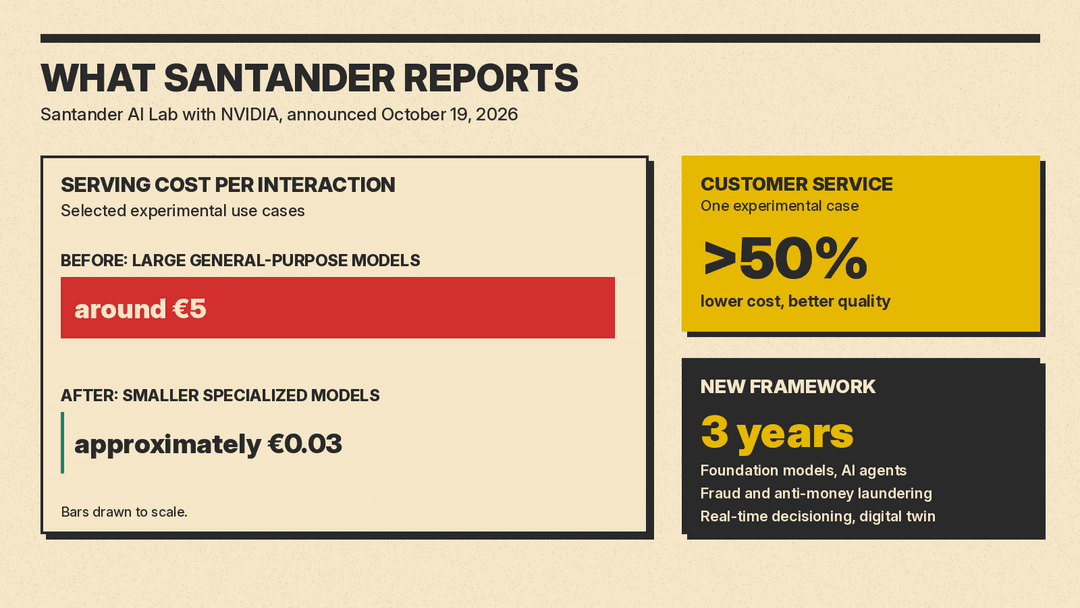
Banco Santander says its AI Lab has cut the cost of serving some AI interactions from around €5 to approximately €0.03, by moving away from large general-purpose models toward smaller models built for specific banking tasks. The bank announced the result on October 19, 2026, alongside a new three-year collaboration framework with NVIDIA, which supplied the tools behind the work.
The headline number comes with a qualifier that matters. According to Santander's press release, the €5 to €0.03 drop applies to "selected experimental use cases." In a separate experimental customer-service case, the bank says it improved conversation quality while reducing costs by more than 50%. Neither figure describes the bank's production AI bill as a whole.
What Santander actually built
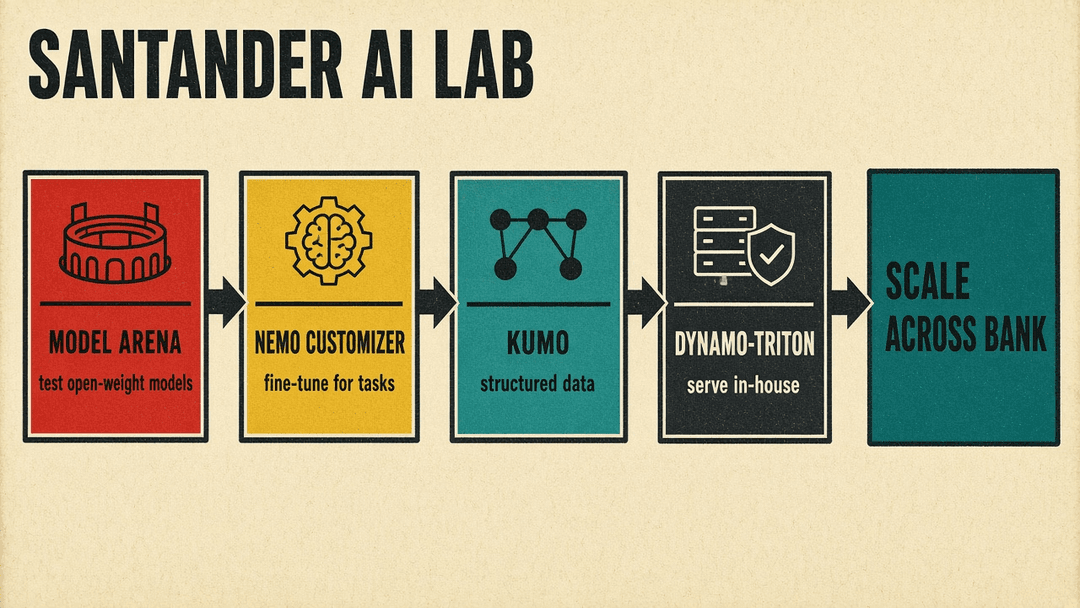
The work runs through Santander AI Lab, the group that tests emerging AI technology before the bank rolls it out more widely. The release describes four pieces:
- Model Arena. A system Santander built to evaluate open-weight models against banking tasks, so the bank can pick the right model for each workload. Santander says it is also developing Model Arena to design, simulate, evaluate and supervise banking agents.
- Specialized models. The bank is fine-tuning models for specific tasks with NVIDIA NeMo Customizer.
- Structured-data models. Santander has built what it calls specialized intelligence for core banking workloads on NVIDIA Kumo, which the release describes as a family of open-weight foundation models for structured data.
- Serving inside its own stack. The Lab is running inference within Santander's own architecture using NVIDIA Dynamo-Triton. The bank says this is the approach behind the serving-cost reduction.
The Lab also does performance engineering and adversarial testing of conversational AI in controlled environments. Santander describes the goal as a rigorous experimentation path: capabilities get optimized and stress-tested against banking requirements before they scale across the group.
Why smaller models cut the bill
The reasoning is straightforward. A general-purpose frontier model is built to handle almost anything, and a bank pays for that breadth on every call. A routine customer-service question does not need it. A smaller model, fine-tuned on the bank's own data and checked against real banking tasks, can handle that narrow job for far less compute per answer.
NVIDIA's global banking lead, Aser Blanco, put it this way in the release: "Transforming years of data into usable and proprietary intelligence is not about model size, but about training and fine tuning. In this new world, cost per intelligence output is a key metric."
That framing suits NVIDIA, which sells the hardware and software for both large and small models. But it also matches a shift away from loyalty to any single model vendor. We argued in an opinion piece on model routing that the advantage goes to companies that can measure models against their own tasks and switch between them. Model Arena is a bank-built version of that idea.
What the three-year framework covers
The next phase of the collaboration covers foundation models, AI agents, fraud and anti-money laundering capabilities, real-time decisioning, and advanced simulation technologies, including a banking digital twin, according to the release. Santander says it is moving from open-weight models toward specialized models and "governed banking agents designed for greater control, safety and lower operating costs at scale."
Iñaki Bernal, Santander's chief artificial intelligence officer, said in the release that combining NVIDIA's technology with "Santander's scale across businesses, customers and geographies" puts the bank, he believes, in a position to turn those advances "into practical banking capabilities."
How it fits Santander's AI targets
Computer Weekly reports that at an investor event in February, Santander presented a 2026 to 2028 plan to use AI to deliver €1bn in business value through cost cuts and revenue growth. Ricardo Manjón, the bank's chief data and AI officer, said €35m of that was achieved in the first three months of this year and that the bank expects to reach €200m by the end of the financial year, according to the same report.
Santander is not the only bank working with NVIDIA on customer service. Computer Weekly notes that NatWest Group said last week it is using NVIDIA's AI technology in a voice-based customer service tool that is being tested with 75% of Royal Bank of Scotland customers.
Why it matters
For banks, the cost of running AI is starting to matter as much as what the models can do. A customer-service assistant that costs euros per conversation is hard to justify at a large bank's volume. One that costs cents changes the math.
Three caveats apply. The biggest saving is from experimental cases, not production. Santander has not published the models it compared, the tasks, or how it measured quality. And the announcement is a joint release with the vendor whose tools produced the result. The useful signal is the method: test open-weight models on your own tasks, fine-tune the winners, and serve them on your own infrastructure.
Agents are the next step, and banks are being careful there. Customer-facing agents that move money raise harder questions about access and identity, which we covered in our explainer on how AI agents get into your accounts. That may be why Santander's release describes its future agents as "governed."
