
Siemens has shown what it calls "currently unique" AI tools, tested in live production at its electronics factory in Erlangen, Germany, built with NVIDIA. The company says one workflow cuts engineering effort for new circuit board assemblies by up to 85 percent, and an AI agent for production planning can save up to 20 percent in costs. Both figures come from Siemens' own press release, and both are "up to" claims. Here is what the two systems do, what powers them, and what the announcement does not say.
What was announced
Siemens and NVIDIA said at CES in January 2026 that they would build what they called the world's first fully AI-powered manufacturing sites. On October 19, Siemens unveiled new AI solutions at its Erlangen Electronics Factory, which it describes as a "living lab" and a blueprint for scaling the tools to other industries. According to Siemens, the joint team developed the first new AI offerings in less than ten months and tested them in live production. Siemens says further applications are planned in the coming months. NVIDIA is working with other sectors too: the same day, Santander said it cut the cost of some experimental AI interactions with smaller models and NVIDIA tools.
The plant itself is a long-running test site. It opened in 1971, employs about 1,000 people, and makes power electronics and automation technology. Siemens says more than 100 AI algorithms are already in use there across production, logistics, quality inspection and maintenance, and it plans to invest €500 million in the site through 2030.
Tool 1: inspection systems trained before the prototype exists
The first workflow targets new printed circuit board (PCB) assemblies, which Siemens calls the core of the drives and frequency converters made in Erlangen.
The old bottleneck, per Siemens: preparing quality inspection took several weeks, because teams had to wait for physical prototypes before they could train the vision systems and configure the inspection equipment by hand.
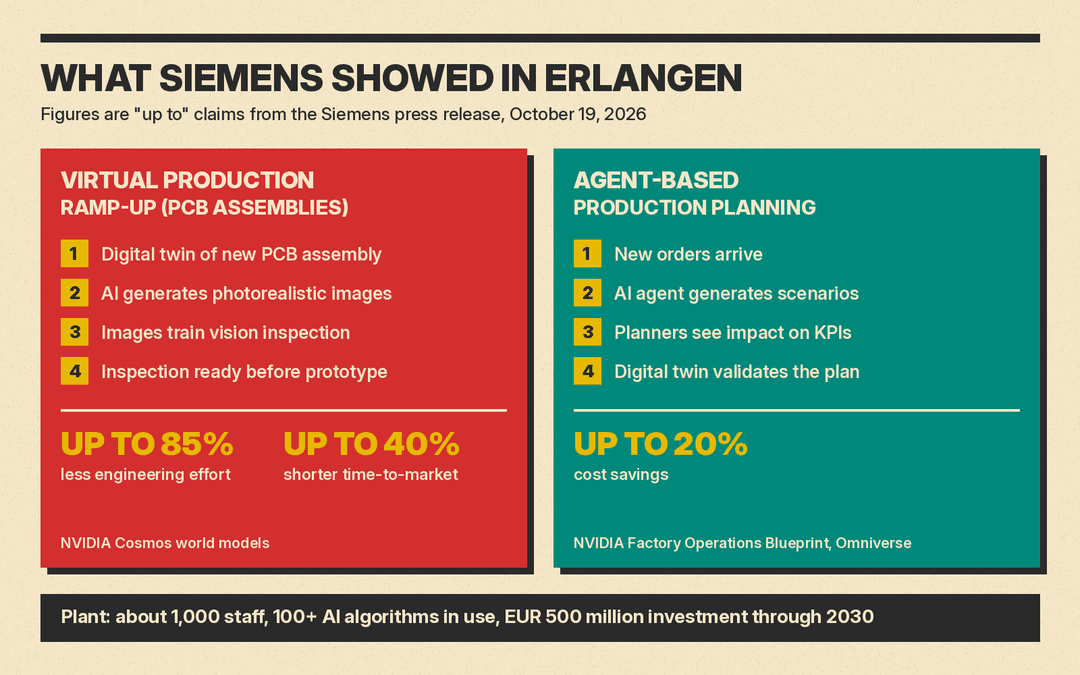
The new process starts from the digital twin of the board. AI generates photorealistic representations of the PCB assembly from that twin, and those train the vision inspection system. Engineers can then prepare inspection before any physical prototype is available. Siemens says this virtual production preparation can reduce engineering effort by up to 85 percent and cut time-to-market by up to 40 percent.
On the NVIDIA side, the release says NVIDIA Cosmos world models generate the realistic training data for quality inspection.
Tool 2: an AI agent that drafts production plans
The second workflow is production planning: balancing capacity, material availability, delivery dates and production lines when orders change. Siemens says planners used to weigh these factors based on their own experience.
Now, when new orders arrive, an AI agent automatically generates several production scenarios and shows planners the impact of each option against defined KPIs. Before any plan goes live, it is validated against a digital twin of the whole facility. Siemens says this end-to-end, agent-based planning can enable cost savings of up to 20 percent and lets the plant respond more flexibly to new orders, material shortages or shifting customer requirements.
The release credits the NVIDIA Factory Operations Blueprint for supporting the planning agents, and NVIDIA Omniverse libraries for testing those plans virtually with real factory data. As Siemens describes it, the agent proposes options and planners see the impact of each one.
The bigger target: 70 to 80 percent automation
Siemens board member Cedrik Neike framed the work in European terms. "The historic opportunity for Germany and Europe lies in bringing artificial intelligence out of the data centers and into the factories," he said in the release, adding that Erlangen has an annual productivity increase of seven percent.
Speaking at the plant, Neike said AI could help preserve manufacturing jobs in high-wage countries such as Germany, Reuters reported. He said manufacturers need annual productivity gains of 7 to 9 percent to stay competitive, and that Siemens aims to use AI to raise factory automation to 70 to 80 percent, from 30 to 40 percent today.
NVIDIA's Rev Lebaredian, vice president of Physical AI Simulation, described the same approach in the release: "training inspection systems before physical prototypes exist, designing and testing production plans in simulation before changing the real world."
According to Dow Jones, the announcement came as an investment summit between NVIDIA, the German government and German business leaders began in Berlin.
What the numbers do and do not tell you
The figures are useful as direction, not as a forecast for another factory.
- They are ceilings. Each figure is "up to." Siemens does not give an average, a range, or how many PCB assemblies or planning cycles they were measured on.
- No baseline is given. The release says inspection prep "previously took several weeks" but does not give the new duration in hours or days.
- One plant, one product family. The ramp-up result is for new PCB assemblies at a site that has tested digital manufacturing for more than a decade. A plant without detailed digital twins would likely need to build those first.
- No product details yet. The release calls these "AI offerings" but does not say when other manufacturers can buy them, what they cost, or which Siemens software they ship in.
Why it matters
The notable part is where the AI sits: before production starts. Training inspection on AI-generated images removes the wait for a prototype, and checking plans on a digital twin is meant to catch problems before the real line changes. For manufacturers, the practical takeaway is that both tools depend on an accurate digital twin. That, more than the AI model, is likely to be the gating item for anyone trying to copy Erlangen. Simulation also has limits: in a recent study of GPT-6 Astra on robot tasks, results that held up in simulation ran into cost, time and safety limits on real robots.
Sources
- Siemens: Siemens partners with NVIDIA to advance AI-driven, autonomous factories (press release, Oct 19, 2026)
- Reuters via StreetInsider: Siemens targets up to 80% factory automation with AI, board member says
- Dow Jones via MarketScreener: Siemens and Nvidia Develop AI-Driven Factory Automation Technology
