
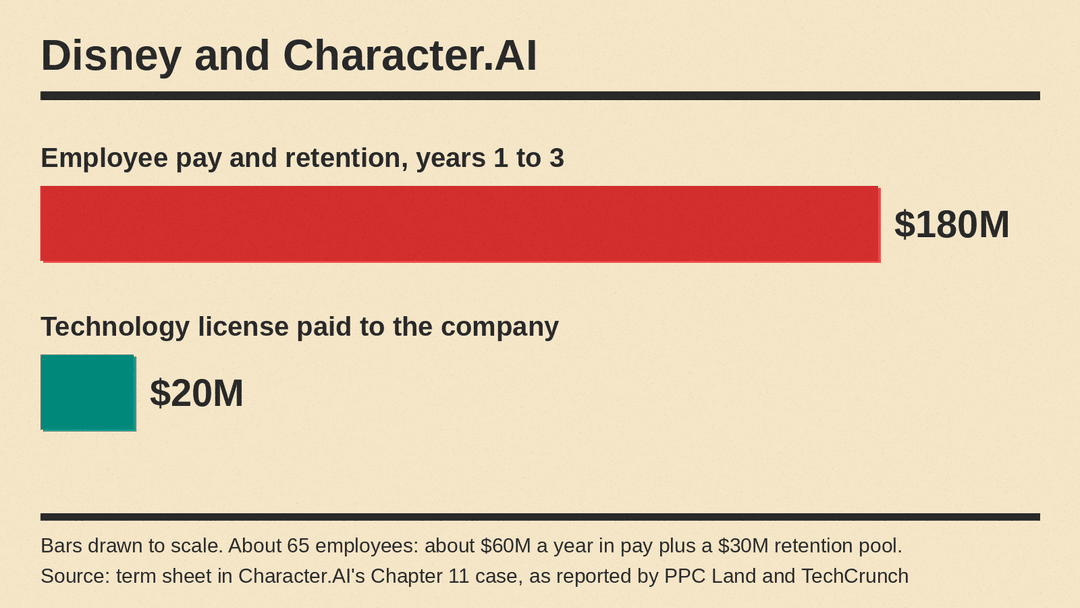
Disney expects to spend about $180 million over three years on pay and retention for the Character.AI employees it is hiring, while the bankrupt chatbot company itself would receive $20 million for a license to selected technology. The figures come from a term sheet filed in Character.AI's Chapter 11 case in the US Bankruptcy Court for the District of Delaware, first reported by Bloomberg and detailed by TechCrunch and PPC Land.
The split is the story. Disney is paying roughly nine times as much for the people as it is paying the company they are leaving.
What the filing says
Under the term sheet, Disney committed to offer jobs to "at least sixty (60) other Company employees" beyond a group of up to six key employees, one of them the chief executive. Based on about 65 offered employees, Disney estimates their annual run rate total compensation at about $60 million. It adds a $30 million retention pool, paid on the first and second anniversaries of hiring and conditional on staff staying. "The estimated total compensation and retention over years 1-3 is estimated to be approximately US$ 180 million," the document states, as quoted by PPC Land.
That money goes straight to employees. The term sheet says it "will not constitute consideration payable to the Company," which means Character.AI's creditors have a claim on the $20 million license fee, not on the $180 million. According to TechCrunch, the filing says the "vast majority" of employees who received offers accepted them. PPC Land, citing earlier filings, reports that 66 of the company's 86 employees have moved to Disney.
Character.AI's former CEO, Karandeep Anand, recently became Disney's first chief technology officer, TechCrunch notes. The motion addresses the hiring of an "insider" in a footnote and argues the deal was run by committees made up only of independent members.
What $20 million buys, and what it does not
The $20 million is structured as a stalking horse bid, which sets a floor that other bidders can top at auction. Disney paid a non-refundable $5.5 million up front on September 18 and a $2 million deposit the same day, with the remaining $12.5 million due at closing, according to PPC Land's reading of the exhibits.
The license covers code behind Character.AI's post-training stack, safety classifiers, inference and serving infrastructure, an age prediction model, and nine patents. It does not include the consumer app, the brand, user data, chat logs or the finished models. Those stay in the bankruptcy estate for any other buyer. PPC Land reports that if no rival bidder emerges, Disney's deal proceeds and the app is expected to shut down. The company has asked the court to hear the bidding procedures motion on shortened notice, citing "limited liquidity and substantial monthly cash burn."
The filing describes why the company ended up here: despite a "large and engaged user base," Character.AI has been weighed down by high costs and "potential litigation-related liabilities and regulatory engagement," per TechCrunch. TechCrunch also notes the company was sued by a parent after a teenager's death and faces government investigations over child safety.
The acqui-hire pattern, round two
This is the second time a large company has hired Character.AI talent while leaving the company itself behind. In August 2024, Google struck a $2.7 billion licensing deal that brought Character.AI's founders to Google, as PPC Land recounts. That deal became a template for what is now a common structure in AI: license the technology, hire the team, and skip a formal acquisition along with its liabilities and regulatory review.
The Disney version shows the economics more plainly than most, because a bankruptcy court requires the terms to be disclosed. The employees, their pay and the know-how in their heads carry most of the value. The consumer product, with its user data and legal exposure, is the part nobody has yet paid for. The term sheet also has Character.AI waive non-compete and confidentiality covenants for departing staff and release them from claims, including fiduciary duty claims, which removes the main legal hurdles to the move.
Why it matters
For Disney, the deal buys an in-house AI engineering group with experience running a consumer chatbot at scale, including safety and age assurance systems, at a time when entertainment companies are working out how to put interactive characters in front of audiences. The cost is about $60 million a year in compensation plus the retention pool, with no assumption of the app or its liabilities.
For the AI startup market, it is another data point that talent can be priced separately from the company that employs it, and that in distressed cases the gap can be wide. Investors in consumer AI apps carrying litigation risk now have a public example of how value gets divided when things go wrong: staff and licensed code leave on negotiated terms, while equity holders and creditors compete for what remains. Other companion apps are still raising money: Tolan raised $30 million on October 19.
The bidding procedures still need court approval, and a rival bid could change the outcome for the app, though not the hiring already under way.
Sources
- TechCrunch: Disney agrees to hire the majority of Character.AI's workforce
- PPC Land: Disney budgets $180m for Character.ai staff, $20m for the bankrupt company
- RuntimeWire: Disney estimates $180M in pay and retention for Character.AI hires
- Court filing, US Bankruptcy Court for the District of Delaware (via Stretto)
- Techmeme item summarizing Bloomberg's report
