

Standardized evaluation is the bedrock of LLM development, yet production evaluation pipelines face a split between two distinct paradigms: static, deterministic multi-task benchmarks evaluated via log-likelihood or exact string matching, and dynamic, open-ended instruction-following benchmarks evaluated via LLM-as-a-Judge pairwise win rates.
Engineering teams building pre-training runs, fine-tuning recipes, and model alignment loops require distinct tooling for each paradigm. Four open-source frameworks dominate modern LLM benchmarking pipelines: EleutherAI lm-evaluation-harness, Hugging Face Lighteval, AlpacaEval 2.0, and LMSYS Arena-Hard-Auto. Each makes specific architectural trade-offs across execution backends, token costs, bias mitigation, and correlation with human preferences.
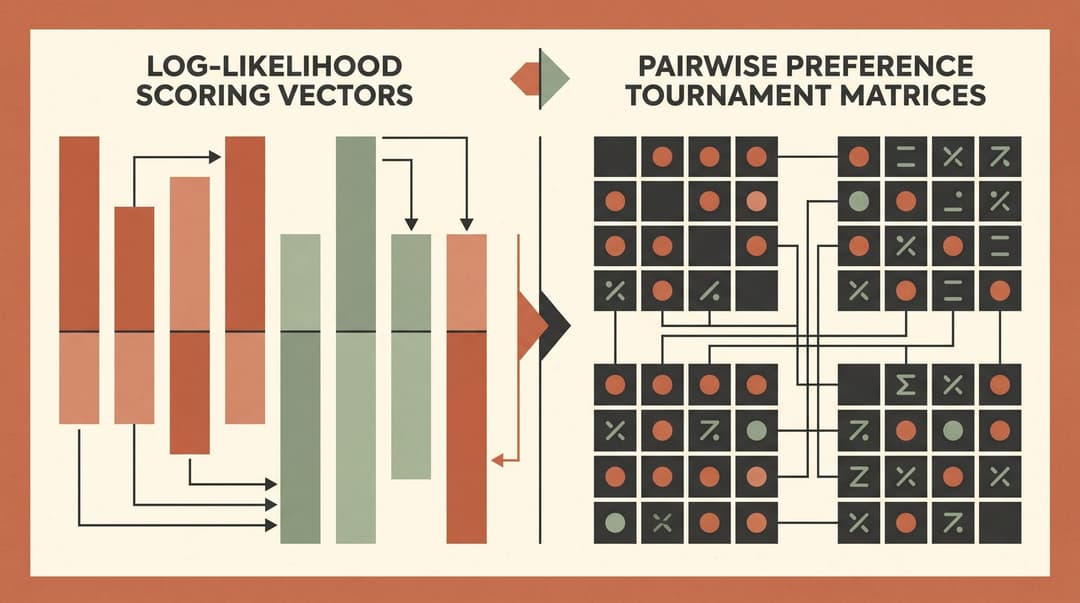
The Two Evaluation Paradigms
Production LLM evaluation divides cleanly across two operational tiers:
- Static Multi-Task and Log-Likelihood Harnesses (lm-eval, Lighteval): These tools measure core capabilities such as knowledge recall, mathematical reasoning, syntactic comprehension, and code generation across standardized datasets like MMLU, GSM8K, ARC, and HumanEval. Evaluation relies on deterministic metrics including token log-probabilities (for multiple-choice tasks), exact string extraction, or automated unit test execution.
- Generative Pairwise Judge Harnesses (AlpacaEval 2.0, Arena-Hard-Auto): These tools measure subjective instruction-following quality, conversational nuance, formatting fidelity, and helpfulness on open-ended queries. Evaluation relies on frontier judge models (such as GPT-4-Turbo or GPT-4o) scoring model completions against fixed reference baselines.
1. EleutherAI lm-evaluation-harness
Developed and maintained by EleutherAI, lm-evaluation-harness (often invoked as lm-eval) is the standard framework for evaluating foundation language models across academic datasets.
Key Architectural Characteristics
- YAML-Driven Task Configuration: Over 200 standard benchmarks are configured as modular YAML files specifying prompt templates, few-shot exemplars, metric extractors, and dataset splits.
- Log-Likelihood and Generative Execution: Supports native log-likelihood evaluation over token sequences for multiple-choice tasks (calculating normalized token probabilities across candidate continuations) as well as greedy and sampling-based generative completions.
- Broad Backend Interoperability: Connects natively with Hugging Face
transformers,vLLM,SGLang,Megatron-LM,DeepSpeed, and major inference APIs (OpenAI, Anthropic, Cohere, Bedrock). - Metric Normalization: Implements length-normalized log-likelihood (dividing total sequence log-probability by target token count) to prevent probability penalization on longer completion candidates.
Production Trade-offs
- Strengths: Unrivaled reproducibility, extensive task coverage, and low computational overhead when evaluating base pre-training checkpoints via log-probabilities without generating new tokens.
- Limitations: Multiple-choice log-likelihood evaluation does not capture chat and instruction-following nuances. Chat template handling across varied tokenizers requires careful configuration to avoid prompt format drift.
2. Hugging Face Lighteval
Developed by Hugging Face's Open R&D and Leaderboard team, Lighteval is a lightweight, modular evaluation toolkit engineered to power the Hugging Face Open LLM Leaderboard v2.
Key Architectural Characteristics
- Optimized Execution Engines: Built for high-throughput batching across local GPU clusters and distributed inference servers. Supports native
vLLM,TGI(Text Generation Inference), Hugging Face Inference Endpoints, andAcceleratemulti-GPU pipelines. - Modern Benchmark Suite: Implements modern, contamination-resistant benchmark configurations including MMLU-Pro, GPQA Diamond, MuSR, MATH-Hard, and IFEval (Instruction Following Evaluation).
- Python-First Task Definitions: While supporting declarative configurations, Lighteval enables programmatic prompt curation and custom metric definitions in pure Python without deep YAML nesting.
- Direct Hugging Face Hub Integration: Pushes structured evaluation artifacts, per-prompt model logs, and metric summary cards directly to private or public Hugging Face Hub datasets and model repositories.
Production Trade-offs
- Strengths: High throughput on local GPU clusters via direct vLLM integration, streamlined deployment for Hugging Face-centric workflows, and strict support for modern hard benchmarks.
- Limitations: Smaller historical task catalog compared to EleutherAI lm-eval, though actively expanding with modern post-2024 benchmark suites.
3. AlpacaEval 2.0 (Length-Controlled)
Maintained by the Stanford Center for Research on Foundation Models (CRFM) and Tatsu Lab, AlpacaEval 2.0 provides automated, cost-effective instruction-following evaluation using an LLM-as-a-Judge design.
Key Architectural Characteristics
- 805 Diverse User Prompts: Curated from real-world instruction datasets, including AlpacaFarm, Self-Instruct, OpenAssistant, Vicuna, Koala, and Anthropic HH-RLHF.
- Length-Controlled (LC) Win Rate: Addresses the known verbosity bias of LLM judges (where longer responses receive artificially inflated preference scores) by fitting a generalized linear model (GLM) conditioned on output length. The resulting metric estimates preference as if both candidates had equal length.
- High Human Agreement: Achieves a 0.98 Spearman rank correlation with LMSYS Chatbot Arena human preference rankings while eliminating length-gaming vulnerabilities.
- Inference Economics: Evaluates complete model runs in under 3 minutes for less than $10 in judge API credits against a standard reference baseline (GPT-4-Turbo).
Production Trade-offs
- Strengths: Fast turnaround, low financial cost, and robust length-debiasing make it suitable for continuous integration (CI) quality gates during post-training RLHF and DPO alignment.
- Limitations: Relies on relatively simple, single-turn instructions; less effective at measuring deep multi-step mathematical reasoning or complex tool use compared to specialized harnesses.
4. LMSYS Arena-Hard-Auto
Developed by LMSYS Org, Arena-Hard-Auto is an automated pipeline designed to evaluate models against hard, complex real-world queries extracted from live LMSYS Chatbot Arena interactions.
Key Architectural Characteristics
- 500 Hard Queries: Mined from over 200,000 real-world Chatbot Arena prompts using prompt quality classifiers and topic diversity filtering, targeting complex reasoning, domain-specific coding, structured analysis, and nuanced writing.
- Standardized Reference Baseline: Evaluates candidate completions against fixed baseline generations (default: GPT-4-0314) using GPT-4-Turbo or GPT-4.1 as the judge.
- High Model Separability: Distinguishes performance differences among top-tier frontier models where older benchmarks suffer from ceiling effects.
- Strong Human Elo Correlation: Exhibits an 82.6% to 89.1% agreement rate with live Chatbot Arena crowdsourced human tournament rankings.
Production Trade-offs
- Strengths: Excellent differentiation among frontier-class models; realistic prompts reflect authentic user distribution and challenging tasks.
- Limitations: Higher judge token consumption per query due to detailed prompts and lengthy model outputs; requires reliable access to frontier judge API keys.
Architectural and Operational Comparison
- EleutherAI lm-eval:
- Primary Metric: Log-likelihood, Exact Match, Pass@k
- Evaluation Paradigm: Static multi-task academic benchmarks
- Supported Backends: Transformers, vLLM, SGLang, Megatron, APIs
- Primary Cost Driver: Local GPU compute hours
- Target Workflow: Foundation model pre-training, checkpoint ablation
- Hugging Face Lighteval:
- Primary Metric: Log-likelihood, Normalized Accuracy, IFEval rule checks
- Evaluation Paradigm: Standardized leaderboard benchmarks (MMLU-Pro, GPQA)
- Supported Backends: vLLM, TGI, Accelerate, HF Endpoints
- Primary Cost Driver: Local GPU compute hours
- Target Workflow: Leaderboard verification, automated regression tests
- AlpacaEval 2.0:
- Primary Metric: Length-Controlled (LC) Win Rate
- Evaluation Paradigm: Pairwise LLM-as-a-Judge on general instructions
- Supported Backends: OpenAI API, Anthropic API, local endpoint models
- Primary Cost Driver: API judge tokens (under $10 per run)
- Target Workflow: Post-training alignment (SFT, DPO, RLHF), CI quality gates
- LMSYS Arena-Hard-Auto:
- Primary Metric: Pairwise Win Rate against fixed baseline
- Evaluation Paradigm: Pairwise LLM-as-a-Judge on 500 hard real-world queries
- Supported Backends: OpenAI API, vLLM, Anthropic API
- Primary Cost Driver: API judge tokens ($15 to $30 per run)
- Target Workflow: Frontier model benchmarking, release candidate qualification
Production Implementation Recommendations
- Pre-Training and Early Intermediate Checkpoints: Deploy EleutherAI lm-eval with local vLLM or Hugging Face backends. Evaluating raw log-likelihood over MMLU, ARC-Challenge, and GSM8K tracks base representation quality without incurring generative decoding latency or API judge costs.
- Open Leaderboard and Benchmark Standardization: Deploy Hugging Face Lighteval within cluster orchestration pipelines. Lighteval's native vLLM integration and built-in modern task suites (MMLU-Pro, GPQA Diamond, IFEval) ensure alignment with Open LLM Leaderboard standards.
- Alignment Loops and Continuous Integration (CI): Integrate AlpacaEval 2.0 into automated training pipelines for SFT, DPO, and PPO runs. Its sub-$10 execution cost and GLM-based length debiasing prevent overfitting to verbosity while providing high correlation with human preference.
- Release Candidate Qualification: Run Arena-Hard-Auto as a final validation gate before deploying user-facing conversational models. Its 500 complex prompts expose reasoning failures and stylistic degradation that simpler benchmarks miss.
