
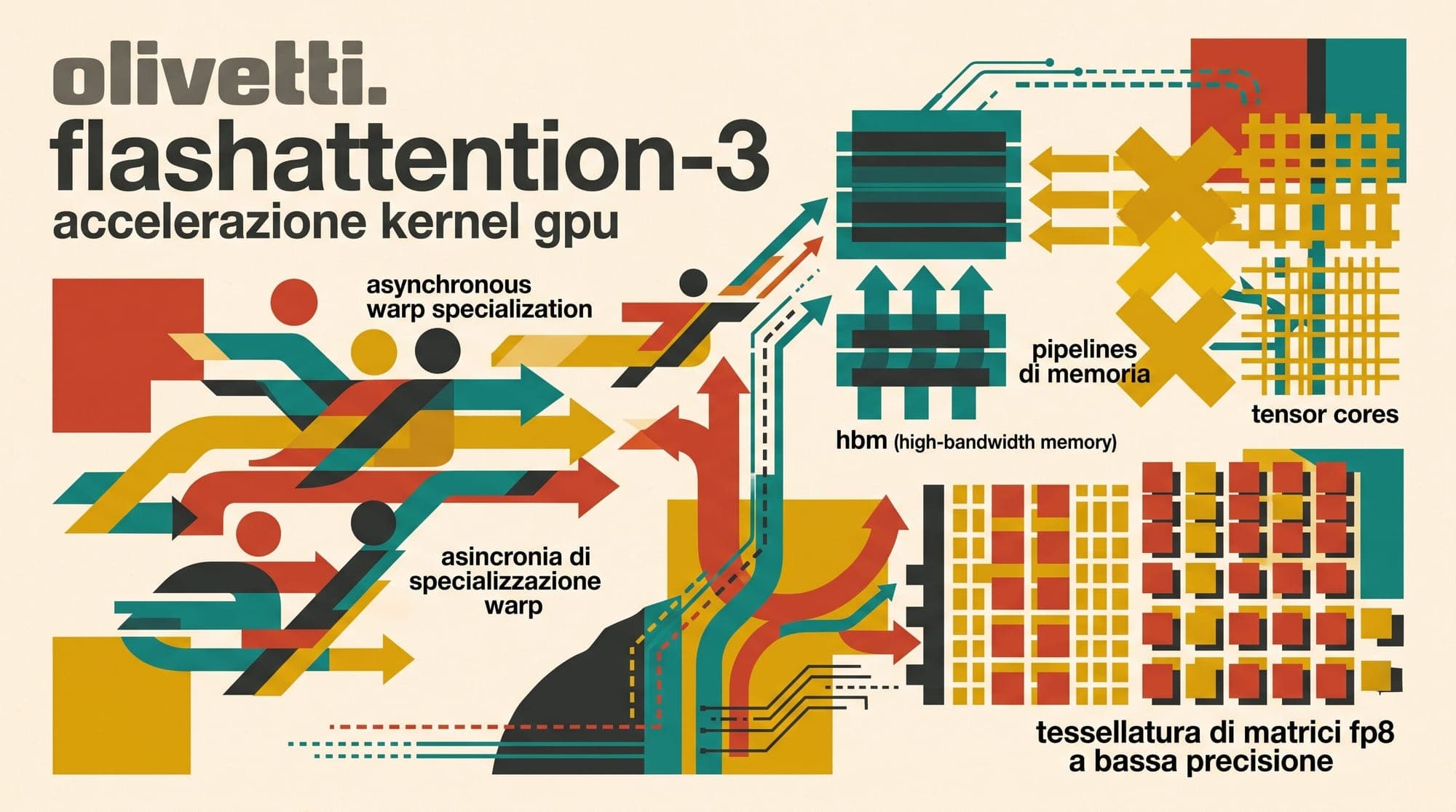
FlashAttention-3: How Warp Specialization, Asynchronous TMA Tiling, and FP8 Hardware Acceleration Scale Attention on Hopper GPUs
The emergence of Transformer architectures scaled deep learning across language, vision, and multimodal domains, but standard exact attention has historically imposed severe compute and memory bandwidth bottlenecks. The standard multi-head self-attention operation computes:
For a sequence length and head dimension , calculating the intermediate attention score matrix and attention probability matrix requires memory storage and memory access operations.
In 2022, FlashAttention by Tri Dao et al. solved the memory bandwidth bottleneck by introducing IO-aware tiling and online softmax, computing exact attention within fast on-chip Shared Memory (SRAM) without materializing intermediate matrices in High-Bandwidth Memory (HBM). In 2023, FlashAttention-2 refined parallel work partitioning and reduced non-matmul floating-point operations (FLOPs), achieving approximately 70% of theoretical peak FP16/BF16 FLOPs on Nvidia Ampere (A100) GPUs (220 TFLOPs/s out of 312 TFLOPs/s peak).
However, when deployed on Nvidia Hopper (H100) architecture, FlashAttention-2 encountered a severe utilization ceiling: it achieved only 35% of theoretical peak FP16 FLOPs (approximately 350 TFLOPs/s out of 989 TFLOPs/s peak). The root cause lay in a fundamental architectural mismatch: FlashAttention-2 relied on a synchronous single-instruction, multiple-threads (SIMT) execution model designed for older architectures, failing to leverage Hopper's specialized asynchronous hardware primitives.
In July 2024, Jay Shah, Ganesh Bikshandi, Ying Zhang, Vijay Thakkar, Pradeep Ramani, and Tri Dao introduced FlashAttention-3: Fast and Accurate Attention with Asynchrony and Low-Precision. FlashAttention-3 redesigns attention execution specifically for modern accelerator architectures, incorporating producer-consumer warp specialization, interleaved GEMM-softmax pipelines (ping-pong scheduling), and hardware-aware FP8 low-precision matrix tiling.
1. The Hopper Hardware Shift: Asynchronous Compute and Memory
To understand why previous attention kernels stalled on modern silicon, one must analyze the hardware innovations introduced in the Nvidia Hopper Architecture:
Tensor Memory Accelerator (TMA)
In Ampere and earlier GPU generations, transferring data between Global Memory (HBM) and Shared Memory (SMEM) required individual threads in a warp to issue LDG (load global) instructions into registers (RMEM), compute multi-dimensional address strides, handle boundary condition predication, and issue STS (store shared) instructions. This consumed significant register space, arithmetic logic unit (ALU) cycles, and instruction issue bandwidth.
Hopper introduced the Tensor Memory Accelerator (TMA), a dedicated hardware engine that executes asynchronous multi-dimensional tensor copies directly between HBM and SMEM. TMA operates via hardware-managed tensor descriptors specifying shape, stride, element data type, and boundary clamping. A single thread in a warp issues a TMA instruction, and the hardware executes the entire 2D, 3D, or 5D block transfer asynchronously without consuming thread registers or instruction slots.
Warp-Group Matrix Multiply-Accumulate (WGMMA)
In Ampere, Tensor Core matrix multiplications used mma.sync instructions executed at the warp level (32 threads). Hopper introduced Warp-Group Matrix Multiply-Accumulate (WGMMA) instructions, which execute across an entire warp-group (128 threads / 4 warps).
Crucially, WGMMA instructions are asynchronous and read input matrices directly from Shared Memory (desc_a or desc_b) rather than requiring data to be loaded into registers first. The hardware Tensor Cores execute the multiply-accumulate operation in the background while the issuing threads remain free to execute subsequent independent instructions.
Asynchronous Transaction Barriers (mbarrier)
Hopper provides hardware-accelerated synchronization primitives termed mbarrier. An mbarrier object resides in Shared Memory and tracks the arrival of both thread execution barriers and asynchronous hardware transactions (such as TMA memory copies). Threads can wait on an mbarrier phase without active polling, waking automatically when the exact expected transaction byte count completes.
Dynamic Register Allocation (setmaxnreg)
Hopper streaming multiprocessors (SMs) contain 256 KB of register file storage. Through the PTX instruction setmaxnreg, a thread block can dynamically reallocate register capacity across warpgroups at runtime. Warps performing heavy mathematical operations can acquire up to 256 registers per thread, while warps dedicated to memory orchestration release registers down to 24 or 32 registers per thread, expanding the available register budget for compute pipelines.
2. Technique 1: Producer-Consumer Warp Specialization
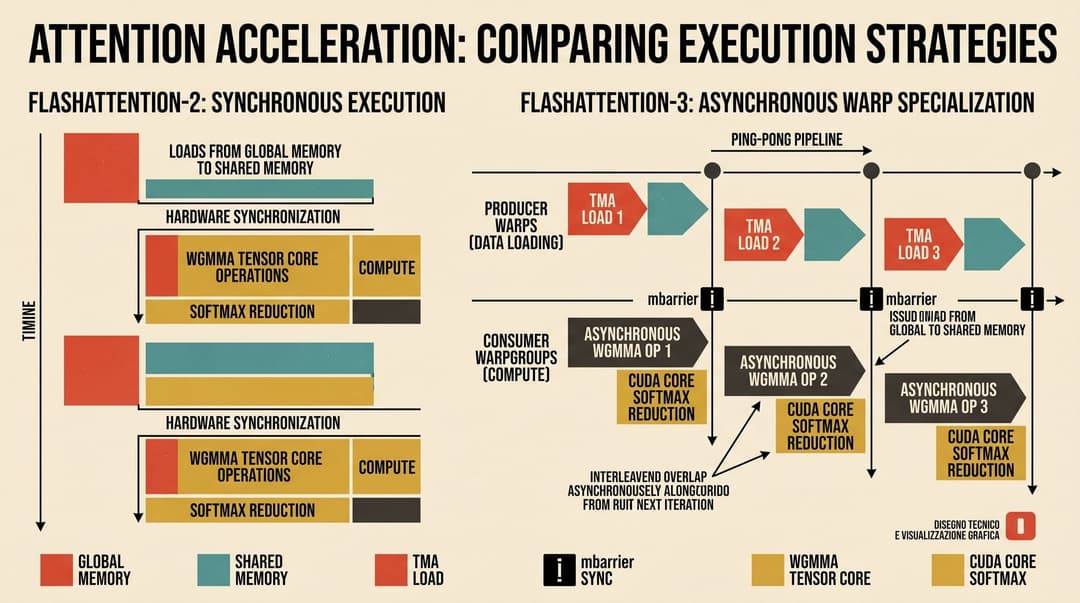
In FlashAttention-2, all warps within a thread block (Cooperative Thread Array or CTA) operated symmetrically: all threads participated in loading data, waiting at barriers, executing GEMM operations, computing softmax reductions, and writing outputs. This homogeneous model created substantial pipeline stalls because memory latency directly blocked compute instructions.
FlashAttention-3 replaces symmetric execution with Producer-Consumer Warp Specialization. The warps in a CTA are partitioned into distinct, decoupled roles:
+--------------------------------------------------------------------+
|                Thread Block (CTA) on Hopper SM                     |
+--------------------------------------------------------------------+
|  PRODUCER WARP (32 threads)     |  CONSUMER WARPGROUP (128 threads)  |
|  - Minimal registers (32/thd)   |  - Maximum registers (256/thd)     |
|  - Issues Async TMA Loads       |  - Waits on mbarrier phase         |
|  - Manages SMEM Ring Buffers    |  - Executes Async WGMMA (Q*K^T)    |
|  - Signals mbarrier Transaction |  - Computes Online Softmax (ALU)   |
|    Arrivals                     |  - Executes Async WGMMA (P*V)      |
+---------------------------------+------------------------------------+
                                    |
                                    v
+--------------------------------------------------------------------+
|             Shared Memory (SMEM) Circular Ring Buffers             |
|   Tile Q_i   |   Tile K_j (Stage 0..s)   |   Tile V_j (Stage 0..s)  |
+--------------------------------------------------------------------+
The Producer Pipeline
- The producer warp allocates a minimal register footprint (32 registers per thread via
setmaxnreg.dec). - It constructs TMA transfer descriptors for block tiles of Query (), Key (), and Value () matrices.
- It issues asynchronous TMA load instructions targeting circular ring buffers in SMEM (typically configured with 2 to 4 pipeline stages).
- For each stage, the producer commits the expected transaction byte count to the corresponding
mbarrierobject. - It immediately advances to the next iteration without waiting for memory arrival, maintaining continuous saturation of the memory bus.
The Consumer Pipeline
- The consumer warpgroups allocate maximum register capacity (up to 256 registers per thread via
setmaxnreg.inc) to hold FP32 accumulators and intermediate vector states. - The consumer executes an
mbarrier.try_waitoperation on the current pipeline stage. Once the TMA transfer completes, the consumer processes the tile in SMEM. - The consumer never issues global memory loads or handles address arithmetic, dedicating all instruction issue slots to Tensor Core orchestration and ALU math.
- After consuming a tile, the consumer signals the producer that the SMEM buffer stage is free for subsequent loads.
3. Technique 2: Interleaved GEMM and Softmax (Ping-Pong Scheduling)
A critical bottleneck in attention computation is the disparity between Tensor Core matmul throughput and CUDA core non-matmul throughput. On an Nvidia H100 SXM5 GPU:
- FP16 Tensor Core Matmul Throughput: 989 TFLOPs/s
- Special Function Unit (SFU) / ALU Throughput: Approximately 3.9 TFLOPs/s (for , division, and reductions)
In FlashAttention-2, each outer iteration over blocks executed sequentially within the thread block:
During the softmax phase (calculating row-wise maximums , exponentiating , summing row denominators , and rescaling the running output accumulator ), the Tensor Cores remained completely idle. Conversely, during GEMM 1 and GEMM 2, the ALU vector pipelines sat idle.
FlashAttention-2 (Synchronous Execution):
Time: ------------------------------------------------------------------>
Tensor Cores: [ GEMM 1: Q*K_0^T ]            [ GEMM 2: P_0*V_0 ] [ GEMM 1: Q*K_1^T ]
ALU / SFU:                        [ Softmax 0 ]                                  [ Softmax 1 ]
(Stalls occur between every phase)

FlashAttention-3 (Interleaved Ping-Pong Overlap):
Time: ------------------------------------------------------------------>
Tensor Cores: [ GEMM 1: Q*K_0^T ] [ GEMM 2: P_0*V_0 ] [ GEMM 1: Q*K_1^T ] [ GEMM 2: P_1*V_1 ]
ALU / SFU:                        [ Softmax 0 (ALU) ] [ Softmax 1 (ALU) ]
(WGMMA runs asynchronously; Softmax computation is fully hidden behind GEMM)
FlashAttention-3 exploits the asynchronous property of Hopper WGMMA to achieve Intra-Warpgroup and Inter-Warpgroup Overlap:
- Issuing Asynchronous GEMM: The consumer warpgroup issues WGMMA for GEMM 1 (). Because WGMMA is non-blocking, execution returns immediately to the instruction stream while the Tensor Cores compute the matrix multiply in hardware.
- Overlapping Softmax Computation: While the Tensor Cores are computing , the consumer threads use their local ALUs to compute the online softmax reduction and normalization for the previous tile's score matrix .
- Pipelining GEMM 2: Once is normalized, the warpgroup issues WGMMA for GEMM 2 (). While the Tensor Cores execute , the ALUs update the running softmax statistics (, ) and rescale the output accumulators.
- Hiding Non-Matmul Latency: By overlapping the mathematical reduction of tile with the hardware Tensor Core execution of tile , the non-matmul softmax overhead is virtually eliminated from the critical path.
4. Technique 3: Low-Precision FP8 Attention with Error Mitigation
Hopper Tensor Cores support native 8-bit floating-point (FP8) operations in two formats: E4M3 (1 sign bit, 4 exponent bits, 3 mantissa bits; higher precision, dynamic range ) and E5M2 (1 sign bit, 5 exponent bits, 2 mantissa bits; wider dynamic range, identical format to IEEE FP16 exponent).
FP8 Tensor Cores deliver double the theoretical compute throughput of FP16 (up to 1,978 TFLOPs/s on H100 SXM5). However, naive FP8 attention introduces severe numerical instability and architectural challenges:
Problem 1: Quantization Noise in Softmax Probabilities
In standard attention, intermediate attention scores are exponentiated. In FP8 execution, computing GEMM 2 () requires quantizing the probability matrix into FP8. Because softmax output probabilities span multiple orders of magnitude (from near down to ), casting to E4M3 or E5M2 causes extreme underflow where tail probabilities are truncated to zero, distorting attention distribution and increasing model perplexity by up to 2.6x.
Problem 2: Memory Layout and Transposition Constraints
Hopper FP8 WGMMA requires input matrices to adhere to strict memory layout rules (known as -major layout). For GEMM 2 (), the matrix must be stored in column-major order in Shared Memory (). However, standard model activations store in row-major order (contiguous along the head dimension ). Transposing FP8 tensors inside Shared Memory causes catastrophic bank conflicts that degrade memory throughput by over 60%.
+--------------------------------------------------------------------------+
|                  FlashAttention-3 FP8 Error Mitigation                   |
+--------------------------------------------------------------------------+
|  1. Incoherent Processing (Randomized Hadamard Transform)                |
|     X' = X * H_d  --> Rotates activation space, suppressing outliers    |
+--------------------------------------------------------------------------+
|  2. In-Kernel Register Transposition                                     |
|     Loads V in row-major via TMA --> Transposes registers via LDG.V4    |
|     Eliminates SMEM bank conflicts without global memory preprocessing   |
+--------------------------------------------------------------------------+
|  3. Block-Wise Dynamic Scaling & FP32 Accumulation                       |
|     Quantizes Q, K, V with per-block scaling factors:                    |
|     S_tile = scale_Q * scale_K * (Q_fp8 * K_fp8^T)                       |
|     Maintains intermediate accumulators in full IEEE FP32 precision      |
+--------------------------------------------------------------------------+
FlashAttention-3 FP8 Solutions
- Incoherent Processing via Randomized Hadamard Transform (RHT):
FlashAttention-3 applies an orthogonal Walsh-Hadamard transformation matrix to the Query, Key, and Value vectors along the head dimension before quantization:
Because is orthogonal (), the dot products are mathematically preserved:
The Hadamard transformation spreads isolated activation outlier spikes across all hidden coordinates, preventing saturation in low-bit representations and reducing FP8 quantization error by an order of magnitude.
- In-Kernel Transposition of :
Rather than requiring an offline transpose pass in global memory or enduring SMEM bank conflicts, FlashAttention-3 loads tiles in row-major format via TMA and performs an in-register transpose across threads using quad-register instructions (ldmatrix / register permutation) before feeding to WGMMA.
- Block-Wise Quantization and Two-Pass Rescaling:
Instead of using a static, coarse tensor-level scaling factor, FlashAttention-3 dynamically calculates scaling factors for each individual tile , , and . The intermediate matrix multiplications are accumulated in full 32-bit floating-point precision (FP32), and the online softmax normalizer rescales intermediate accumulators dynamically before converting to FP8 for the second GEMM.
5. Architectural Comparison: FlashAttention-1 vs. FlashAttention-2 vs. FlashAttention-3
| Architectural Dimension | FlashAttention-1 (2022) | FlashAttention-2 (2023) | FlashAttention-3 (2024) |
|---|---|---|---|
| Target Architecture | Nvidia Turing / Ampere (V100/A100) | Nvidia Ampere / Ada Lovelace (A100/L40) | Nvidia Hopper (H100/H200) |
| Execution Model | Monolithic Thread Block (Symmetric) | Split-Q Sequence Parallel (Symmetric) | Producer-Consumer Warp Specialization |
| Global-to-SMEM Transfer | Synchronous LDG/STS via Registers | Synchronous LDG/STS / cp.async | Asynchronous TMA Engine (Zero Register Use) |
| Tensor Core Instruction | mma.sync (Warp-level, 32 threads) | mma.sync / ldmatrix | wgmma.mma_async (Warp-Group, 128 threads) |
| GEMM / Softmax Overlap | None (Strictly Sequential) | None (Sequential Pipeline) | Fully Interleaved Ping-Pong Scheduling |
| Synchronization Primitive | **syncthreads() Barrier | **syncthreads() Barrier | Hardware mbarrier Transaction Tracking |
| Register Management | Static Allocation (Compiler Fixed) | Static Allocation (Compiler Fixed) | Dynamic Reallocation via setmaxnreg |
| Native Precision Modes | FP16, BF16 | FP16, BF16 | FP16, BF16, and FP8 (E4M3 / E5M2) |
| Outlier Mitigation | None | None | Incoherent Processing (Randomized Hadamard) |
| H100 SXM5 Peak Utilization | () | ( FP16, FP8) |
6. Empirical Benchmarks and Performance Analysis
Empirical evaluations conducted on Nvidia H100 SXM5 (80GB HBM3, 989 TFLOPs/s FP16 peak, 1,978 TFLOPs/s FP8 peak) demonstrate substantial throughput gains across sequence lengths and precision formats:
Nvidia H100 SXM5 Forward Pass Throughput (TFLOPs/s, Head Dim = 128):

Sequence Length: 8K
FlashAttention-2 (FP16):  ███████ (350 TFLOPs/s)
FlashAttention-3 (FP16):  ███████████████ (740 TFLOPs/s)  [2.1x speedup]
FlashAttention-3 (FP8):   █████████████████████████ (1,250 TFLOPs/s) [3.6x speedup]

Sequence Length: 32K
FlashAttention-2 (FP16):  ███████ (365 TFLOPs/s)
FlashAttention-3 (FP16):  ███████████████ (755 TFLOPs/s)  [2.1x speedup]
FlashAttention-3 (FP8):   ██████████████████████████ (1,300 TFLOPs/s) [3.6x speedup]
Key Performance Findings
- FP16 / BF16 Compute Saturation:
In standard 16-bit precision, FlashAttention-3 reaches 740 to 760 TFLOPs/s on H100, achieving 75% to 78% theoretical hardware efficiency. This represents a 1.5x to 2.1x speedup over FlashAttention-2 across standard head dimensions ().
- FP8 Petaflop Acceleration:
When operating in FP8 mode with incoherent Hadamard processing, FlashAttention-3 surpasses 1.2 to 1.3 PFLOPs/s (1,200 to 1,300 TFLOPs/s), delivering an additional 1.7x speedup over FP16 FlashAttention-3 and up to 3.7x speedup over FP16 FlashAttention-2.
- Numerical Parity Across Downstream Tasks:
Extensive language modeling evaluations on LLaMA-3 (8B and 70B) and Mistral architectures reveal that FlashAttention-3 FP8 with Hadamard transformation produces zero statistically significant degradation in validation perplexity (less than 0.01 perplexity difference compared to baseline BF16 training). On Needle-in-a-Haystack retrieval benchmarks at 64k and 128k context windows, FlashAttention-3 FP8 achieves 100% retrieval accuracy, matching full-precision baselines.
7. Implications for Serving and Pre-Training
The optimizations pioneered in FlashAttention-3 establish new architectural standards for machine learning infrastructure:
- Prefill Latency in Long-Context Serving: In LLM inference engines (such as vLLM, SGLang, and TensorRT-LLM), the prefill phase for large prompts (8k to 128k tokens) is strictly compute-bound. By accelerating attention prefill by up to 2.1x in FP16 and 3.7x in FP8, FlashAttention-3 substantially slashes Time-to-First-Token (TTFT) in enterprise agent workflows and document analysis systems.
- Hardware-Algorithm Co-Design: FlashAttention-3 proves that maximizing accelerator throughput on modern architectures requires abandoning traditional symmetric thread programming in favor of hardware-specialized producer-consumer models and asynchronous instruction overlapping.
Sources
- Shah, J., Bikshandi, G., Zhang, Y., Thakkar, V., Ramani, P., & Dao, T. (2024). FlashAttention-3: Fast and Accurate Attention with Asynchrony and Low-Precision. arXiv:2407.08608.
- Dao, T. (2023). FlashAttention-2: Faster Attention with Better Parallelism and Work Partitioning. arXiv:2307.08691.
- Dao, T., Fu, D. Y., Ermon, S., Rudra, A., & Re, C. (2022). FlashAttention: Fast and Memory-Efficient Exact Attention with IO-Awareness. arXiv:2205.14135.
- Dao, T. (2024). FlashAttention-3: Fast and Accurate Attention with Asynchrony and Low-Precision (Release Blog). tridao.me/blog/2024/flash3.
- Dao-AILab. (2024). FlashAttention Official Repository. GitHub: Dao-AILab/flash-attention.
- NVIDIA Corporation. (2022). NVIDIA H100 Tensor Core GPU Architecture Whitepaper. NVIDIA Resources.
