

A multi-institution study from researchers at Princeton University, UC San Diego, and collaborating labs provides the first large-scale empirical analysis of how "skills" (modular instruction packages loaded at inference time) alter autonomous AI agent trajectories. Analyzing 8,135 experimental trials across diverse model architectures, benchmarks, and agent harnesses, the authors establish that skills improve task completion primarily by acting as procedural anchors rather than by injecting missing domain knowledge.
The paper, titled "Demystifying Agent Skills: Why They Work-Until They Don't" (arXiv:2608.14036), resolves a persistent blind spot in agent benchmarking. While prior evaluations measured aggregate success rates, they failed to explain the structural mechanisms driving performance gains or identify the failure modes introduced by external prompt modules.
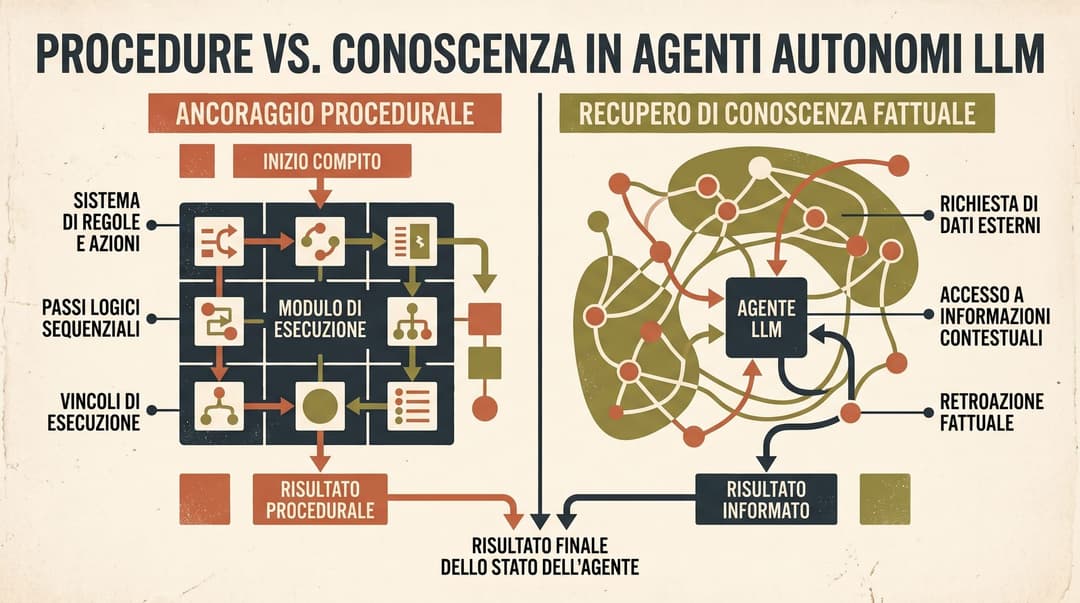
Procedural Anchoring Versus Knowledge Injection
The central finding of the research is that skills function as execution scaffolds rather than reference encyclopedias. Through open-coded trajectory analysis across 240 paired trials and 238 validated behavioral labels, the researchers constructed a taxonomy spanning three macro categories and twelve operational skill-use modes.
Procedural anchoring accounted for 65.7 percent of all cases where an agent equipped with a skill outperformed an unassisted baseline. In these instances, the skill stabilized multi-step execution by establishing clear setup steps, enforcing tool invocation sequencing, specifying verification checkpoints, and standardizing output formats. This structure prevented error cascades such as improper environment configuration or invalid parameter payloads.
In contrast, explicit factual knowledge injection accounted for only 4.5 percent of performance improvements. The underlying foundation models generally possessed the requisite factual knowledge in their pre-trained weights; the primary limitation was behavioral drift and ungrounded execution loops during complex tasks. In matched head-to-head comparisons, structured skills outperformed standard Workflow Memory approaches by 6.06 percentage points.
Retrieval Degradation and the 100-Skill Ceiling
While modular skills offer measurable execution improvements, the study identified severe scaling bottlenecks in skill discovery and selection.
When the available skill pool expanded from 5 to 100 entries, actual-use retrieval precision plummeted from 29.6 percent down to 3.3 percent. Semantic overlap between similarly named or conceptually adjacent skills created confusable distractors that degraded offline retrieval classifiers.
However, the downstream task success rate proved surprisingly resilient to sub-optimal retrieval. The researchers observed that exact ground-truth skill invocation is neither strictly necessary nor sufficient. Approximate or conceptually related skills frequently provide adequate procedural guidance to prevent early-stage execution failures, indicating that general task discipline matters more than hyper-specialized instruction text.
Brittle Assumptions and Failure Topologies
The study also documented the specific failure modes introduced when agents rely on static skill modules. In approximately 10 percent of evaluated cases, skills actively degraded performance.
The dominant failure modes included:
- Brittle assumptions: Hardcoded tool signatures, fixed path expectations, or rigid output contracts that broke when minor runtime variations occurred.
- Incompatible contexts: Agents forcing a familiar playbook onto an edge case that required an alternative strategy.
- Insufficient adaptation: Agents adhering dogmatically to intermediate procedural steps even after receiving clear environmental error signals or execution failures.
The authors conclude that advancing agent autonomy requires shifting from static experience accumulation to dynamic skill lifecycles, emphasizing robust multi-stage retrieval, runtime constraint reconciliation, and automated skill pruning.
