Category / page 16

Chips & Infrastructure

314 articles

Articles, page 16

301-314 of 314
  1. Microsoft opens 26 open models to startups on Azure through Fireworks

    Microsoft is pushing its newly generally available Fireworks AI integration at startups, publishing a deployment blueprint on August 4, 2026 that pairs a reference architecture for running open models on Microsoft Foundry with a financial incentive: members of the Microsoft for Startups program can apply Azure credits to Fireworks deployments, with the program advertising up to $150,000 in credits. The Fireworks integration reached general availability, placing open-weight models from DeepSeek,


    Microsoft
    2 min read
  2. SK hynix commits $39 billion to two new fabs as AI memory demand reshapes its roadmap

    SK hynix's board has approved 54 trillion won (about $39 billion) to build two new memory fabrication plants, the company announced on August 7, 2026, turning the first two arms of a much larger investment plan into funded construction schedules. The larger project, Y2, is the second fab at the Yongin Semiconductor Cluster. At 35.2 trillion won it is a DRAM plant of roughly 1.13 million square meters, with ground breaking set for July 2027 and its first cleanroom opening in June 2029 to produce

    SK hynix
    2 min read
  3. AMD Acquires Taalas to Build Chips Hard-Wired for Specific AI Models

    AMD announced on August 6 that it has reached a definitive agreement to acquire Taalas, a Toronto-based startup that builds processors customized around individual AI models. The deal adds specialized inference silicon to AMD's accelerator portfolio, targeting a class of workloads where a model is fixed and the goal is maximum throughput at minimum cost. Taalas, founded in 2023, produces what it calls Hardcore Models: chips whose circuitry is laid out for one specific model's weights. The custo

    Hardware
    2 min read
  4. Anthropic assembles in-house chip design team for Claude

    Anthropic assembles in-house chip design team for Claude Anthropic confirmed on August 5 that it is building an internal team to design custom silicon for its Claude AI models, joining a growing list of AI labs that have concluded off-the-shelf chips are no longer sufficient for the scale they need. The company is recruiting engineers with chip design experience for what it calls a "custom silicon team," according to a job listing. The group will co-design hardware and AI models in tandem, aim

    Anthropic
    2 min read
  5. AWS Puts Continuum Security Scanning Into Claude Code, Codex, and Kiro

    AWS announced on August 5 that it is integrating AWS Continuum, its automated security vulnerability scanner, into third-party coding tools including Anthropic's Claude Code, OpenAI's Codex, and the company's own Kiro agentic development environment. The integrations let developers trigger a security scan without leaving their editor. Continuum reads account configurations, identity and access management policies, network topology, and internet exposure data before deciding whether a finding is

    AWS
    2 min read
  6. NSF Commits $100 Million to Regional AI Infrastructure Hubs

    The U.S. National Science Foundation launched a $100 million program on August 4 to build state and regional AI infrastructure hubs, with NVIDIA, AMD, Intel, and Dell Technologies among the private-sector partners. The NSF State and Regional Artificial Intelligence Infrastructure Hubs program will fund up to 10 regional consortia that pool compute, data, and expertise for researchers, students, and educators who currently lack access to AI-scale computing resources. Public-private cost

    AI
    2 min read
  7. Google Offloads $35 Billion in Anthropic Chip Risk via SPV Structure

    Google has assembled one of the largest infrastructure financing programs in history to supply Anthropic with its proprietary AI chips while keeping the hardware off everyone's balance sheets, according to Financial Times reporting. The arrangement involves Google, Broadcom, Morgan Stanley, Apollo, Blackstone, and several cryptocurrency mining companies in a chain of deals designed to sidestep the balance-sheet constraints that would otherwise make the transaction impossible. How the st

    AI
    3 min read
  8. Nvidia Opens Alpamayo 2 Super for Commercial Use

    Nvidia has released the weights for Alpamayo 2 Super, a 34-billion-parameter vision-language-action model for autonomous-vehicle development, under the Linux Foundation's OpenMDW-1.1 license. The change gives automakers and autonomous-driving developers a commercial path to fine-tune, redistribute, and build derivative models from Nvidia's largest Alpamayo release, according to the company's announcement and model card. A cloud teacher model, not a robotaxi driver Alpamayo 2 Super combi

    AI
    2 min read
  9. Google Brings AI Model Routing to API Gateway

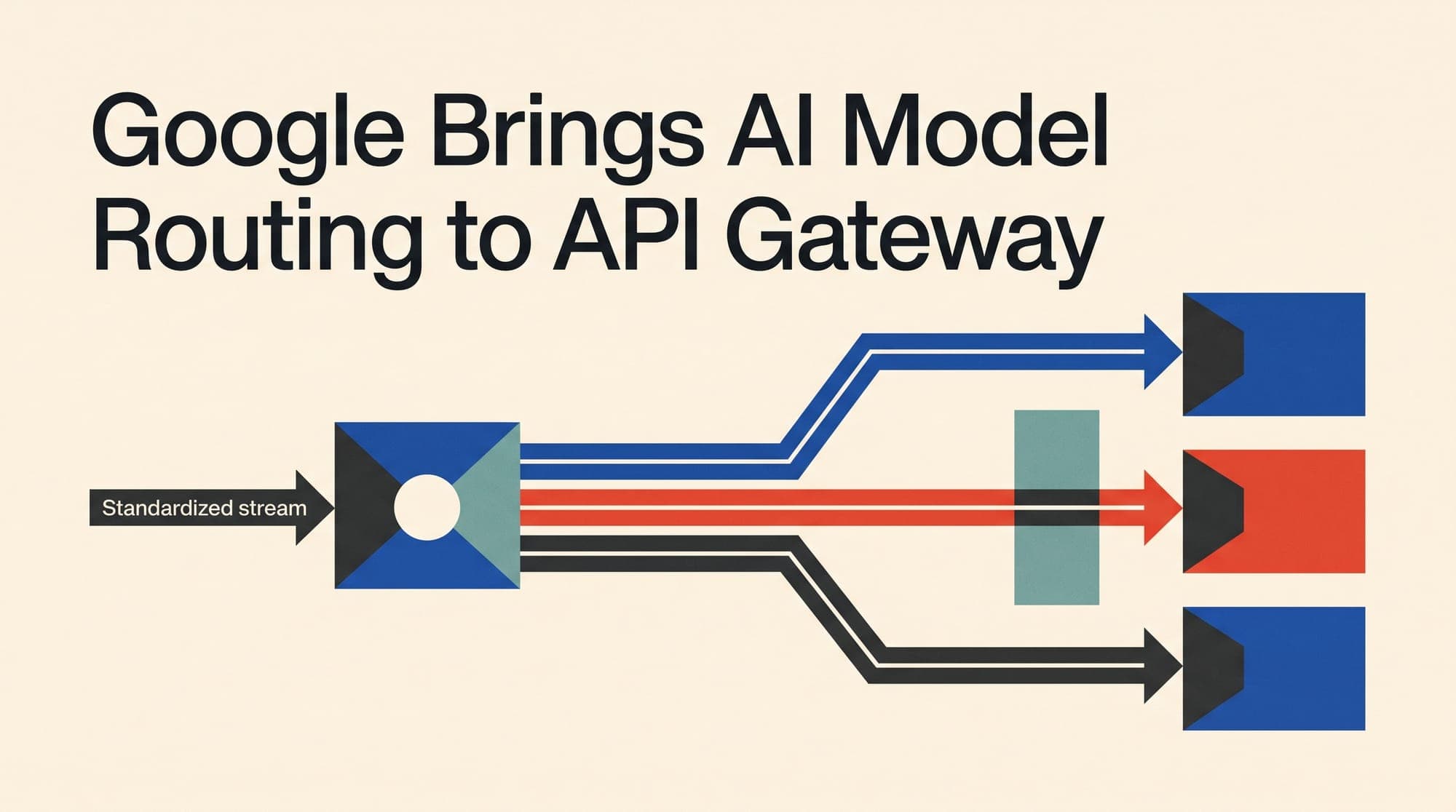
    Google Cloud has added managed AI model routing to API Gateway, giving developers one OpenAI-compatible endpoint for models hosted through Vertex AI Model Garden. The feature is now in public preview and can direct requests to Gemini, Anthropic Claude, and OpenAI GPT-family models without requiring teams to operate a separate proxy service, according to Google's announcement. Routing moves into the gateway Developers define virtual model names and backend targets inside an OpenAPI 3.x s

    AI
    2 min read
  10. Anthropic Signs $10B Compute Deal With Cloud Startup That Didn't Exist Six Months Ago

    Anthropic has locked in $10 billion worth of computing capacity from Volta Infra Holdings, a cloud infrastructure startup founded in early 2026, in a six-year deal that underscores the AI industry's increasingly aggressive scramble for compute. The deal, reported by Bloomberg, will draw on a data center in Tydal, Norway, where Bitcoin miner Bitdeer Technologies operates hydropower-fed infrastructure packed with Nvidia's latest Vera Rubin chips. Volta describes the capacity at 133 megawatt

    Anthropic
    1 min read
  11. Claude suffers global outage as network failures hit all models

    Anthropic's Claude platform experienced a widespread service disruption on July 29, 2026, with elevated error rates and latency affecting every model across its entire product suite. The incident knocked out claude.ai, the Claude API, Claude Code, and Claude Cowork for nearly three hours. The outage began at 19:49 UTC when Anthropic's status page first flagged elevated errors across multiple models. Users immediately reported 529 "Overloaded" errors, a non-standard HTTP response indicating the

    Anthropic
    1 min read
  12. Anthropic brings Claude inference to India through Amazon Bedrock

    Anthropic will offer Claude with in-country inference in India through Amazon Bedrock, letting organizations process requests on servers located within India. The move targets banks, insurers, and government agencies that need data residency guarantees before deploying AI in production. What in-country inference means Requests routed through the India endpoint stay on Indian servers. For regulated industries, that data residency is the difference between running pilots and deploying systems t

    Anthropic
    2 min read
  13. Zhipu AI explores custom silicon as GLM-5.2 demand surges

    Chinese AI lab Zhipu AI is in early discussions with domestic chip design houses about building a bespoke processor optimized for its GLM model family, according to a report by The Information. The move comes as daily token usage for GLM-5.2 surged 27-fold during its first week of release, straining compute capacity already squeezed by U.S. export controls on advanced semiconductors. The Beijing-based company, which trades on the Hong Kong Stock Exchange as Z.ai, has made preliminary inquiries

    Hardware
    2 min read
  14. EPA rules islanded data center power plants exempt from Clean Air Act

    The US Environmental Protection Agency issued guidance on July 27 stating that power generation facilities operating separately from the public grid are not subject to the Clean Air Act's Acid Rain Program. The interpretation applies to so-called "islanded" power plants that supply electricity exclusively to data centers. The ruling removes a significant federal permitting barrier for data center developers who build on-site power generation rather than drawing from the grid. EPA Assistant Admi

    Policy
    2 min read