Z.ai Delays GLM-5.3 Open-Weight Release After New Cyber Benchmark Scores

Chinese AI lab Z.ai has delayed the open-weights release of its GLM-5.3 model by approximately two weeks, citing safety evaluations and hardening following benchmark results that show the model excels at finding vulnerabilities but trails peers on exploitation.
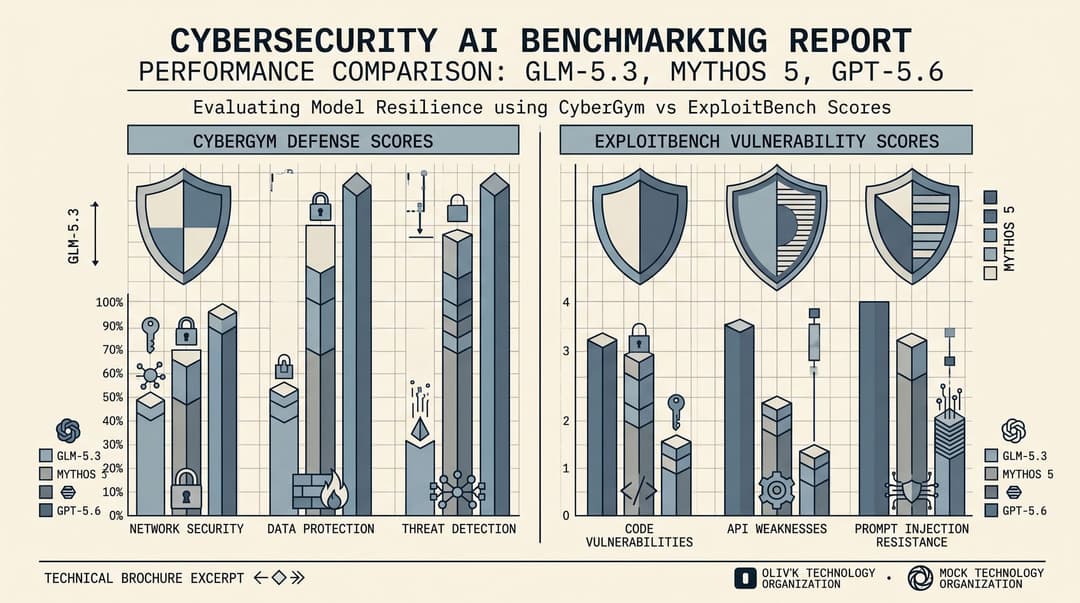
GLM-5.3 scored 84.5% on CyberGym, a benchmark testing vulnerability discovery and verification -- ahead of Anthropic's Mythos 5 (83.8%) and OpenAI's GPT-5.6 Sol (83.6%). However, on ExploitBench -- which tests the ability to craft working exploits -- GLM-5.3 scored 54.4%, well below Mythos 5's 78.0% and GPT-5.6 Sol's 76.5%.
The widening gap between discovery and exploitation mirrors a pattern seen across frontier AI labs. OpenAI recently built a dedicated cybersecurity model and delayed another release over offensive capability concerns.
The 2,436 Bug Problem
Since GLM-5.2, Z.ai says its models have been running against real-world codebases in collaboration with several Chinese security teams. After expert review, screening, and deduplication, the model identified 2,436 vulnerabilities across 269 open-source projects. The findings span system kernels, operating systems, browser engines, and network protocols.
Of those:
- 107 rated critical, 990 rated high
- 1,097 medium-to-high severity
- 53 publicly disclosed (with CVEs), 2,383 under embargo
- Affected software includes the Linux kernel, Redis, WebKit, and FreeBSD
- The oldest flaw was introduced in 1981; average vulnerability age before discovery: 26.6 years
Z.ai publishes findings on its Security Disclosure Ledger, which serves as external evidence beyond benchmark tasks -- though the company controls that record itself.
Available Now, Weights Coming Later
GLM-5.3 is already selectable through the GLM Coding Plan using Anthropic-compatible and OpenAI-compatible endpoints, and users can connect it to Claude Code, Codex, or other agents supporting custom model configuration. General API access and the open-weights download are being released in stages after safety evaluations.
The more consequential release is scheduled for approximately two weeks from now. Once weights are available, developers will be able to test whether benchmark improvements carry over to local deployments and different inference stacks. Moonshot released Kimi K3's weights under similar delayed conditions, and the gap between "open-weights announced" and "weights you can actually run" has become a recurring pattern in the open-model space.
Where the Model Stands
On coding benchmarks, GLM-5.3 reports open-source SOTA on Terminal Bench 3.0 and Agents' Last Exam, with a 50% improvement over GLM-5.2 on Z.ai's internal Code Bench.
The CyberGym and ExploitBench results follow a familiar frontier pattern: discovery capability outpaces exploitation capability, creating a window where the model appears safer than it may actually be operationally. The weight delay itself suggests Z.ai is treating the discovery results as a signal that additional hardening is warranted before public release.