
African Defense-Tech Startup Terra Industries Raises $52M Seed

African defense-tech startup Terra Industries, founded in 2024, has raised a $52 million seed round from 8VC and other investors, and says it is on track to book $100 million in contracts. The company builds AI-driven security and surveillance systems for the African continent, focusing on drone-based monitoring, threat detection, and infrastructure protection. Terra's defense technology integrates computer vision, sensor fusion, and autonomous aerial platforms to provide real-time situational

1 min
African Defense-Tech Startup Terra Industries Raises $52M Seed

African defense-tech startup Terra Industries, founded in 2024, has raised a $52 million seed round from 8VC and other investors, and says it is on track to book $100 million in contracts.
African Defense-Tech Startup Terra Industries Raises 2M Seed

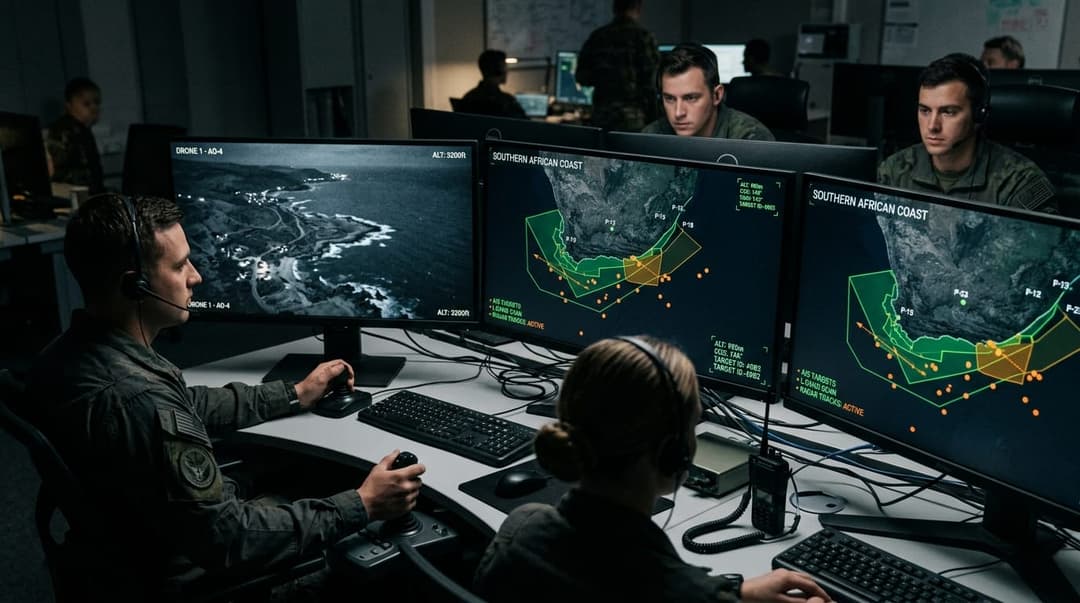
The company builds AI-driven security and surveillance systems for the African continent, focusing on drone-based monitoring, threat detection, and infrastructure protection. Terra's defense technology integrates computer vision, sensor fusion, and autonomous aerial platforms to provide real-time situational awareness for government and military clients.

The seed round, one of the largest on record for an African defense technology startup, reflects growing investor appetite for AI-powered security solutions in regions with complex security challenges. Terra's $100 million contract pipeline suggests significant demand for locally developed defense technology that can operate across diverse terrains and threat environments.

Terra Industries is part of a broader wave of African AI startups attracting international venture capital as the continent's technology ecosystem matures. Defense and security applications have become a particular focus for investors seeking high-growth opportunities in AI-driven hardware and software.

Sources

Terra Industries raises $52M seed round for African defense tech - TechCrunch via Techmeme: https://www.techmeme.com/260817/p30

Written by

More to read

  • Activation Checkpointing in Large Language Models: How Selective Recomputation Eliminates Memory Bottlenecks

    Large language model pre-training and fine-tuning are fundamentally constrained by GPU memory (VRAM). While distributed techniques such as Fully Sharded Data Parallel (FSDP), ZeRO, and Tensor Parallelism successfully shard model parameters, optimizer states, and gradients across hundreds or thousands of GPUs, activation memory presents a distinct scaling bottleneck. During the forward pass of a transformer model, intermediate tensor outputs must be preserved in GPU memory so that backpropagatio

    1 min
  • Anthropic Demonstrates Autonomous De Novo Protein Design and Chemical Analysis with Claude

    Anthropic Demonstrates Autonomous De Novo Protein Design and Chemical Analysis with Claude Anthropic has published experimental results demonstrating Claude's ability to autonomously design de novo protein binders with physical wet-lab validation and automate complex analytical chemistry workflows. The findings show frontier LLMs acting as autonomous agents across computational biology and molecular characterization pipelines. In the primary experiment, Anthropic evaluated Claude Mythos Previe

    1 min
  • Cerebras Unveils CS-4 Rack-Scale System Powered by Three WSE-3 Turbo Chips and Nexus Architecture

    Cerebras Unveils CS-4 Rack-Scale System Powered by Three WSE-3 Turbo Chips and Nexus Architecture Cerebras Systems has announced the CS-4, a rack-scale AI accelerator system designed around three of its next-generation Wafer Scale Engine 3 Turbo (WSE-3 Turbo) chips and a modular hardware architecture dubbed Nexus. Cerebras confirmed that initial customer shipments for the CS-4 are scheduled to begin in the current quarter. The new system marks a structural shift from Cerebras's single-wafer CS

    1 min