
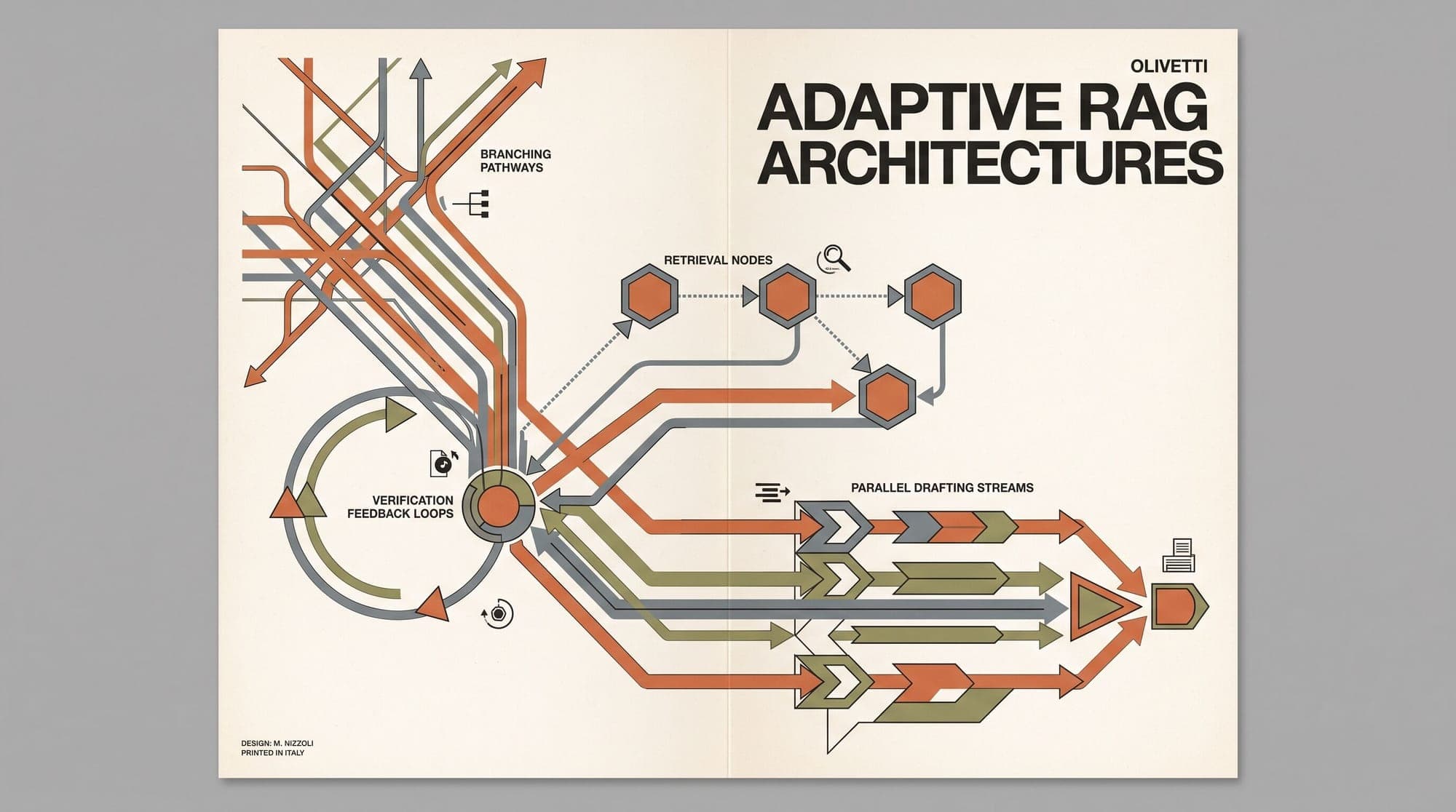
Standard retrieval-augmented generation follows a static, two-stage linear pipeline: embed the incoming user query, fetch top-k passages from a dense or hybrid index, insert the retrieved chunks into a prompt context window, and generate an answer. In production systems, this rigid workflow breaks down under three frequent operational failure modes:
- Unnecessary retrieval overhead: Simple queries that the language model already knows accurately from parametric memory still incur vector search and context loading latencies.
- Noisy context distraction: Low-quality or topically adjacent but factually irrelevant documents pollute the context, causing the generator to hallucinate or ignore its own parametric capabilities.
- Retrieval failure blindness: When the internal index contains no relevant evidence, naive RAG forces the generator to fabricate an answer from irrelevant snippets rather than identifying the information gap or initiating an external fallback.
To resolve these structural bottlenecks, advanced RAG engineering has evolved beyond static pipelines toward adaptive, self-evaluating, and speculative architectures. Four primary paradigms have emerged in production: Adaptive RAG, Self-RAG, Corrective RAG (CRAG), and Speculative RAG. Each architecture introduces dedicated decision boundaries, reflection loops, or multi-model verification mechanics to optimize retrieval accuracy, latency, and inference economics.
Adaptive RAG: Query Complexity Routing
Developed by researchers at KAIST and published at NAACL 2024, Adaptive-RAG introduces dynamic routing based on question complexity rather than applying a fixed retrieval strategy to every prompt.
Architectural Mechanics
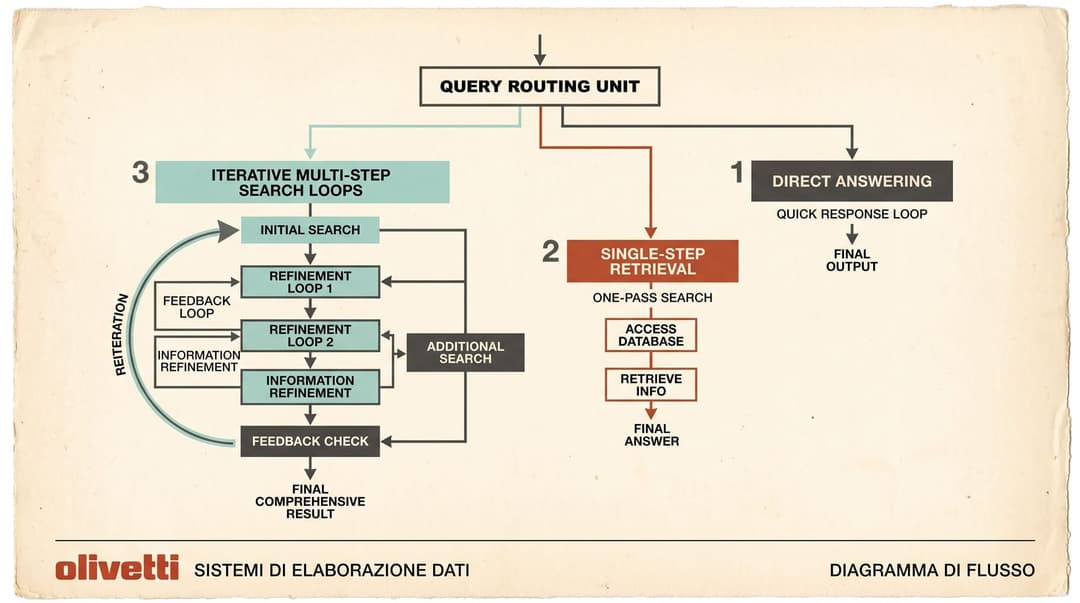
Adaptive-RAG replaces the uniform retrieval pipeline with a dynamic classifier that categorizes queries into distinct complexity tiers:
- Non-retrieval (A = 0): Straightforward, factual, or conversational queries that can be answered reliably by the generator's internal parametric memory without external retrieval.
- Single-step retrieval (A = 1): Moderate queries requiring explicit factual grounding from a single retrieval pass over a local knowledge base.
- Multi-step iterative retrieval (A > 1): Complex multi-hop queries that require query decomposition, iterative sub-query execution, and intermediate context synthesis.
The classifier is trained using query-complexity annotations derived from model prediction outcomes. If a small model answers correctly without retrieval, the query is labeled as non-retrieval. If single-step retrieval yields a correct answer, it receives a single-step label. Otherwise, it is assigned to multi-step retrieval.
Serving Latency and Economics
In production environments, query complexity distribution is heavily skewed toward simple and single-hop lookups. By routing 30% to 50% of routine traffic away from multi-step search loops and skipping vector retrieval entirely for memorized facts, Adaptive-RAG substantially lowers token consumption and end-to-end time-to-first-token (TTFT) across high-throughput endpoints.
Self-RAG: Internalized Reflection Tokens and Grounding Critique
Introduced by Asai et al. (ICLR 2024) from the University of Washington and the Allen Institute for AI, Self-Reflective Retrieval-Augmented Generation (Self-RAG) embeds retrieval decisions and output critiques directly into the language model's vocabulary via specialized reflection tokens.
The Reflection Token Taxonomy
Self-RAG trains a single language model to generate structured control tokens during inference across both retrieval and generation phases:
- Retrieval Trigger:
[Retrieve]or[No Retrieval]. Emitted at arbitrary sequence positions to determine whether external evidence is necessary. - Relevance Evaluation:
[IsREL]or[NotREL]. Assesses whether retrieved document segments contain relevant supporting information for the query. - Factual Grounding:
[ISSUP],[PartiallySUP], or[NotSUP]. Evaluates whether the generated text segment is strictly supported by the retrieved evidence. - Utility Scoring:
[ISUSE:1]through[ISUSE:5]. Grades the overall helpfulness, coherence, and utility of the response.
Training and Inference Decoding
Self-RAG employs a two-stage training workflow:
- Critic Model Training: An auxiliary critic model is trained on labeled feedback pairs to emit accurate reflection tokens over candidate passages and model responses.
- Generator Model Training: The target generator model is fine-tuned using Supervised Fine-Tuning (SFT) on offline corpora annotated with critic reflection tokens, enabling it to learn generation and critique concurrently.
During inference, Self-RAG executes segment-level beam search. When [Retrieve] is predicted, multiple candidate passages are fetched in parallel. The generator produces candidate continuation segments for each passage, scores each branch using the weighted log-probabilities of its critique tokens (IsREL, ISSUP, ISUSE), and prunes low-scoring trajectories before continuing generation.
Corrective RAG (CRAG): External Retrieval Evaluators and Refinement Loops
Published by Yan et al. (2024) from USTC and Microsoft, Corrective RAG (CRAG) decouples retrieval verification from the main generation model by introducing an external, lightweight retrieval evaluator and an automated correction loop.
Confidence Scoring and Action Triggers
CRAG places a lightweight discriminator (typically a fine-tuned T5-large or small cross-encoder) between the retrieval engine and the prompt assembly stage. The evaluator computes a scalar confidence score evaluating the relevance of retrieved documents to the user query, triggering one of three actions based on upper () and lower () thresholds:
- Correct (): The retrieved documents are validated as highly relevant. CRAG executes a decompose-then-recompose knowledge refinement algorithm, partitioning documents into fine-grained sentence strips, scoring each strip, and discarding irrelevant fragments before passing the consolidated context to the generator.
- Incorrect (): The retrieved documents are deemed irrelevant. CRAG discards the local chunks, rewrites the query into search keywords, and executes an external web search fallback to fetch relevant external context.
- Ambiguous (): The retrieved context is partially relevant. CRAG combines refined internal knowledge strips with external web search results to ensure comprehensive coverage without overwhelming the context window.
Production Implementations
Unlike Self-RAG, which requires specialized fine-tuned model checkpoints, CRAG is model-agnostic and functions with off-the-shelf foundation models. In production, CRAG is frequently orchestrated using state-graph engines like LangGraph, where evaluator scores route execution state across retrieval, rewriting, and fallback nodes.
Speculative RAG: Parallel Specialist Drafting and Generalist Verification
Published by Wang et al. (2024) from UC San Diego and Google, Speculative RAG addresses the latency and context bloat of multi-document retrieval by adopting a drafter-verifier architecture.
Drafter-Verifier Separation
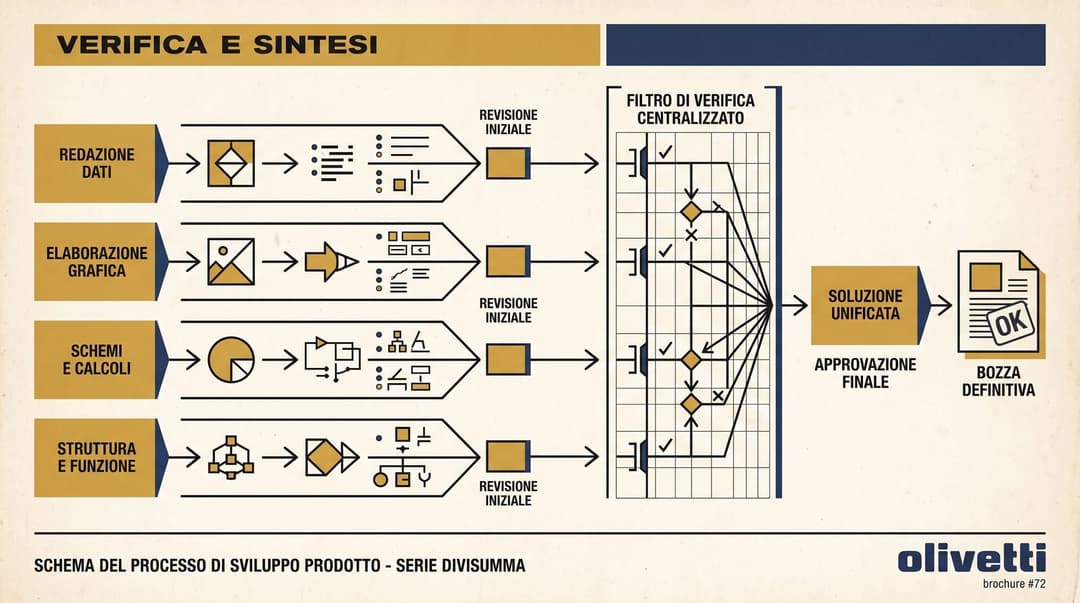
Standard RAG architectures feed all retrieved passages into a single large language model, forcing the model to process thousands of tokens of dense context during prefill. Speculative RAG splits this workload into two distinct roles:
- Specialist Drafter: A compact, fine-tuned specialist language model (such as a 7B or 8B parameter model) receives partitioned subsets of the retrieved documents. In parallel, multiple drafter instances generate candidate answers and reasoning rationales across different document perspectives.
- Generalist Verifier: A large foundation model receives the generated drafts and rationales alongside the original query. In a single forward pass, the verifier evaluates candidate correctness, resolves conflicting claims, and selects or synthesizes the final output.
Performance Gains and Latency Metrics
Because the specialist drafter operates over smaller, non-overlapping document subsets in parallel, draft generation incurs minimal compute. The generalist verifier processes only the concise drafts rather than the full raw document corpus, reducing input token volume significantly.
Across benchmarks including TriviaQA, MuSiQue, and PubHealth, Speculative RAG delivers latency reductions of up to 51% compared to standard multi-document RAG pipelines, while matching or exceeding the factual accuracy of full-context generalist generation.
Architectural Comparison and Trade-Offs
Choosing an advanced RAG pattern requires balancing verification accuracy against serving latency, infrastructure complexity, and model coupling:
- Adaptive RAG: Best suited for high-volume enterprise search endpoints where query complexity varies widely. Requires a low-latency routing classifier, but introduces zero overhead for simple queries and leaves downstream generation models uncoupled.
- Self-RAG: Delivers granular, token-level reflection and factual grounding verification within a single model. However, it requires proprietary or open-weight fine-tuning, increases decoding compute via segment-level beam search, and cannot be easily integrated into closed-API foundation models.
- Corrective RAG (CRAG): Highly composable and compatible with any commercial or open-weight LLM API. Introduces evaluator latency (50ms to 200ms depending on evaluator model size) and external web search latency on fallback paths, but prevents hallucination from corrupted or out-of-domain local indices.
- Speculative RAG: Maximizes serving throughput and reduces context window costs on knowledge-intensive multi-document QA. Requires managing two separate serving endpoints (specialist drafter clusters and generalist verifier instances), but minimizes total time-to-completion.
In enterprise production deployments, these architectures are often layered: an Adaptive RAG router first determines retrieval necessity, a CRAG evaluation layer validates and refines retrieved chunks, and a speculative or reflection-guided decoding pipeline generates verifiable outputs.
Sources
- Self-RAG: Learning to Retrieve, Generate, and Critique through Self-Reflection (Asai et al., ICLR 2024)
- Corrective Retrieval Augmented Generation (Yan et al., 2024)
- Adaptive-RAG: Learning to Adapt Retrieval-Augmented Large Language Models through Question Complexity (Jeong et al., NAACL 2024)
- Speculative RAG: Enhancing Retrieval Augmented Generation through Drafting and Verification (Wang et al., 2024)
