
Speculative RAG in Production: Drafting, Verification, and Systems-Level Scheduling
RAG pipelines have a latency problem. The standard pattern — retrieve, rerank, generate — chains three sequential stages. Retrieval is fast; reranking and generation are not. When a query fans out to dozens of chunks, the cross-encoder or LLM reranker becomes a bottleneck, and the generator sits idle waiting for the reranker to finish.
Three recent papers attack this from different angles: Speculative RAG (Google Research, ICLR 2025) decomposes the task into parallel drafting and verification; Omnia (HPDC 2025) introduces chunk speculation with backpressure-aware scheduling at the serving layer; HyperRAG (arXiv 2025) caches document-side KV state for decoder-based rerankers. Together they sketch a path from prototype to production-grade RAG serving.
The Algorithmic Shift: Drafting and Verification
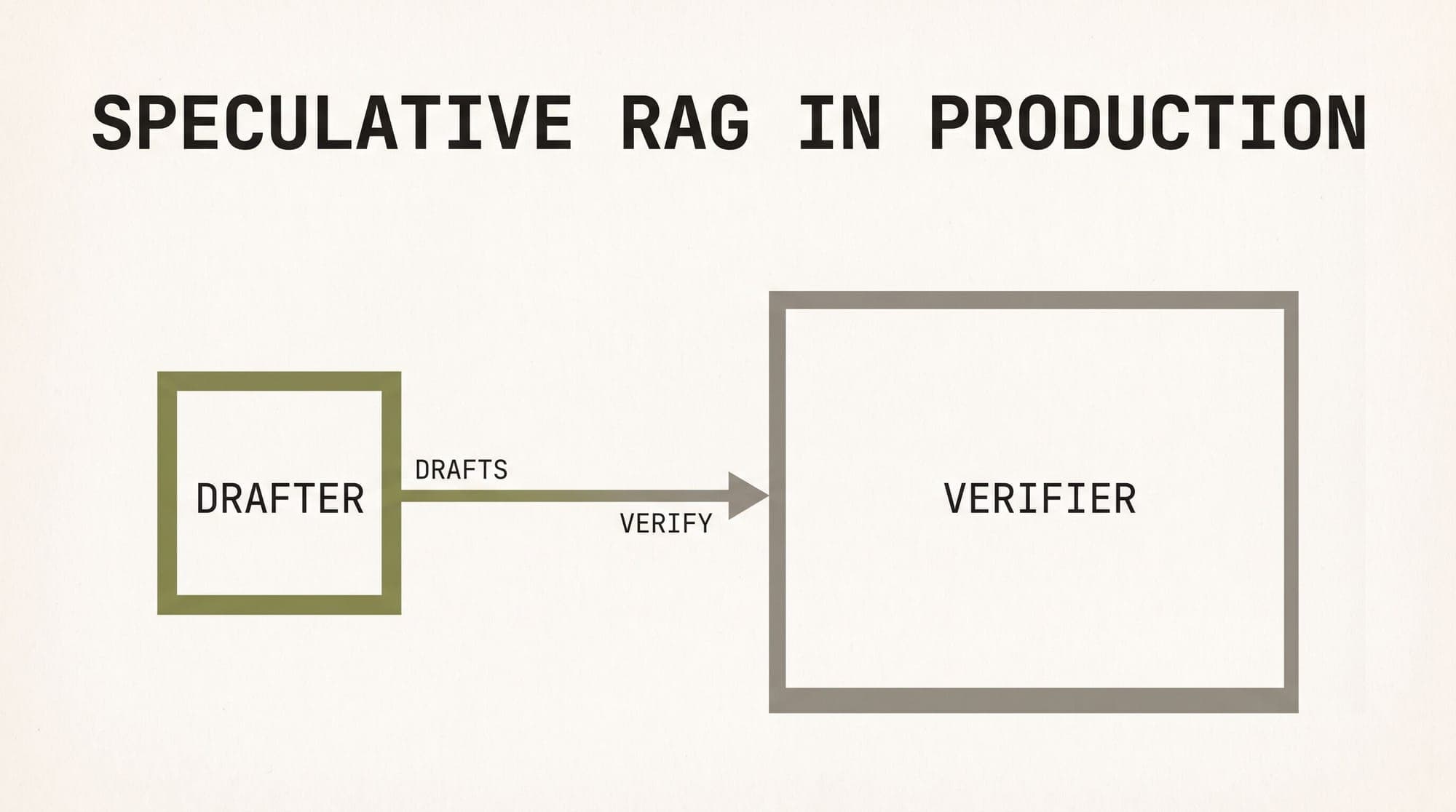
Speculative RAG reframes RAG as a two-model collaborative process. A small specialist drafter (e.g., Mistral-7B fine-tuned on RAG data) generates multiple answer drafts in parallel, each from a distinct subset of retrieved documents. A large generalist verifier (e.g., Mixtral-8x7B) then scores the drafts by conditional generation probability and picks the best one — no additional training required.
Document partitioning. Retrieved documents are clustered by content similarity; one document per cluster forms a subset. This minimizes redundancy and maximizes perspective diversity. Each subset feeds an independent drafter instance.
Verification. The verifier computes P(answer, rationale | query, draft) as a confidence score. Drafts hallucinating from irrelevant documents (e.g., confusing the 1980 Nine to Five film with the 2010 musical) receive lower scores and are discarded.
Results. On PubHealth, Speculative RAG beats Mixtral-Instruct-8x7B by 12.97% accuracy while cutting latency 51%. Gains hold across TriviaQA, MuSiQue, ARC-Challenge, and PopQA. The drafter handles document reasoning; the verifier only validates — reducing tokens per forward pass and enabling parallelism.
Source: Google Research blog | arXiv:2407.08223
The Systems Shift: Chunk Speculation and Backpressure Scheduling
Omnia operates at the serving infrastructure layer. It observes that RAG's cascaded dispatch (retrieve → rerank → generate) creates cumulative latency and that reranking's high fan-in (scoring many chunks per query) saturates the system under burst traffic.
Chunk speculation. Omnia replaces the single reranker with a two-level coarse-to-fine architecture. The coarse reranker quickly scores all chunks; once the top-k set from the fine reranker stabilizes, remaining tail chunks are pruned — early termination. Simultaneously, progressive prefilling overlaps fine reranking with generation prefilling: after the first reranking group finishes, the top-1 chunk begins speculative prefilling; subsequent groups append sub-prefillings incrementally. Prefix caching in vLLM/SGLang/TensorRT-LLM absorbs rollback cost on mis-speculation.
Backpressure-Aware Reranker Scheduling (BARS). Progressive prefilling competes with ongoing decoding for GPU resources. BARS monitors two signals: active decoding request count and KV-cache memory occupancy. Low backpressure → eager sub-prefilling (small group size). High backpressure → conservative scheduling (large group size) to protect decode throughput. This prevents one request's latency optimization from starving others.
Results. Omnia increases max sustainable request rate by 57% and reduces end-to-end latency 2.99× (up to 9.84×) with near-lossless accuracy. Backend-agnostic: plugs into vLLM, SGLang, TensorRT-LLM.
The Reranker Efficiency Shift: KV-Cache Reuse
HyperRAG targets the reranker itself. Decoder-based rerankers (e.g., Gemma-2B) outperform encoder-only models but recompute document-side KV caches for every query. HyperRAG precomputes and stores document chunk KV caches on SSD/NVMe. At query time, only the query tokens are processed; document KVs are loaded and concatenated. This shifts the bottleneck from GPU compute to storage bandwidth.
Key insight. Document chunks are longer than queries → high KV reuse ratio. Quantization is skipped (degrades bandwidth on small caches). Input format is reversed: [document] + [query] so the query attends over the full cached document context.
Results. 2–3× throughput improvement with decoder-only rerankers, higher downstream EM scores vs. encoder baselines. Works with any decoder backbone.
Source: HyperRAG, arXiv:2504.02921
Production Implications
| Layer | Technique | What It Solves | Trade-off |
|---|---|---|---|
| Algorithmic | Speculative RAG (draft + verify) | Long-context reasoning quality + latency | Requires two models; drafter needs RAG fine-tune |
| Serving | Omnia (chunk speculation + BARS) | Cascaded latency + burst saturation | Added system complexity; prefix caching dependency |
| Reranker | HyperRAG (KV-cache reuse) | Decoder reranker compute cost | Storage I/O pressure; cache invalidation on corpus updates |
Where to start. If you control the model stack, Speculative RAG's accuracy gains are compelling for knowledge-intensive workloads. If you operate a shared RAG serving platform, Omnia's plug-and-play integration with vLLM/SGLang delivers immediate throughput gains. If you've already adopted decoder rerankers, HyperRAG's KV-cache reuse is a drop-in optimization.
Open questions. Draft diversity vs. verifier calibration: how many subsets before diminishing returns? Chunk speculation's early-termination threshold: static or learned? KV-cache staleness: incremental update vs. full rebuild on corpus drift. The papers provide baselines; production tuning remains.
Sources
- Google Research. "Speculative RAG: Enhancing Retrieval Augmented Generation through Drafting." (Aug 2024) — https://research.google/blog/speculative-rag-enhancing-retrieval-augmented-generation-through-drafting
- Wang et al. "Speculative RAG: Enhancing Retrieval Augmented Generation through Drafting." ICLR 2025, arXiv:2407.08223 — https://arxiv.org/abs/2407.08223
- Fu et al. "Omnia: Efficient RAG Serving through Speculative Scheduling." HPDC 2025 — https://dl.acm.org/doi/10.1145/3806645.3807814
- An et al. "HyperRAG: Enhancing Quality-Efficiency Tradeoffs in Retrieval-Augmented Generation with Reranker KV-Cache Reuse." arXiv:2504.02921 (Apr 2025) — https://arxiv.org/abs/2504.02921
- Vespa Blog. "Eliminating the Precision–Latency Trade-Off in Large-Scale RAG." (Dec 2025) — https://blog.vespa.ai/eliminating-the-precision-latency-trade-off-in-large-scale-rag
