
Standard Retrieval-Augmented Generation (RAG) pipelines face an escalating trade-off between retrieval recall and inference latency. To ensure sufficient coverage for ambiguous or complex knowledge-intensive queries, production systems commonly ingest between 10 and 20 candidate passages per query. However, concatenating large document sets directly into the prompt context of a large language model introduces severe bottlenecks: quadratic attention scaling during the prefill phase, elevated Time-to-First-Token (TTFT), and context degradation such as the lost-in-the-middle phenomenon, where models overlook relevant information placed in the center of lengthy contexts.
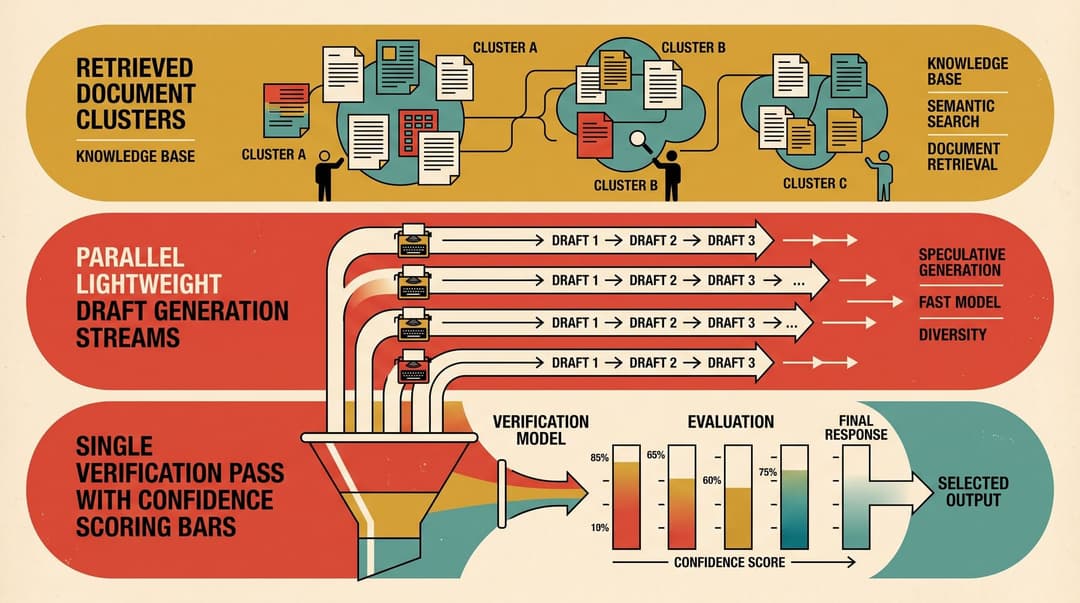
Speculative RAG resolves this latency and accuracy penalty by decoupling retrieval reasoning from final verification. Inspired by speculative decoding at the token level, researchers from UC Santa Cruz and Google Research introduced Speculative RAG, a framework that delegates document ingestion to a parallel swarm of lightweight specialist drafter models. Each drafter processes a compact, distinct subset of retrieved evidence to generate candidate answers paired with concise rationales. A single frozen generalist model then validates the candidate drafts in a single forward pass without reading the full, raw retrieved corpus.
This architecture simultaneously lowers end-to-end latency by up to 51% and increases accuracy by up to 12.97% across standard question-answering and claim-verification benchmarks.
The Core Bottleneck in Monolithic RAG
In standard RAG architectures, every retrieved document is formatted into a single context window:
Where is the user query and represents each retrieved document. When increases to cover multi-hop reasoning or ambiguous topics, three distinct system failure modes emerge:
- Quadratic Prefill Latency and Memory Saturation: In multi-tenant inference engines such as vLLM and SGLang, prefill compute for large generalist models (e.g., 70B parameters or large Mixture-of-Experts) scales heavily with prompt length. Long context windows monopolize High Bandwidth Memory (HBM) for the Key-Value (KV) cache, reducing serving batch size and concurrency.
- Contextual Distraction and Lost-in-the-Middle: Generalist LLMs exhibit position bias. As documents accumulate, irrelevant distractors dilute attention weights, leading to hallucinated answers or failure to extract critical facts.
- Redundancy Across Candidate Documents: Dense vector search frequently retrieves near-duplicate passages that reiterate identical facts while missing alternative interpretations or counter-evidence required for robust claim verification.
Prior advanced RAG frameworks attempt to mitigate these failures via iterative critique or reflection. Self-RAG trains models to emit special reflection tokens to critique retrieved content, while Corrective RAG (CRAG) introduces external evaluators to trigger web searches on low-confidence retrieval. However, both approaches either require expensive end-to-end fine-tuning of large generalist models or add sequential inference hops that worsen total request latency.
Architectural Anatomy of Speculative RAG
Speculative RAG structures generation into a three-stage pipeline: multi-perspective document clustering, parallel drafting, and single-pass verification.
                  [ Posed Query Q ]
                          │
             [ Knowledge Base Retrieval ]
                          │
             Top-N Retrieved Documents (D)
                          │
             ┌────────────┴────────────┐
             │ Multi-Perspective       │
             │ Clustering & Sampling   │
             └────────────┬────────────┘
        ┌─────────────────┼─────────────────┐
        ▼                 ▼                 ▼
   [ Subset δ₁ ]     [ Subset δ₂ ]     [ Subset δₘ ]
   (k documents)     (k documents)     (k documents)
        │                 │                 │
        ▼                 ▼                 ▼
 ┌──────────────┐  ┌──────────────┐  ┌──────────────┐
 │ Drafter (7B) │  │ Drafter (7B) │  │ Drafter (7B) │  (Parallel Execution)
 └──────┬───────┘  └──────┬───────┘  └──────┬───────┘
        │                 │                 │
   Draft (α₁, β₁)    Draft (α₂, β₂)    Draft (αₘ, βₘ)
        └─────────────────┼─────────────────┘
                          │
                          ▼
             ┌─────────────────────────┐
             │ Generalist Verifier     │
             │ (Frozen 70B / MoE)      │
             │ Single-Pass Logit Score │
             └────────────┬────────────┘
                          │
                          ▼
                   [ Best Answer α* ]
1. Multi-Perspective Document Sampling
Rather than feeding all retrieved documents to a single model or partitioning them randomly, Speculative RAG clusters the retrieved candidate set into semantic perspectives.
Given retrieved documents and user query :
- Contextual Embedding: An instruction-aware embedding model generates query-conditioned document vectors:
- Thematic Clustering: K-Means clusters the embeddings into distinct content clusters:
- Diverse Subset Construction: The system draws one document uniformly at random from each cluster to construct a subset :
By repeating this procedure times, the engine produces distinct document subsets . Each subset contains exactly documents that span the diverse perspectives of the retrieval results while eliminating intra-cluster redundancy. In typical production setups, is set between 2 and 6 documents, keeping the input context for each drafter extremely small.
2. Specialist RAG Drafter ()
The drafter is a small, specialized model (such as an instruction-tuned 7B parameter model) optimized strictly for extracting facts and reasoning over short context windows. The drafter does not need broad general-purpose world knowledge because it operates purely as an evidence processor.
During offline training, instruction pairs are augmented with teacher-synthesized rationales , forming quadruplets. The drafter is fine-tuned under the standard autoregressive language modeling objective:
During inference, drafter instances process the subsets concurrently. Each drafter outputs a candidate answer along with its supporting rationale .
The drafter also yields a draft confidence score based on generation probability:
3. Generalist RAG Verifier ()
The verifier is a high-capacity, general-purpose model (e.g., Mixtral-8x7B, Llama-3.3-70B, or proprietary frontier models). Crucially, the verifier remains completely frozen and requires no fine-tuning.
Instead of reading the verbose, raw retrieved documents , the verifier only reviews the question and the concise draft-rationale pairs . The verification process evaluates two complementary criteria in a single forward pass:
- Self-Consistency Score (): Measures whether the generated draft and rationale logically cohere with the query under the generalist model's prior distribution:
- Self-Reflection Score (): Evaluates explicit validation by appending a fixed reflection prompt (e.g., "Do you think the explanation supports the answers? (Yes or No)") and extracting the conditional likelihood of the affirmative token:
The final score for candidate draft is the product of all three components:
The production engine selects the candidate with the maximum composite score:
Because logit extraction over candidate tokens requires only evaluating pre-existing tokens rather than autoregressively generating new sequences, the verifier executes its scoring pass in milliseconds.
Empirical Benchmark Performance
According to empirical evaluations published by Wang et al. (2024), Speculative RAG consistently outperforms monolithic baselines and advanced critique-based architectures across open-domain QA and verification benchmarks.
| Architecture | Model Backbone | TriviaQA (EM) | MuSiQue (F1/Acc) | PubHealth (Acc) | ARC-Challenge (Acc) | Latency Reduction |
|---|---|---|---|---|---|---|
| Standard RAG | Mistral-7B | 54.15% | 16.71% | 34.85% | 42.75% | Baseline (0%) |
| Standard RAG | Mistral-7B-Instruct | 67.11% | 17.99% | 42.15% | 47.70% | Baseline (0%) |
| Standard RAG | Mixtral-8x7B-Instruct | 73.91% | 29.42% | 63.63% | 78.41% | Baseline (0%) |
| CRAG | Mistral-7B | — | — | 59.04% | 74.87% | Slower (+Hop) |
| Self-RAG | Mistral-7B | 64.84% | 21.72% | 72.44% | 74.91% | Slower (+Tokens) |
| Self-CRAG | Mistral-7B | — | — | 72.85% | 75.26% | Slower (+Tokens) |
| Speculative RAG | Drafter-7B + Verifier-7B | 73.91% | 31.03% | 75.79% | 76.19% | 23% to 45% lower |
| Speculative RAG | Drafter-7B + Verifier-8x7B | 74.24% | 31.57% | 76.60% | 80.55% | 51.25% lower |
The performance gains are especially pronounced on complex verification and multi-hop tasks:
- PubHealth (+12.97% accuracy gain over Mixtral-8x7B): Medical claim verification demands analyzing contradictory claims. Multi-perspective sampling ensures that opposing viewpoints are isolated into separate drafts rather than jumbled together in one confusing prompt.
- Latency Collapse (-51.25% on PubHealth, -23.41% on TriviaQA): Delegating drafting to parallel 7B worker instances reduces the verifier's context from thousands of raw document tokens to a concise prompt containing only candidate rationales.
Production Implementation & Serving Economics
Deploying Speculative RAG in enterprise infrastructure requires specific architectural considerations across serving runtimes, cluster topology, and memory management.
                      [ User API Gateway ]
                               │
                [ Document Retrieval Engine ]
                               │
                 Top-N Candidate Documents
                               │
            ┌──────────────────┴──────────────────┐
            ▼                                     ▼
   [ Drafter Worker Pool ]               [ Verifier Engine ]
   - 4-8x Replicas (7B/8B FP8)           - 1x Replica (70B / MoE)
   - Low VRAM footprint (<8GB/worker)    - Single Forward Pass
   - Fast parallel generation            - Token probability extraction
            │                                     ▲
            └──────── Drafts + Rationales ────────┘
1. Cluster Topologies: Disaggregated Workers vs. Colocated Nodes
To maximize resource utilization:
- Drafter Fleet: Small 7B drafter models quantized to FP8 or INT4 can be distributed across lower-tier GPUs (e.g., NVIDIA L4 or A10G instances) or colocated on spare VRAM of larger compute nodes. Generating 5 parallel drafts across 5 lightweight instances requires minimal compute budget compared to running a 70B model autoregressively over a 16K token prompt.
- Verifier Node: The larger verifier runs on high-memory hardware (e.g., A100/H100 clusters). Because the verifier only computes token probabilities over short candidate prompts without autoregressive token generation loops, its GPU occupancy is brief, enabling high batch throughput.
2. Prefix Caching and Deterministic Verification
Because the verification step formats candidates into structured evaluation prompts:
The query prefix remains identical across all candidate verifications. Modern inference engines utilizing prefix caching (such as RadixAttention in SGLang or Chunked Prefill in vLLM) cache the query KV states across the batch of verification candidates, reducing verifier prefill compute to near zero.
3. Fallback and Guardrail Policies
In production environments, edge cases where retrieval fails entirely must be handled gracefully:
- Low Confidence Thresholding: If the composite score for all candidates falls below an empirical confidence floor , the system flags the query as unanswerable or triggers secondary fallback retrieval (such as a broader web search).
- Consensus Voting: When multiple distinct drafts produce identical answer spans with high self-reflection scores, the system can bypass full logit multiplication and fast-path the majority answer to achieve sub-second response times.
Speculative RAG shifts the paradigm of retrieval-augmented generation from brute-force context stuffing to structured, multi-perspective hypothesis generation and rapid verification. By separating evidence extraction from logical arbitration, engineering teams can scale retrieval recall without paying the compounding latency tax of frontier LLMs.
Sources
- Wang et al. (2024). Speculative RAG: Enhancing Retrieval Augmented Generation through Drafting. arXiv preprint arXiv:2407.08223.
- Google Research (2024). Speculative RAG: Enhancing Retrieval Augmented Generation through Drafting. Google Research Blog.
- Asai et al. (2023). Self-RAG: Learning to Retrieve, Generate, and Critique through Self-Reflection. arXiv preprint arXiv:2310.11511.
- Yan et al. (2024). Corrective Retrieval Augmented Generation (CRAG). arXiv preprint arXiv:2401.15884.
- Liu et al. (2023). Lost in the Middle: How Language Models Use Long Contexts. Transactions of the Association for Computational Linguistics.
- Kwon et al. (2023). Efficient Memory Management for Large Language Model Serving with PagedAttention. SOSP 2023.
