

The default architecture for first-generation enterprise AI agents routed every prompt, tool selection, and intermediate evaluation step to a single frontier large language model. While this monolithic approach simplified initial orchestration, it introduced severe latency bottlenecks and unsustainable inference unit economics in high-throughput production environments.
In production agentic loops, between 40% and 70% of model invocations are narrow, highly structured operations: classifying intent, extracting structured JSON parameters, rewriting search queries, validating tool outputs, or routing downstream tasks. Routing these deterministic sub-tasks to a 200-billion-plus parameter frontier model incurs significant cost and adds round-trip network and prefill latencies of 500ms to 2,000ms per step.
Deploying Small Language Models (SLMs) in the 0.5B to 8B parameter range as specialized micro-workers enables engineering teams to offload high-volume sub-tasks to local or dedicated GPU infrastructure. When paired with constrained grammar decoding and domain fine-tuning, modern SLMs match or exceed frontier model accuracy on bounded tasks while reducing inference spend by 80% to 95% and lowering Time-to-First-Token (TTFT) below 50ms.
The Modern SLM Parameter Spectrum
The industry definition of a small language model encompasses models with 500 million to 8 billion parameters that can execute on single enterprise GPUs (such as NVIDIA L4, A10G, or T4) or consumer-grade edge silicon without multi-GPU tensor parallelism.
| Model Series | Parameter Tiers | Context Window | Dominant Production Specialization |
|---|---|---|---|
| Meta Llama 3.2 | 1B, 3B | 128K | On-device processing, edge routing, low-latency classification |
| Alibaba Qwen 2.5 | 0.5B, 1.5B, 3B, 7B | 128K | Multilingual extraction, structured coding, function calling |
| Microsoft Phi-3.5 / Phi-4 Mini | 3.8B | 128K | Dense reasoning, mathematical verification, synthetic filtering |
| Google Gemma 2 | 2B, 9B | 8K | High-throughput embedding scoring, text transformation |
| Hugging Face SmolLM2 | 135M, 360M, 1.7B | 8K | In-browser inference, lightweight intent tagging, sanitization |
Advances in pre-training data curation, knowledge distillation, and architecture modifications such as Grouped-Query Attention (GQA) have narrowed the raw capability gap on constrained benchmarks. Models like Qwen 2.5 3B and Phi-3.5 Mini regularly achieve 65% to 70% on MMLU and competitive HumanEval pass rates, establishing baseline competence for bounded operational steps.
The Sub-Task Distribution in Agentic Systems
In a position paper titled Small Language Models are the Future of Agentic AI, researchers from NVIDIA Research (Belcak et al., 2025) demonstrated that agentic systems decompose complex goals into discrete execution graphs. The majority of intermediate invocations do not require open-domain world knowledge or unbounded reasoning. Instead, they require rigid adherence to schema contracts and deterministic transformations.
Production telemetry reveals four primary classes of agent sub-tasks suitable for SLM offloading:
- Schema Extraction and Parsing: Converting unstructured text, emails, or raw API outputs into validated JSON structures according to a predefined Pydantic or JSON Schema definition.
- Deterministic Classification and Routing: Triage of inbound customer requests, ticket categorization, and intent routing across multiple agent tools.
- Query Decomposition and Reformulation: Expanding user search inputs into multi-hop retrieval queries or generating keyword variations for hybrid RAG search engines.
- Tool Argument Validation and Output Verification: Checking whether a prior tool execution succeeded, asserting parameter types, and formatting output payloads before returning state to the parent workflow.
Constrained Grammar Decoding with Small Models
A common operational failure when deploying small models is hallucinated keys or malformed syntax in structured output generation. While an unconstrained 1B parameter model may drift on complex JSON syntax, pairing the model with grammar-constrained decoding frameworks such as Outlines, XGrammar, or guidance solves this reliability failure mode.
Constrained decoding enforces a finite-state machine (FSM) or context-free grammar directly at the logit level during token sampling. Tokens that violate the schema are masked out with negative infinity probability before softmax evaluation.
import outlines
from pydantic import BaseModel, Field

class RoutingDecision(BaseModel):
    intent: str = Field(description="Primary category of the inquiry")
    requires_retrieval: bool = Field(description="Whether RAG search is required")
    priority: int = Field(ge=1, le=5, description="Priority score from 1 to 5")
    target_tool: str = Field(description="Name of the downstream microservice")

# Initialize lightweight local engine (e.g., Llama-3.2-3B-Instruct)
model = outlines.models.transformers("meta-llama/Llama-3.2-3B-Instruct")
generator = outlines.generate.json(model, RoutingDecision)

# Guaranteed 100% schema-valid JSON generation
result = generator("Customer asks: 'Can I get an invoice for my July subscription charge?'")
print(result.target_tool)  # billing_service
Because the grammar compiler eliminates illegal generation paths, a 3B parameter model running constrained decoding achieves >99.8% structural compliance, matching frontier model reliability at a fraction of the compute overhead.
Serving Economics and Latency Profiling
The economic argument for small language models is driven by batch efficiency and hardware density. Frontier commercial APIs charge between $2.50 and $15.00 per million output tokens, with input pricing scaling proportionally on large system prompts.
In contrast, an 8-bit or 16-bit 3B parameter model requires under 6GB of VRAM for weights, leaving substantial memory on a 24GB NVIDIA L4 or A10G instance for large KV cache allocations and high-concurrency continuous batching.
| Metric | Frontier API (e.g. Claude 3.5 Sonnet) | Self-Hosted SLM (e.g. Qwen 2.5 3B on L4) |
|---|---|---|
| Time to First Token (TTFT) | 350ms - 1,200ms | 15ms - 45ms |
| Decode Throughput (Batch=1) | 60 - 90 tok/s | 450 - 750 tok/s |
| Aggregate Cluster Throughput | Rate-limited by provider tiers | >4,500 tok/s per $0.70/hr L4 GPU | | Cost per 1M Blended Tokens | $3.00 - $15.00 | $0.03 - $0.08 (at 60% saturation) |
| Data Residency Boundary | External third-party cloud | Dedicated VPC / On-Premise |
For high-volume pipelines processing tens of millions of tokens daily, shifting 70% of baseline operations to an internal SLM cluster amortizes fixed GPU infrastructure costs within weeks while eliminating API rate limit throttling.
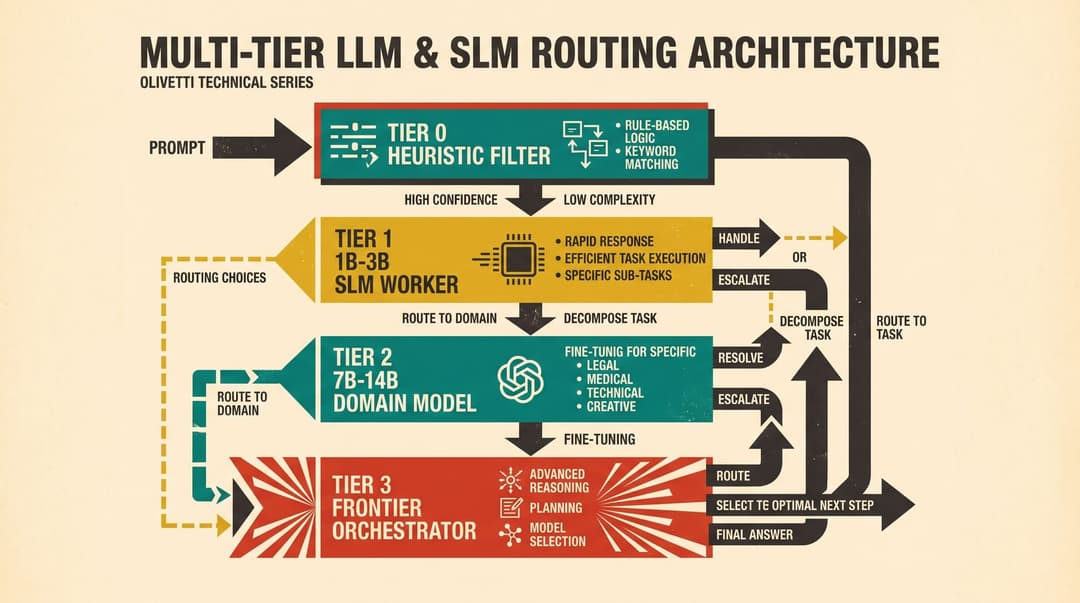
The 4-Tier Production Routing Architecture
Leading enterprise implementations structure their model topology into four distinct tiers rather than relying on a single model endpoint:
[ Inbound User Request ]
           │
           ▼
┌────────────────────────────────────────┐
│ Tier 0: Heuristic & Vector Filter      │  -> Fast regex, regex classifiers, or
│ Latency: <5ms | Cost: ~$0.00           │     bi-encoder embedding similarity
└──────────────────┬─────────────────────┘
                   │
                   ▼
┌────────────────────────────────────────┐
│ Tier 1: Micro-SLM (0.5B - 3B)          │  -> Intent triage, query rewriting,
│ Latency: 20-50ms | Cost: ~$0.04/MTok   │     JSON extraction, tool validation
└──────────────────┬─────────────────────┘
                   │ Escalation (if ambiguity score > threshold)
                   ▼
┌────────────────────────────────────────┐
│ Tier 2: Domain-Tuned SLM (7B - 14B)    │  -> Code refactoring, domain policy
│ Latency: 80-200ms | Cost: ~$0.20/MTok  │     synthesis, multi-step extraction
└──────────────────┬─────────────────────┘
                   │ Escalation (if complex multi-step reasoning needed)
                   ▼
┌────────────────────────────────────────┐
│ Tier 3: Frontier LLM Orchestrator      │  -> Open-ended strategy, long-context
│ Latency: 500-2000ms | Cost: $3-$15/MTok│     synthesis, ambiguous edge cases
└────────────────────────────────────────┘
In this cascade, Tier 1 models handle 60% of all incoming requests and resolve internal agent loops. Only tasks with high ambiguity scores, failed schema validations, or explicit requirements for open-ended synthesis escalate to Tier 2 and Tier 3.
Operational Boundaries and Failure Modes
Small language models are not universal replacements for frontier architectures. Applying SLMs outside their operational envelope leads to predictable degradation:
- Needle-In-A-Haystack Degradation: While many 3B and 7B models report 128K context windows via RoPE scaling, effective retrieval accuracy drops sharply beyond 32K tokens compared to frontier models with dedicated long-context architectures.
- Multi-Constraint Reasoning: Small models struggle when given three or more conflicting negative constraints (e.g., "Summarize the incident, but do not mention server names, do not use passive voice, and format as markdown tables with alternating row colors").
- Complex Multi-Hop Planning: Open-ended autonomous planning requiring world models or counterfactual reasoning across multiple domains remains unreliable below the 70B parameter threshold.
Engineering Decision Framework
When determining whether to offload a specific agent sub-task to an SLM, apply the following evaluation checklist:
- Schema Predictability: Is the expected output format expressible as an exact Pydantic schema or regex pattern? (If yes, deploy SLM with constrained decoding).
- Context Budget: Does the input payload stay under 16K tokens? (If yes, SLMs retain high fidelity).
- Latency Ceiling: Does the user-facing interaction require sub-200ms response times (e.g., autocomplete, real-time voice, search auto-suggest)? (If yes, local SLM is required).
- Volume Threshold: Does the workload exceed 50,000 requests per day? (If yes, self-hosted SLM infrastructure yields positive ROI over commercial API spend).
Sources
- NVIDIA Research: Small Language Models are the Future of Agentic AI (Belcak et al., arXiv:2506.02153)
- Microsoft Research: Phi-3 Technical Report
- Meta AI: Llama 3.2 Model Release and Architecture Specifications
- Qwen Team: Qwen 2.5 Technical Report and Foundation Models
- Outlines: Fast and Reliable Structured Output Generation
- XGrammar: High-Performance Structured Generation Engine
