
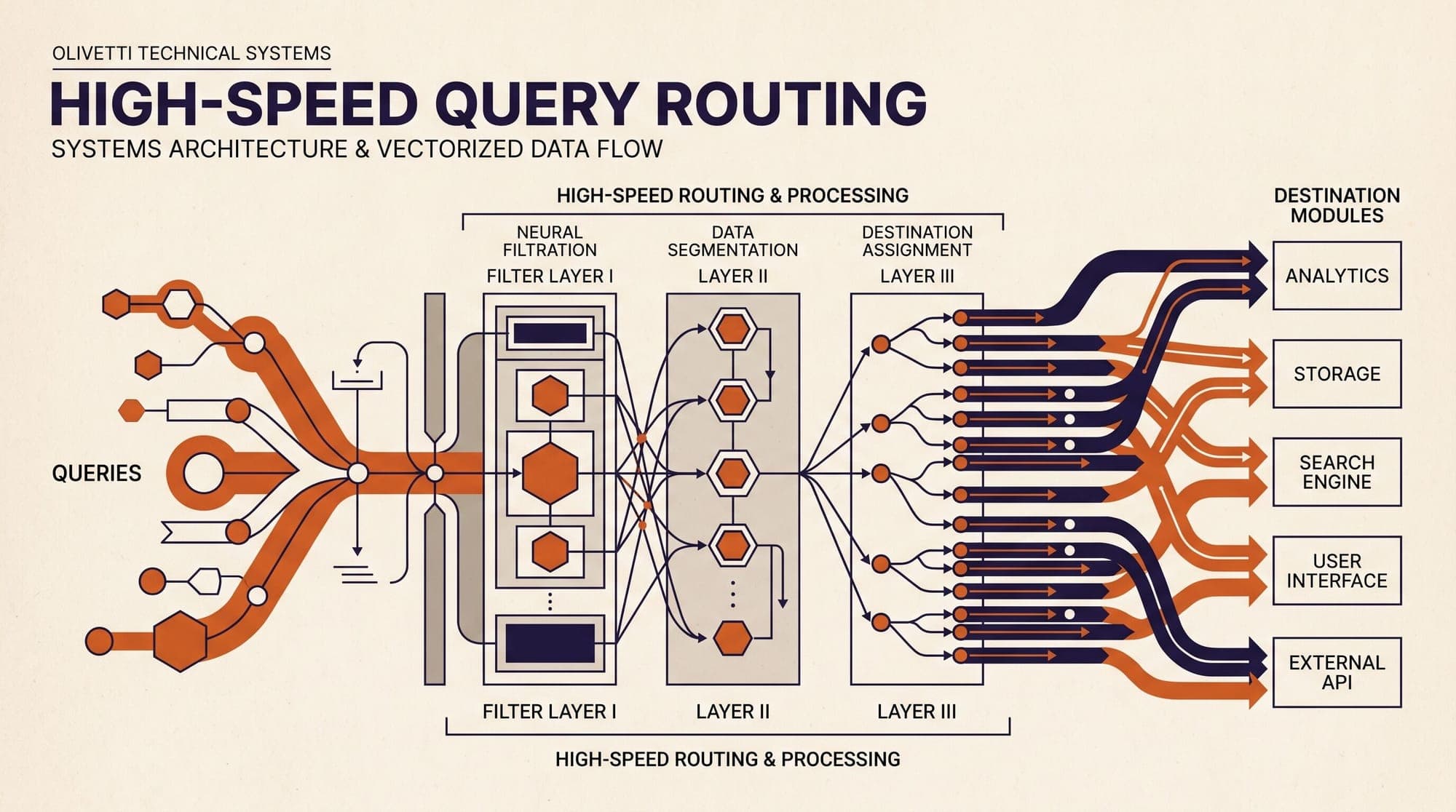
Routing user requests to specialized tools, APIs, or tiered foundation models is central to production AI architectures. However, relying on large language models (LLMs) or native JSON tool-calling mechanisms to perform initial intent classification introduces significant latency and cost overheads. A single LLM-based classification pass typically adds between 200 milliseconds and 1.5 seconds of time-to-first-token (TTFT) latency, alongside linear token billing for routine triage queries.
To eliminate these bottlenecks, engineering teams increasingly deploy dedicated semantic routers. By evaluating user queries within vectorized embedding spaces or through lightweight classification heads, semantic routers execute sub-50ms routing decisions at a fraction of LLM inference costs.
Core Mechanics of Semantic Routing
Semantic routing replaces generative parsing with geometric proximity and statistical classification in embedding space. Instead of executing prompt-driven instruction following, the system represents predefined routes as clusters of reference utterances.
The standard semantic routing workflow operates across three sequential stages:
- Utterance Pre-Encoding: Target routes (such as customer support categories, database queries, code execution, or specialized model endpoints) are populated with canonical sample phrases. A bi-encoder model (such as MiniLM, BGE, or ModernBERT) converts these reference utterances into high-dimensional dense vectors stored in memory or in vector indexing layers like Pinecone or Qdrant.
- Real-Time Query Vectorization: Incoming user requests pass through the same bi-encoder to produce a query embedding vector.
- Similarity Scoring and Threshold Evaluation: The router calculates vector similarity (typically cosine similarity or dot product) between the query vector and candidate route representations. If the highest similarity score exceeds a configured confidence threshold, the request immediately dispatches to the corresponding downstream target.
Open-source implementations such as Aurelio Labs' Semantic Router popularized this pattern, providing zero-shot routing capabilities without requiring neural network fine-tuning.
from semantic_router import Route
from semantic_router.encoders import HuggingFaceEncoder
from semantic_router.layer import RouteLayer

# Define domain-specific intent routes
sql_route = Route(
    name="sql_analytics",
    utterances=[
        "Show quarterly revenue breakdown by region",
        "How many active subscriptions churned last month?",
        "Pull user signups grouped by acquisition channel",
    ],
)

general_faq_route = Route(
    name="general_faq",
    utterances=[
        "What is your enterprise refund policy?",
        "How do I reset my account password?",
        "Where can I download my billing invoices?",
    ],
)

encoder = HuggingFaceEncoder(name="sentence-transformers/all-MiniLM-L6-v2")
router = RouteLayer(encoder=encoder, routes=[sql_route, general_faq_route])

# Sub-30ms intent evaluation
decision = router("Give me last quarter churn figures")
print(decision.name)  # Output: sql_analytics
The Limitations of Raw Cosine Similarity
While centroid-based cosine matching performs well on distinct, orthogonal topics, production deployments encounter distinct failure modes when intent boundaries overlap or out-of-scope (OOS) inputs surge.
Recent industry benchmarks published by machine learning researchers demonstrate that simple cosine similarity against utterance centroids achieves roughly 70.9% F1 accuracy on complex enterprise intent datasets. Scaling the underlying embedding model from 110 million parameters to 335 million parameters yields only minor gains (approximately 0.6 percentage points) because the bottleneck stems from geometric overlap rather than embedding capacity.
Key challenges with basic cosine thresholding include:
- Centroid Dilution: Averaging diverse utterances into a single centroid flattens multimodal distributions, eroding decision boundaries for broad intents.
- Out-of-Scope Leakage: Unseen queries falling equidistant between route clusters often trigger false positives if global thresholds are set too leniently, or default to brittle fallbacks when thresholds are rigid.
- Context Insensitivity: Bi-encoders compress entire inputs into static vectors, losing nuance on subtle negation or conditional phrasing.
To resolve these limitations without sacrificing speed, production architectures train lightweight decision boundaries, such as a multi-layer perceptron (MLP) head, logistic regression probe, or fine-tuned bi-encoder architectures like SetFit or ModernBERT. Adding an MLP classification layer on top of frozen embeddings increases classification accuracy by more than 20 percentage points while maintaining inference times under 20 milliseconds.
Gateway-Level vs. Application-Level Topologies
Semantic routing can be situated at different architectural layers depending on latency targets and infrastructure requirements:
1. Application-Level Routing
Embedded directly within API handlers or agent orchestration frameworks (such as FastAPI, LangGraph, or LlamaIndex), application-level routers intercept user messages before agent graph execution. This pattern allows access to application session state and user permissions, making it straightforward to dynamically adjust route tables per tenant.
2. Infrastructure and Gateway-Level Routing
In high-scale serving clusters, semantic routing is offloaded to proxy layers. A prominent example is the vLLM Semantic Router (Iris), which integrates with cloud-native proxies via Envoy's External Processing (ExtProc) gRPC protocol.
As detailed in research on reasoning-aware inference for vLLM, gateway-level semantic routers evaluate prompt complexity and domain intent at the network edge. Requests needing light factual retrieval are directed to standard dense models, while computationally heavy math or code challenges route to extended reasoning models. This pattern reduced token consumption by 48.5% and end-to-end serving latency by 47.1% on the MMLU-Pro benchmark.
Incoming Request (HTTP / gRPC)
       │
       ▼
┌──────────────────────────────────────┐
│       Envoy Reverse Proxy            │
│   (ExtProc Filter Integration)       │
└──────────────────┬───────────────────┘
                   │ gRPC Stream
                   ▼
┌──────────────────────────────────────┐
│     vLLM Semantic Router (Iris)      │
│  - Intent / Complexity Classifier   │
│  - Semantic Cache & PII Scrubbing    │
└──────────────────┬───────────────────┘
                   │ Route Metadata (Model Tag)
                   ▼
┌──────────────────────────────────────────────────────────┐
│              Heterogeneous Inference Pool                │
│  ┌───────────────────────┐   ┌────────────────────────┐  │
│  │ Fast SLM / Small LLM  │   │ Deep Reasoning LLM     │  │
│  │ (Factual / Simple Q&A)│   │ (Code / Math / Logic)  │  │
│  └───────────────────────┘   └────────────────────────┘  │
└──────────────────────────────────────────────────────────┘
The Multi-Tier Cascade Routing Pattern
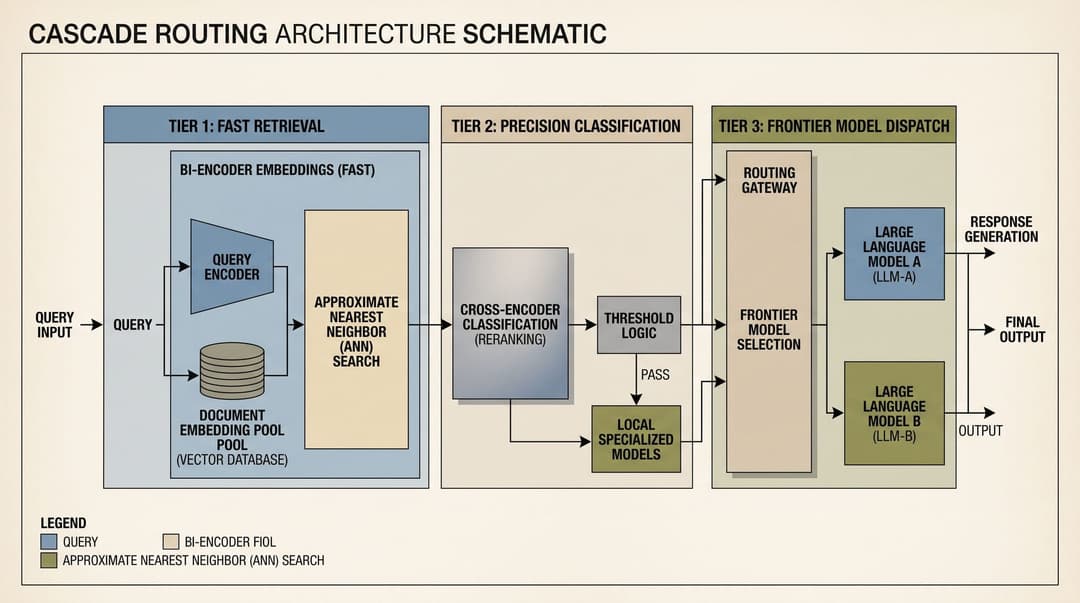
Production systems rarely rely on a single routing mechanism. Instead, they implement tiered cascades that trade latency against classification accuracy across four distinct stages:
User Query
    │
    ▼
[ Tier 0: Regex / Deterministic Filter ]  ── (Match) ──> Dispatch Tool / Cache (<1ms)
    │ (No match)
    ▼
[ Tier 1: Bi-Encoder + Linear Probe ]     ── (High Conf) ──> Route Model / Target (10-30ms)
    │ (Confidence < Threshold)
    ▼
[ Tier 2: Small Fine-Tuned Cross-Encoder] ── (High Conf) ──> Route Model / Target (40-80ms)
    │ (Ambiguous / Out-of-Scope)
    ▼
[ Tier 3: Frontier LLM Triage / Planner ] ──> Dynamic Tool Calling (>500ms)
Tier 0: Deterministic Fast Paths (<1ms)
Exact keyword matches, regex filters, and command prefixes bypass embedding generation entirely. Explicit system commands (such as /reset, /export, or standardized query templates) execute instantaneously.
Tier 1: Bi-Encoder Embedding Probes (10–30ms)
High-throughput embedding models evaluate cosine proximity or pass dense representations through a trained linear classifier. This stage resolves 75% to 90% of routine traffic, correctly triaging common queries without invoking expensive language model passes.
Tier 2: Fine-Tuned Cross-Encoder Classifiers (40–80ms)
Queries that yield ambiguous confidence scores (e.g., between 0.60 and 0.80 similarity) escalate to a compact cross-encoder (such as ModernBERT or a SetFit classifier). Cross-encoders perform joint attention over the query and candidate intent descriptions, capturing syntactic nuances and negations that bi-encoders miss.
Tier 3: Frontier LLM Fallback (>500ms)
Only truly novel, multi-intent, or unstructured inputs reach an LLM classification prompt or dynamic function-calling loop. Restricting LLM triage to this long-tail fraction preserves overall cluster throughput and controls operational spend.
Production Implementation Guidelines
Deploying semantic routers into production environments requires continuous calibration and observability:
- Calibrate Per-Route Thresholds: Different intent classes exhibit distinct dispersion in vector space. Tightly defined intents (such as SQL schema queries) require strict thresholds (e.g., 0.82 cosine similarity), while broader conversational routes require relaxed thresholds (e.g., 0.70) combined with second-tier verification.
- Implement Out-of-Scope Rejection: Explicitly include negative synthetic samples and general conversational utterances in the router index. Testing candidate queries against an explicit out-of-scope bucket prevents ambiguous questions from misrouting to specialized database tools.
- Log Vector Drift and Misclassifications: Maintain audit logs of query vectors alongside downstream execution results. When downstream tools report execution errors or user corrections occur, flag those queries to retrain linear probe heads and update reference utterance sets.
