

Self-Taught Reasoner (STaR) and Quiet-STaR: Mathematical Foundations, Rationalization Dynamics, and Bootstrapped Reasoning in Large Language Models
Chain-of-thought prompting enables autoregressive transformers to solve multi-step arithmetic, symbolic logic, and commonsense reasoning tasks by emitting intermediate tokens before generating a final answer. However, scaling chain-of-thought capabilities faces a fundamental data bottleneck: supervised datasets of high-quality, human-annotated reasoning traces are expensive, narrow in scope, and difficult to construct at trillion-token pre-training scales.
The Self-Taught Reasoner (STaR) framework and its generalized successor Quiet-STaR resolve this bottleneck by treating reasoning traces as latent variables. Instead of relying on static human annotations, these architectures allow language models to bootstrap their own rationales iteratively: sampling candidate trajectories, filtering or rewarding traces based on downstream verification, and updating model parameters through supervised fine-tuning or reinforcement learning.
The Supervision Bottleneck in Multi-Step Reasoning
Standard autoregressive language models predict the next token by maximizing the log-likelihood of a sequence :
When presented with a complex prompt that requires multiple deductive steps to reach answer , standard direct prompting forces the model to compute in a single forward pass with fixed layer depth. This restricts the total computational graph (circuit depth) allocated to the reasoning process.
Chain-of-thought (CoT) expands this computation by introducing an intermediate sequence of rationale tokens , factoring the conditional probability into:
While effective, obtaining supervised triples across arbitrary domains is intractable. The core objective of bootstrapped reasoning algorithms is to discover effective rationale distributions automatically, optimizing the marginal likelihood of correct answers:
Mathematical Formulation of the Self-Taught Reasoner (STaR)
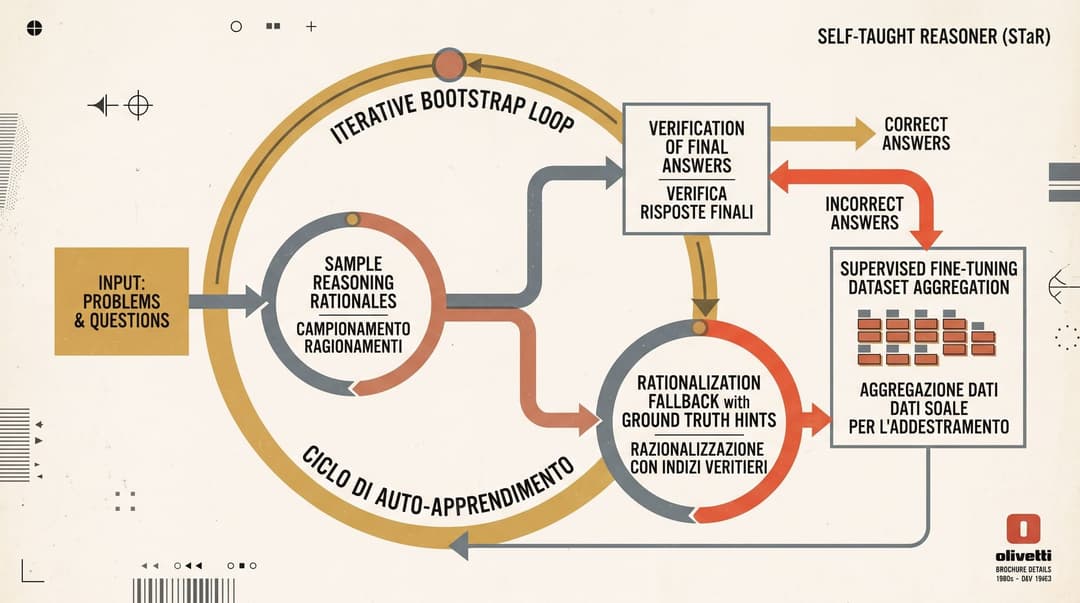
Introduced by Zelikman et al. (2022), the Self-Taught Reasoner operationalizes latent rationale discovery through an iterative expectation-maximization (EM) style loop over a dataset of query-answer pairs .
1. Sampling and Verification
In iteration , given a model parameterized by , the system samples a rationale and predicted answer for each problem using few-shot prompt conditioning:
A deterministic verifier evaluates whether the predicted answer matches ground truth:
Instances yielding correct answers are immediately retained for training:
2. Rationalization with Ground-Truth Conditioning
For instances where the model fails to generate a correct answer (), naive rejection sampling discards the sample, resulting in zero gradient signal on hard problems. STaR introduces rationalization: providing the correct answer as a hint in the prompt to guide rationale generation:
The model then evaluates whether this hint-conditioned rationale allows it to generate the correct answer without seeing the hint at answer time:
If , the rationale represents a valid deductive pathway from to . Crucially, the hint is stripped from the prompt, and the tuple is added to the rationalized dataset:
3. Policy Update and Iteration
The training set for iteration is constructed by aggregating successful direct samples and successful rationalizations:
Parameters are updated via standard supervised maximum likelihood estimation (MLE) over rationales and answers:
This cycle repeats iteratively. Rationalization acts as an exploration scaffold: as improves, problems that previously required hints become directly solvable in subsequent iterations, progressively shifting the rationale distribution toward high-reward trajectories.
Quiet-STaR: Generalizing Reasoning to Unstructured Pre-Training
While STaR demonstrated that models could bootstrap multi-step problem solving, it remained constrained to structured datasets with explicit question-answer pairs and discrete ground-truth labels.
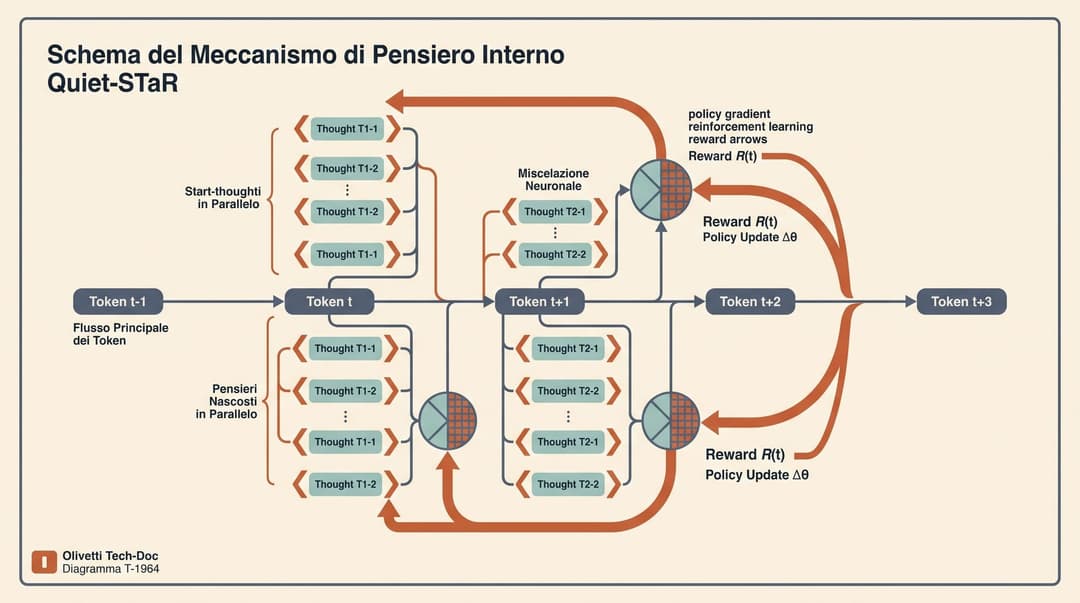
Quiet-STaR (Zelikman et al., 2024) generalizes this mechanism to arbitrary, unstructured text corpora. Instead of generating thoughts only when prompted with an explicit query, Quiet-STaR trains the language model to generate internal, hidden thought tokens at every token position during pre-training before predicting future text.
1. Parallel Token-Wise Thought Generation
Given an arbitrary sequence of observed tokens , Quiet-STaR generates a sequence of thought tokens bounded by learned special tokens ⟨|startofthought|⟩ and ⟨|endofthought|⟩.
Generating thoughts sequentially at each token position in a document of length would require autoregressive generation steps, creating an unfeasible computational overhead. Quiet-STaR circumvents this by using custom 4D attention masks that allow the model to generate parallel thoughts for all token positions in a single batched transformer forward pass:
- Base tokens attend only to preceding base tokens .
- Thought tokens generated at position attend to preceding base tokens and preceding thought tokens within their local branch .
- Thought tokens at position are masked from attending to thoughts generated at position , and base tokens cannot attend to past thought tokens directly.
2. Gated Mixing Head
Rather than forcing the model to rely strictly on its thoughts (which may initially be noisy or irrelevant), Quiet-STaR introduces a learned mixing head that dynamically balances base predictions and thought-augmented predictions.
Let denote the standard next-token probability distribution, and let denote the distribution conditioned on the generated thought branch. The mixing head computes an interpolation scalar via a linear projection of the final hidden states:
The final mixed prediction distribution is defined as:
3. Non-Myopic Lookahead Objective and Reward Computation
If a thought is evaluated solely on its ability to predict the immediately following token , the model tends to learn trivial copy operations or local syntactic hints rather than semantic reasoning.
Quiet-STaR addresses this by employing a non-myopic evaluation window of future tokens (). The utility of thought sequence is measured by the improvement in log-likelihood across the lookahead horizon:
To reduce variance during training, the baseline is computed across the batch of sampled candidate thought trajectories:
The centered reward for trajectory is:
4. Policy Gradient Optimization via REINFORCE
The parameters of the thought generator are optimized using REINFORCE. The gradient of the expected reward with respect to model parameters is:
To ensure optimization stability, negative rewards can be clamped or rectified, preventing early policy collapse when initial thoughts are low quality:
Simultaneously, the language modeling head and mixing head are trained using standard cross-entropy loss on future ground-truth text:
The composite loss function optimized during training is:
where controls the relative weight of the policy gradient update.
Architectural Comparison: STaR, Quiet-STaR, and Modern Reasoning Frameworks
The evolution from prompt-specific bootstrapping to continuous latent thought generation highlights distinct trade-offs in data efficiency, computational complexity, and inference latency.
Key Architectural Dimensions
- Supervision Signal:
- STaR (2022): Task-specific query-answer pairs paired with discrete correctness verification.
- Quiet-STaR (2024): Arbitrary unstructured raw text evaluated via next-token and multi-token future log-likelihood.
- Verification RL (e.g., GRPO / DeepSeek-R1): Problem prompts paired with ground-truth unit tests, math verification engines, or rule-based reward checkers.
- Thought Generation Scope:
- STaR: Per-query sequential chain-of-thought prefix emitted before the final answer.
- Quiet-STaR: Per-token parallel intermediate thought branches generated across all sequence positions simultaneously.
- Verification RL: Full-sequence reasoning trajectories wrapped in structured reasoning tags (
<think> ... </think>). - Training Objective:
- STaR: Supervised maximum likelihood estimation (MLE) over verified and rationalized trace subsets.
- Quiet-STaR: Joint cross-entropy on future ground-truth text combined with REINFORCE policy gradients over thought trajectories.
- Verification RL: Group-relative policy gradient optimization (GRPO/PPO) with advantage normalization across sampled trajectories.
- Exploration Scaffolding:
- STaR: Rationalization with ground-truth answer hints on initially failed queries.
- Quiet-STaR: Stochastic rollout across parallel thought branches evaluated against a baseline.
- Verification RL: High-temperature exploration, best-of-N rollouts, and self-consistency sampling over verifiable domains.
- Primary Failure Modes:
- STaR: Post-hoc rationalization shortcuts and hint memorization.
- Quiet-STaR: High activation memory overhead during training and degenerate thought drift on simple syntactic transitions.
- Verification RL: Reward hacking, superficial verifier gaming, and uncontrolled reasoning token bloat.
Theoretical Challenges and Failure Modes
1. The Rationalization Bias in STaR
In STaR's rationalization step, conditioning the rationale generator on the correct answer () introduces a potential distribution shift. If the model learns to generate post-hoc justifications that rely on reverse-engineering the hint rather than generalizable forward deductions, the rationalized traces provide low utility when the model is evaluated on unseen test prompts where hints are absent. Ensuring that the rationale alone () remains causally sufficient without latent hint leakage is critical.
2. Credit Assignment Across Extended Horizons
In Quiet-STaR, assigning token-level credit across an -token lookahead window suffers from the credit assignment problem common to reinforcement learning. A thought generated at token may contain a valid insight that only affects prediction at token , well beyond typical lookahead windows (). Expanding linearly increases memory footprint and attention complexity during training.
3. Training Compute vs Serving Economics
Generating parallel thought branches of length for every token in a sequence multiplies the training activation memory and FLOP requirements by a factor proportional to . While custom 4D attention masks allow parallel execution, Quiet-STaR requires substantial compute budgets compared to standard next-token pre-training. At inference time, deciding when to activate thought tokens requires calibrated gating mechanisms to prevent 4x to 8x latency degradation on standard text generation tasks.
Sources
- STaR: Bootstrapping Reasoning With Reasoning (Zelikman et al., NeurIPS 2022 / arXiv:2203.14465)
- Quiet-STaR: Language Models Can Teach Themselves to Think Before Speaking (Zelikman et al., 2024 / arXiv:2403.09629)
- Quiet-STaR Official Open-Source Implementation (GitHub)
- Chain-of-Thought Prompting Elicits Reasoning in Large Language Models (Wei et al., NeurIPS 2022 / arXiv:2201.11903)
- DeepSeekMath: Pushing the Limits of Mathematical Reasoning in Open Language Models (Shao et al., 2024 / arXiv:2402.03300)
