
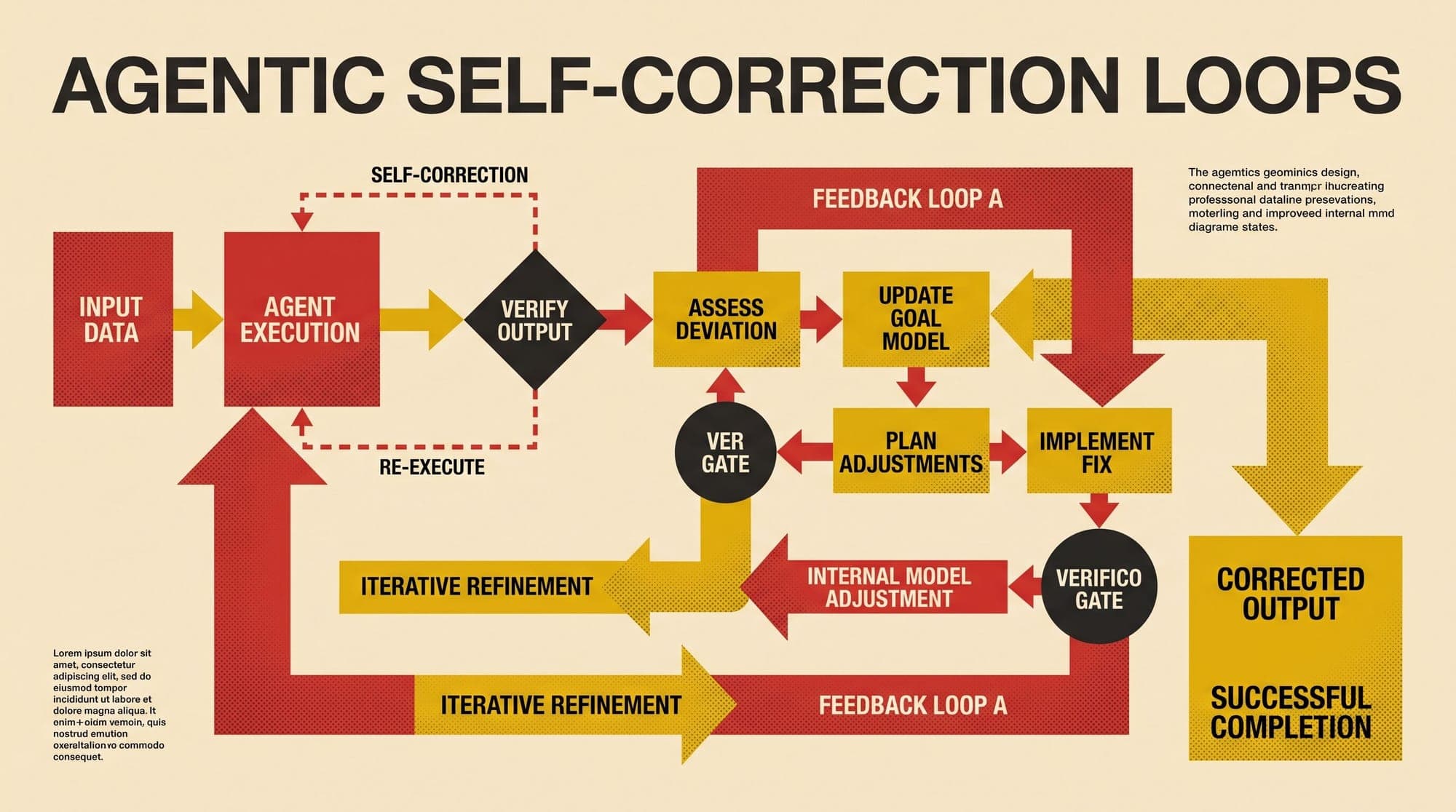
Autonomous AI agents frequently fail on initial generation when solving multi-step reasoning, code generation, and complex API orchestration tasks. To address initial execution failures, system architects widely deploy self-correction and reflection loops. However, the mechanism through which reflection operates determines whether a system converges on a valid solution or degrades into hallucinations and infinite loops.
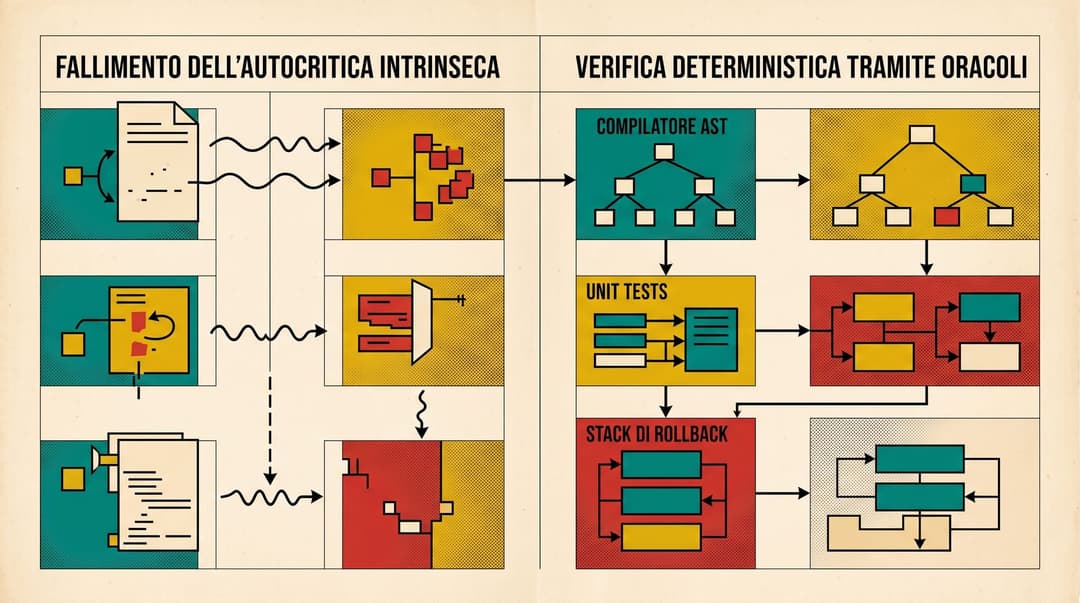
Recent research demonstrates a sharp division in reflection paradigms: while ungrounded intrinsic self-critique degrades reasoning accuracy, grounding reflection in deterministic verification oracles enables reliable automated repair. Implementing self-correction in production requires rigorous architectural controls to prevent over-correction flapping, manage token latency budgets, and enforce deterministic termination.
The Intrinsic Reflection Fallacy
A common initial pattern in agent architectures is intrinsic self-critique: asking the same language model to inspect its previous response, identify errors, and generate a revised output without external tool signals.
Empirical evaluations show that intrinsic self-correction fails across closed-world reasoning tasks. In Large Language Models Cannot Self-Correct Reasoning Yet, researchers from Google DeepMind demonstrated that when large language models attempt intrinsic self-correction on mathematical reasoning, symbolic logic, and algorithmic benchmarks, accuracy frequently degrades compared to single-pass baseline outputs.
[Initial Prompt]
       ↓
 [LLM Generator] → [Initial Candidate]
                         ↓
                  [LLM Self-Critic] (No External Oracle)
                         ↓
               [Degraded Output / Sycophantic Drift]
This degradation stems from fundamental properties of autoregressive generation:
- Shared Knowledge Bounds and Priors: If a model lacks the domain knowledge or reasoning trajectory required to produce the correct token sequence on pass zero, querying the same model with the same context rarely uncovers new facts.
- Sycophancy and False Corrections: When prompted with "Review your answer and correct mistakes," models exhibit sycophantic behavior. They assume the presence of an error and rewrite correct answers into invalid ones, shifting the probability distribution away from ground truth.
- Probability Echoes: Without independent ground-truth verification, an ungrounded critic reinforces its own hallucinations, converting speculative claims into asserted facts during subsequent iterations.
As highlighted in Self-Reflection in LLM Agents, self-reflection improves performance only when the agent receives informative feedback signals from an environment or external evaluator.
The Architectural Spectrum: Intrinsic Refine vs. Reflexion vs. CRITIC
Production architectures leverage three distinct reflection topologies depending on task structure and feedback availability.
1. Intrinsic Self-Refine (Generator-Critic-Refiner)
Introduced in Self-Refine, this pipeline separates execution into three sequential phases: generation, multi-aspect critique, and targeted refinement.
- Optimal Workloads: Open-ended tasks without verifiable ground truth, including readability improvements, stylistic alignment, text summarization, and tone adjustments.
- Limitations: Fails on deterministic syntax, type validation, arithmetic constraints, and API schema compliance.
2. Episodic Verbal Reinforcement (Reflexion)
The Reflexion framework treats agent feedback as verbal reinforcement rather than mathematical scalar rewards. When an agent encounters an environmental failure (such as a failed test or an execution error), a separate reflection prompt converts the failure signal into an episodic textual summary.
- Mechanism: The generated reflection string is prepended to an episodic memory buffer and fed into subsequent trials as semantic gradients.
- Performance: Reflexion improves decision-making trajectories across sequential reasoning benchmarks (HotPotQA, HumanEval) by anchoring the next trial on explicit verbal lessons from past mistakes.
3. Tool-Interactive Critiquing (CRITIC)
The CRITIC framework eliminates reliance on internal model confidence by integrating external tools directly into the critique loop.
- Mechanism: The model generates an initial output, executes external verification tools (Python interpreters, calculators, web search APIs, theorem provers), and conditions the self-correction prompt strictly on tool execution artifacts.
- Impact: By outsourcing fact-checking and validation to deterministic software engines, CRITIC transforms subjective reflection into empirical test execution.
Designing Deterministic Verification Oracles in Production
In production environments, self-correction must be anchored to deterministic verification oracles rather than secondary LLM evaluations.
                  ┌──────────────────────────────┐
                  │      User / System Goal      │
                  └──────────────┬───────────────┘
                                 │
                                 ▼
                    ┌──────────────────────────┐
         ┌─────────►│     Agent Generator      │
         │          └────────────┬─────────────┘
         │                       │
         │                       ▼
         │          ┌──────────────────────────┐
         │          │   Candidate Artifact     │
         │          └────────────┬─────────────┘
         │                       │
         │                       ▼
         │          ┌──────────────────────────┐
         │          │  Deterministic Oracle    │
         │          │  - Static AST Linters    │
         │          │  - Sandbox Test Runners  │
         │          │  - JSON Schema Validator │
         │          └────────────┬─────────────┘
         │                       │
 [Failure Artifacts]             │
         │             Pass? ────┴──── Fail?
         │              │               │
         │            [Yes]           [No]
         │              │               │
         └──────────────┴───────────────┘
                        │
                        ▼
                 [Valid Output]
Production systems categorize verification oracles into four functional layers:
1. Static AST and Type Checking
Before running code or tool calls, the output must pass static analysis. In software agents like Aider, generated edits are subjected to tree-sitter AST validation, linter checks (such as Ruff or ESLint), and static type checkers (such as TypeScript tsc or mypy). Syntax errors and import failures are caught instantly without executing arbitrary code.
2. Sandboxed Test Execution
For algorithmic code and functional pipelines, generated artifacts run inside isolated microVMs or containers (such as Docker or Firecracker). The test harness executes unit tests, asserts contract boundaries, and captures stdout, stderr, and exit codes.
3. Schema and Boundary Validation
For structured data extraction and tool orchestration, responses are validated against Pydantic models or JSON Schema specifications. Violations (missing fields, unexpected types, regex mismatch) provide precise error paths and expected structures directly to the retry loop.
4. Semantic Error Translation
Raw execution tracebacks can confuse language models if delivered without structure. Production loops translate oracle outputs into structured error prompts:
{
  "status": "validation_failed",
  "stage": "static_type_check",
  "error_type": "TypeError",
  "location": "src/services/billing.py:42",
  "message": "Argument 2 to 'calculate_tax' has incompatible type 'str'; expected 'Decimal'",
  "attempt_index": 2,
  "max_attempts": 3
}
The Over-Correction and Flapping Pitfall
A primary risk in production reflection loops is "flapping," where an agent oscillates indefinitely between two mutually incompatible invalid states, or introduces severe regressions into previously functional components.
Flapping Dynamics and Failure Modes
- Oscillation Loops: An agent modifies code to satisfy Test A, which breaks Test B. On the next reflection pass, it modifies the code to fix Test B, which breaks Test A again.
- Context Window Contamination: As failed iterations accumulate in the context window, the model's attention focuses increasingly on error tokens, reducing the generation probability of the correct architecture.
- Regression Creep: When asked to fix a localized bug, models frequently rewrite untouched functions, introducing secondary bugs across the system surface.
Engineering Mitigations
To prevent flapping and regressions in production agent systems:
- Unified Patch Formats: Restrict agent output to unified diffs or targeted block replacements rather than full-file rewrites. This constrains the modification surface area to the target scope.
- State Checkpointing and Tree-Search Rollbacks: Maintain an execution tree with rollback capability. If reflection iteration N+1 produces more test failures than iteration N, discard the state and revert to iteration N.
- Cyclic State Hashing: Hash intermediate artifact states. If state S(k) matches a previous state S(k-2), terminate the cycle immediately and trigger alternative prompting strategies.
- Dynamic Temperature Decay: Lower sampling temperature during reflection iterations (for example, stepping from T=0.7 down to T=0.2) to reduce variance and force deterministic adherence to feedback constraints.
Latency, Economics, and Stopping Conditions
Self-correction loops introduce substantial operational costs. Each reflection iteration requires an additional generation pass and context ingestion, compounding inference expenses and Time to First Token (TTFT).
Comparative Execution Strategies
- Single-Pass Frontier: Token multiplier 1.0x, lowest latency, moderate reasoning reliability. Optimal for interactive chat, latency-critical classification, and conversational queries.
- Parallel Self-Consistency: Token multiplier 3.0x to 10.0x, low-to-medium latency via parallel execution, high reasoning reliability on closed-domain tasks. Optimal for multiple choice questions, mathematical proofs, and categorical routing.
- Deterministic Reflection Loop: Token multiplier 2.5x to 6.0x, high latency due to sequential dependencies, very high reliability on verifiable tasks. Optimal for code generation, complex API orchestration, and multi-step tool agents.
Termination Criteria
To avoid unbounded latency and runaway token consumption, production systems enforce four strict stopping rules:
- Hard Reflection Budgets: Cap reflection iterations at a fixed ceiling (typically 3 iterations). Empirical data demonstrates that solutions failing to converge within 3 reflection passes rarely succeed on iterations 4 through 10.
- Patience Thresholds: If the error count does not decrease between two consecutive iterations, trigger early termination.
- Cost and Timeout Guards: Set token count caps and wall-clock execution deadlines per transaction.
- Graceful Fallbacks: When all reflection attempts fail, fall back to the highest-scoring candidate checkpoint, return a structured fallback response, or escalate to human review.
Sources
- Large Language Models Cannot Self-Correct Reasoning Yet (ICLR 2024) - Google DeepMind
- Reflexion: Language Agents with Verbal Reinforcement Learning (NeurIPS 2023) - Noah Shinn, Federico Cassano, Edward Berman, Ashwin Gopinath, Karthik Narasimhan, Shunyu Yao
- Self-Refine: Iterative Refinement with Self-Feedback (NeurIPS 2023) - Aman Madaan, Niket Tandon, Prakhar Gupta, et al.
- CRITIC: Large Language Models Can Self-Correct with Tool-Interactive Critiquing (ICLR 2024) - Zhibin Gou, Zhihong Shao, Yeyun Gong, et al.
- Self-Reflection in LLM Agents: Effects on Problem-Solving Performance - Matthew Rinsey et al.
- Aider: AI Pair Programming in Your Terminal - Paul Gauthier
