
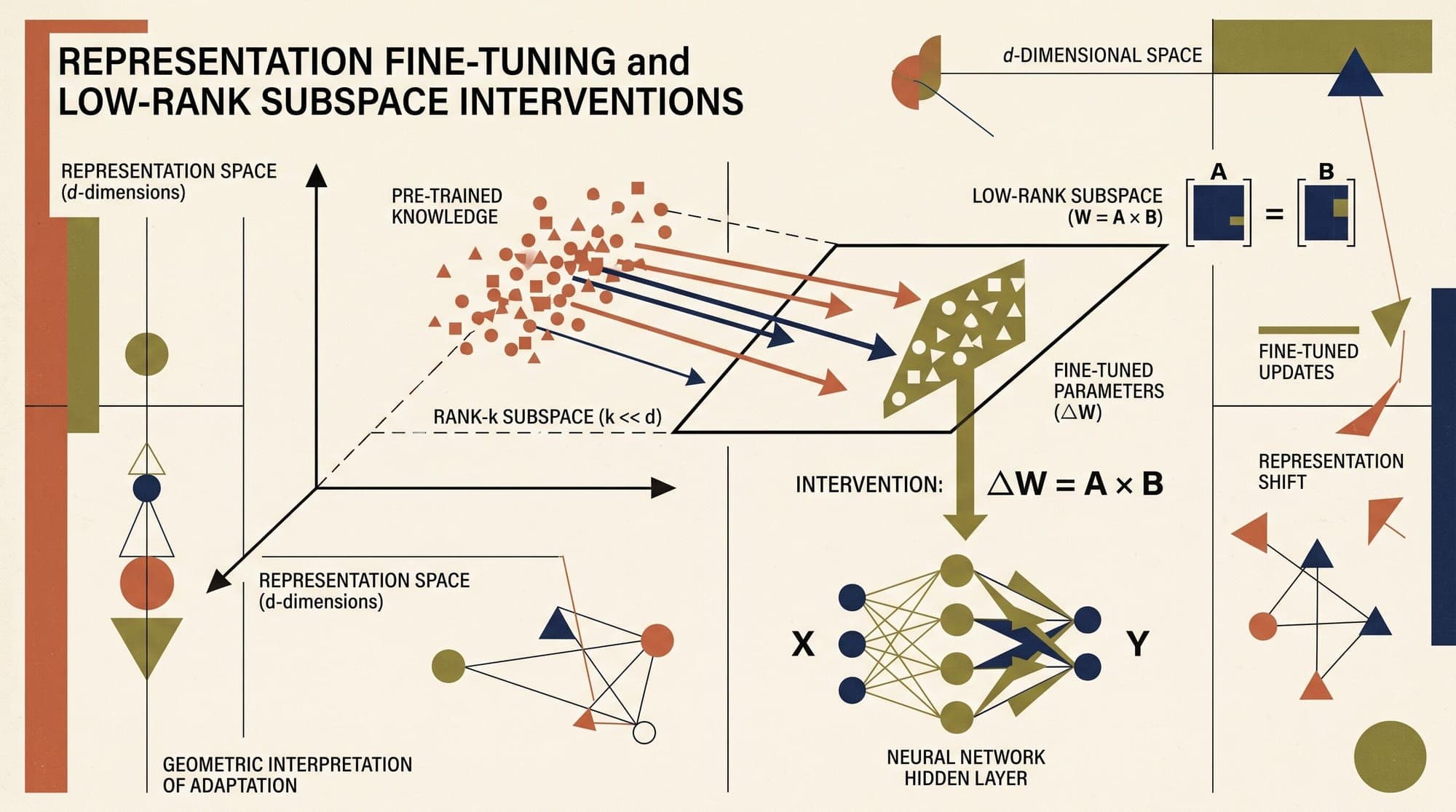
Representation Fine-Tuning (ReFT) introduces a parameter-efficient adaptation paradigm that operates directly on the hidden representations of frozen language models rather than updating or augmenting model weight matrices. Developed by researchers at Stanford University (Wu et al., 2024), ReFT leverages insights from mechanistic interpretability and causal abstraction to steer model behavior through learned low-rank subspace interventions. By editing internal activations at targeted sequence positions and transformer layers, ReFT methods match or exceed the performance of standard parameter-efficient fine-tuning (PEFT) approaches such as Low-Rank Adaptation (LoRA) while requiring 10x to 50x fewer trainable parameters.
The Paradigm Shift: Weight Adaptation vs. Representation Intervention
Traditional parameter-efficient fine-tuning approaches modify the computational graph by adjusting weight matrices:
- Weight-Space Adapters (LoRA, QLoRA, DoRA): Inject low-rank weight updates into linear projection layers (attention queries, keys, values, and feed-forward projections), reparameterizing model weights.
- Prefix and Prompt Tuning: Prepend learnable virtual token embeddings or key-value prefix states to the sequence inputs.
- Bottleneck Adapters: Insert residual multi-layer perceptrons between frozen transformer sub-layers.
While effective, weight-space adaptation requires updating millions of parameters distributed across all transformer layers. Mechanistic interpretability research demonstrates that intermediate hidden representations encode structured semantic concepts, factual associations, and task instructions within distinct linear subspaces (Geiger et al., 2024; Wu et al., 2024).
ReFT builds on this foundation by shifting the locus of adaptation from model weights to internal activation vectors. Instead of learning global matrix perturbations , ReFT learns localized intervention functions applied to specific token positions during the forward pass.
Causal Foundations and Distributed Interchange Interventions
The theoretical foundation of ReFT originates in causal abstraction and Distributed Interchange Interventions (DII). In causal interpretability analysis, interchange interventions replace the internal representation of a base input with an activation vector extracted from a counterfactual source input to determine which neural circuits control specific model outputs.
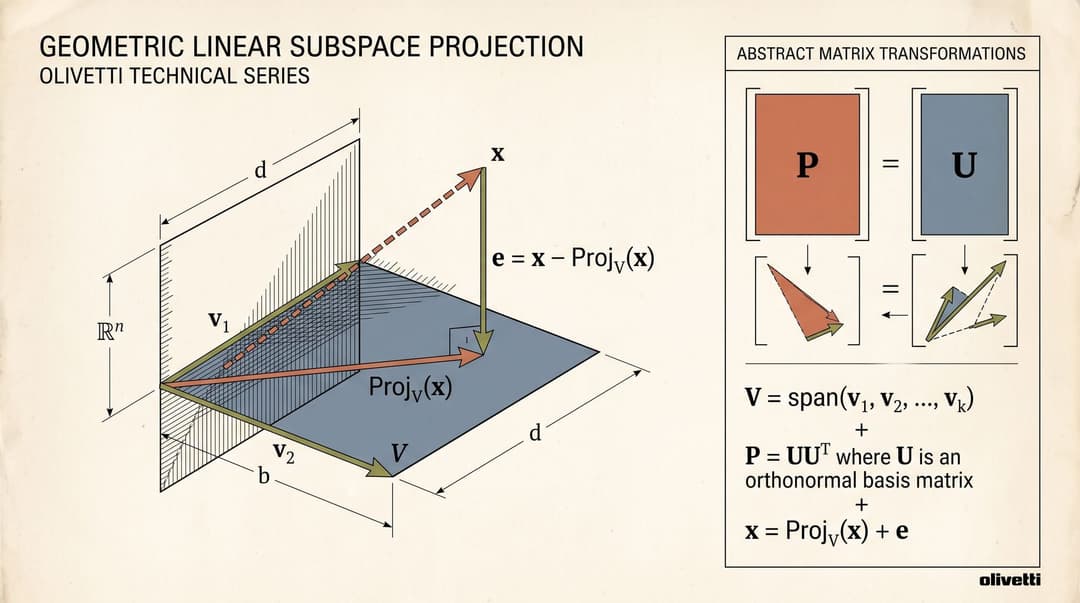
DII generalizes standard interchange interventions by projecting representations into a learned orthogonal coordinate basis, altering only the task-relevant linear subspace while leaving orthogonal components untouched. ReFT repurposes this diagnostic mechanism as a supervised training objective: rather than borrowing source representations from alternative inputs, the model trains parameterized intervention functions to synthesize the optimal subspace representations for downstream task completion.
Mathematical Formulation of LoReFT
The primary formulation in the ReFT family is Low-Rank Linear Subspace ReFT (LoReFT). Let be a frozen autoregressive transformer with hidden dimension . For a hidden state produced at layer and sequence position , the LoReFT intervention function is defined as:
Where:
- is a low-rank projection matrix with orthonormal rows satisfying , where denotes the subspace rank.
- is a learnable linear mapping matrix.
- is a learnable bias vector.
Geometric Decomposition
The operation of decomposes the ambient activation space into two orthogonal subspaces:
- Task Subspace: Spanned by the rows of , with orthogonal projector .
- Invariant Subspace: The orthogonal complement, with projector .
Expanding the LoReFT formulation reveals the exact subspace substitution:
This decomposition demonstrates that LoReFT performs two simultaneous operations:
- It preserves all information lying in the -dimensional orthogonal complement without distortion.
- It completely replaces the -dimensional projection with the learned affine representation .
ReFT Variants and Ablations
The ReFT framework encompasses several architectural variants:
- Direct Linear Subspace ReFT (DiReFT): Constrains , reducing the intervention to . The target subspace coordinates depend solely on the learned bias vector regardless of the input activation .
- No-Orthogonality ReFT (NoReFT): Removes the orthonormality constraint , allowing to be optimized freely in unconstrained matrix space. Empirical evaluations indicate that enforcing orthonormality is critical for numerical stability and generalization.
Intervention Topologies and Parameter Footprint
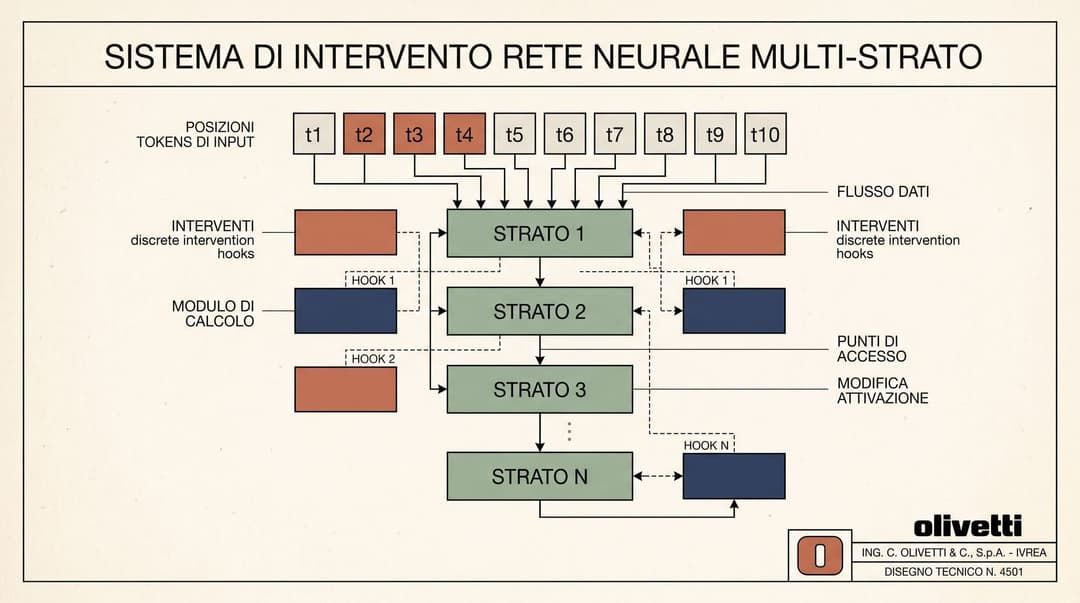
A full ReFT configuration is defined by a set of interventions , specifying target layers , sequence positions , and intervention parameterizations .
Position Scheduling
Interventions are typically applied to a small subset of prompt token positions:
- Prefix Interventions (): Applied to the first tokens of the input prompt (e.g., initial system tokens or sequence delimiters).
- Suffix Interventions (): Applied to the last tokens of the prompt before generation begins.
- Generation Phase: ReFT interventions are computed only during prompt encoding (prefill). Autoregressive decoding tokens attend to the edited prefix and suffix representations stored in the key-value (KV) cache without requiring recurrent intervention execution.
Parameter Efficiency Comparison
For a single LoReFT intervention block with rank and hidden dimension , the trainable parameter count is:
Consider a LLaMA-7B or LLaMA-8B architecture (, 32 layers):
- LoRA (Rank , targeting all linear projections across 32 layers): Requires approximately 18.8 million parameters (~0.27% of base model weights).
- LoRA (Rank , targeting attention projections only): Requires approximately 4.2 million parameters (~0.06% of base model weights).
- LoReFT (Rank , applied across 16 layers at 2 prompt positions): Requires million parameters (~0.015% of base model weights).
- LoReFT (Rank , single-layer intervention): Requires as few as 8,193 trainable parameters (~0.0001% of base model weights).
Training Dynamics and Implementation Architecture
During training, base model weights remain strictly frozen. The training objective minimizes standard autoregressive cross-entropy loss over output tokens given input context :
Orthogonality Enforcement
To guarantee , training frameworks such as pyreft and pyvene parameterize using Riemannian optimization or differentiable matrix parameterizations:
- Cayley Parameterization: Parameterizes an orthogonal matrix via a skew-symmetric matrix using the Cayley transform .
- Gram-Schmidt / QR Decomposition: Applies QR decomposition to an unconstrained parameter matrix at each forward pass, propagating gradients through the orthogonal factor .
Inference Execution and Serving Characteristics
ReFT exhibits distinct serving characteristics compared to weight-space PEFT:
- Zero Base Model Modifications: Base model weights are never altered or patched, avoiding weight drift across concurrent tasks.
- Runtime Activation Hooking: Executing ReFT requires inference engines (such as PyTorch or specialized vLLM hooks) to support tensor modification callbacks after targeted transformer sub-layers.
- KV Cache Persistence: Because interventions execute during the prompt prefill phase, edited hidden states propagate directly into the standard self-attention key-value cache. Autoregressive token generation runs at full baseline hardware efficiency.
Empirical Benchmarks and Comparative Analysis
In comprehensive evaluations across natural language processing and reasoning benchmarks (Wu et al., 2024), LoReFT demonstrated notable performance profiles:
- Commonsense Reasoning (GSM8K, StrategyQA, ARC): On LLaMA-7B and LLaMA-2-13B, LoReFT with matched or outperformed LoRA and full fine-tuning baselines while utilizing 15x to 50x fewer parameters.
- Instruction Tuning (Alpaca-Eval v1.0): LoReFT achieved an 82.3% win rate against text-davinci-003, comparable to LoRA (82.7%) while modifying only 0.01% of total parameters.
- GLUE Benchmark: Across classification and inference tasks (MNLI, QQP, SST-2), LoReFT consistently outperformed Prefix Tuning and Adapter modules across equal parameter budgets.
Architectural Trade-Offs
While ReFT establishes new parameter efficiency bounds, production deployment involves specific engineering considerations:
- Parameter Storage vs. Serving Integration: ReFT reduces adapter checkpoint sizes from tens of megabytes to mere kilobytes, enabling rapid multi-tenant adapter swapping. However, unlike LoRA—which can be statically folded into model weights () for zero-overhead inference—ReFT requires forward-pass activation hook execution.
- Subspace Rank Sensitivity: Performance scales predictably with rank , with diminishing returns observed beyond or .
- Layer Distribution: Intervening in intermediate transformer layers (e.g., layers to ) yields higher downstream control than intervening in the earliest token embedding or final output projection layers.
Sources
- ReFT: Representation Finetuning for Language Models (Wu et al., 2024, arXiv:2404.03592)
- pyvene: A Library for Understanding and Improving PyTorch Models via Interventions (Wu et al., 2024, arXiv:2403.07809)
- pyreft: Stanford NLP Representation Finetuning Library (GitHub)
- Finding Alignments Between Interpretable Causal Variables and Distributed Neural Representations (Geiger et al., 2024, arXiv:2303.02536)
- LoRA: Low-Rank Adaptation of Large Language Models (Hu et al., 2021, arXiv:2106.09685)
