
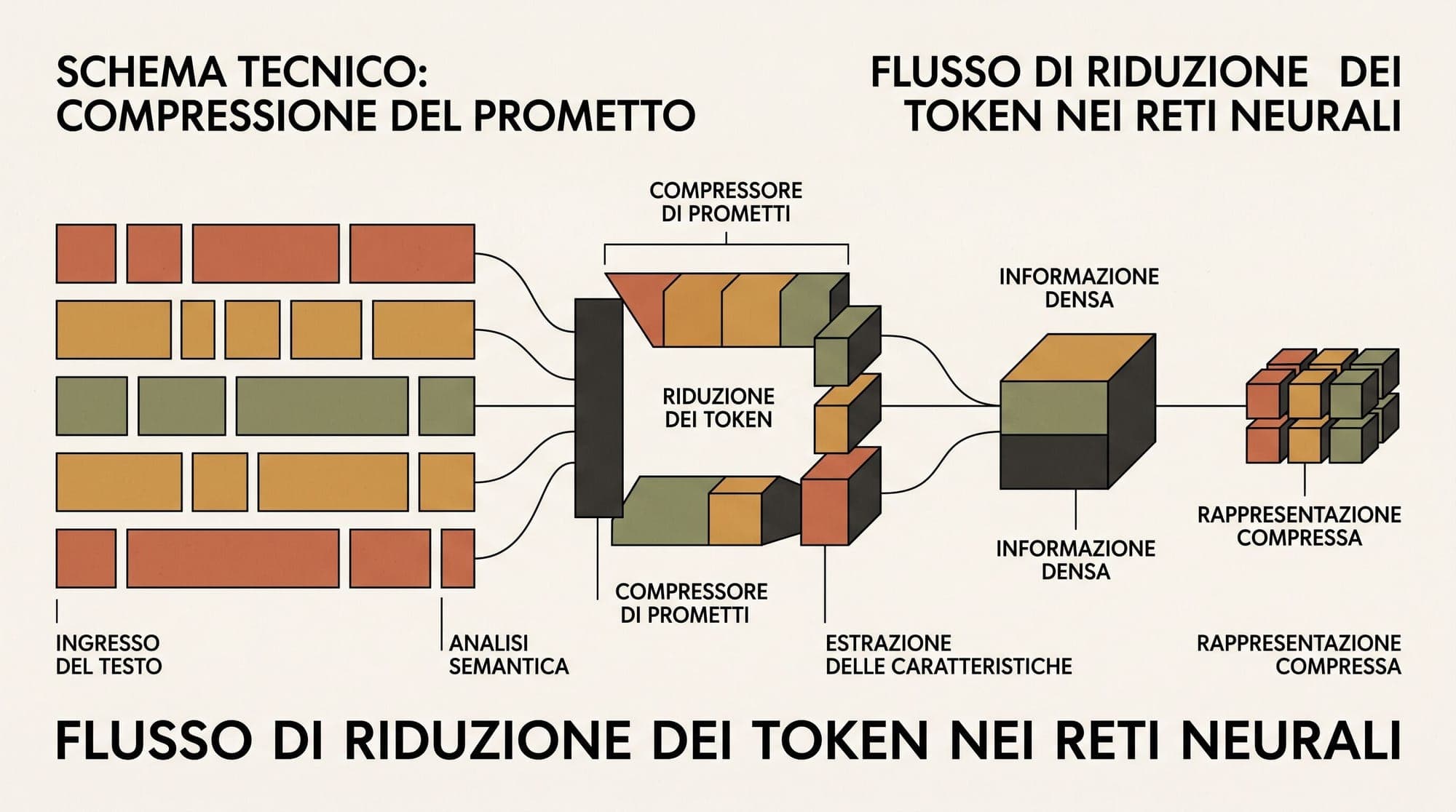
In high-throughput production LLM deployments, prompt length dominates both serving latency and inference costs. For multi-turn conversational agents, long-document retrieval-augmented generation (RAG), and multi-step agentic workflows, input contexts routinely scale from 8,000 to over 64,000 tokens. Because the prefill phase scales quadratically in raw attention FLOPs and linearly in key-value (KV) cache allocation, long prompts drive up Time To First Token (TTFT) and consume disproportionate GPU high-bandwidth memory (HBM). Furthermore, frontier LLM API pricing scales directly per input token, compounding operational expenses.
Prompt compression addresses this bottleneck by filtering out redundant or uninformative tokens from the input before passing the prompt to the target model. Unlike KV cache eviction methods that operate inside the inference engine during autoregressive decoding, extractive prompt compression modifies the raw token sequence at the gateway or orchestration layer. This approach remains fully compatible with black-box proprietary APIs (such as OpenAI, Anthropic, and Google) as well as self-hosted open-weight engines (such as vLLM and TensorRT-LLM).
Deploying prompt compression in production introduces complex trade-offs between compression latency, information retention, grammatical coherence, and downstream task accuracy. This analysis breaks down the four leading extractive compression architectures, evaluates their system-level overheads, and provides an engineering blueprint for integrating prompt compression into production serving stacks.
The Four Core Architectures
Extractive prompt compression has evolved from naive entropy-based lexical pruning to question-conditioned budget controllers and bidirectional token classification encoders.
1. Selective Context: Unsupervised Information-Theoretic Pruning
Introduced by Li et al. (2023), Selective Context applies Shannon information theory to identify and eliminate lexical redundancy. The core intuition is that natural language contains high syntactic redundancy; tokens or phrases with low negative log-likelihood (low self-information) under a small causal language model are predictable and can be dropped without losing core semantic meaning.
The self-information of a lexical unit (token, phrase, or sentence) given its preceding context is calculated as the negative log-probability under a small language model:
I(x_i) = -log P(x_i | x_1, x_2, ... x_{i-1})
Selective Context ranks units by their self-information scores and retains only the top percentile according to a target compression ratio (such as keeping the top 50% most informative units).
Key limitations in production:
- Context blindness: Units are scored sequentially, but when low-information tokens are dropped, the transition probabilities and semantic bindings between remaining disconnected tokens are not dynamically recalculated.
- Task agnosticism: Selective Context prunes prompts without conditioning on the downstream query or question. In retrieval tasks, critical entity names or numeric values might have low surprise in isolation yet remain vital for answering the user question.
2. LLMLingua: Coarse-to-Fine Perplexity Budgeting
To address the context degradation and information loss of naive pruning, Jiang et al. (2023, Microsoft Research) developed LLMLingua. LLMLingua implements a three-stage coarse-to-fine compression framework powered by a small autoregressive language model (such as LLaMA-2-7B or GPT-2-Alpaca):
- Budget Controller: Rather than applying a flat compression ratio across the entire prompt, the budget controller allocates dynamic compression ratios to different structural components (instruction, few-shot demonstration examples, retrieved context, and the user question). Components with higher entropy or task priority receive smaller compression ratios (retaining more tokens).
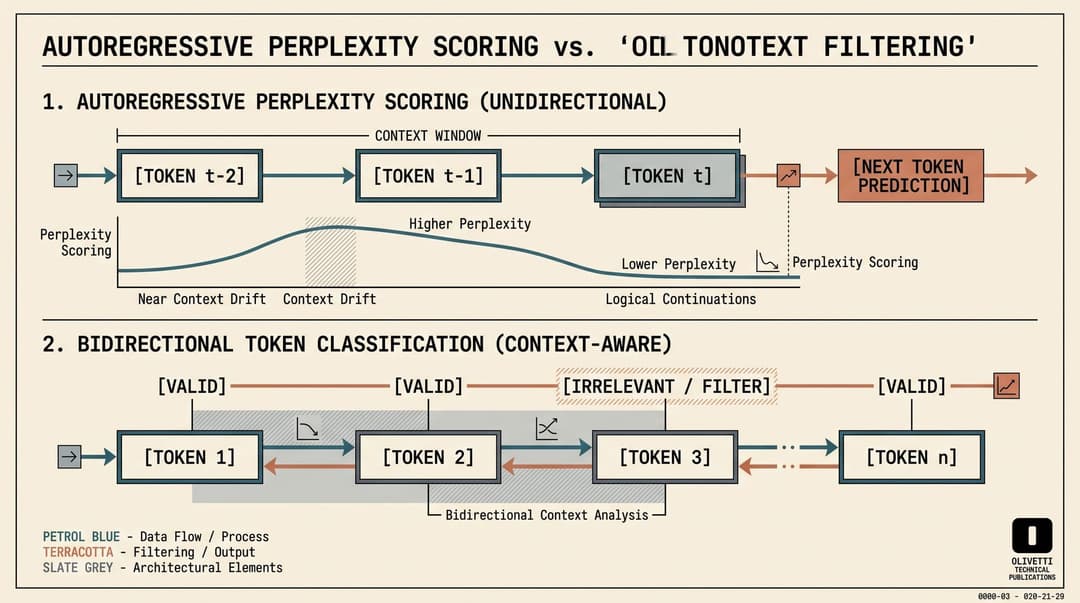
- Iterative Token-level Compression (ITC): Instead of one-pass scoring, ITC segments the prompt into small chunks and iteratively computes conditional perplexity. As tokens in preceding chunks are pruned, the conditional probability distribution for subsequent chunks is updated, preserving sentence-level coherence and reducing semantic drift.
- Distribution Alignment: LLMLingua introduces a probability calibration mechanism to reconcile distribution differences between the small compressor model and the downstream target LLM (such as GPT-4), preventing the compressor from dropping tokens that the target model relies on for reasoning.
LLMLingua achieves up to 20x compression on structured datasets like GSM8K and BBH while retaining core reasoning traces, but its autoregressive scoring loop introduces pre-processing latency when compressing multi-thousand-token prompts.
3. LongLLMLingua: Question-Aware RAG and Lost-in-the-Middle Mitigation
In long-context retrieval scenarios, standard prompt compressors often prune critical evidence because background documents outnumber the question context. Moreover, long-context LLMs suffer from the "lost in the middle" phenomenon identified by Liu et al. (2023), where models struggle to retrieve information placed in the middle of extended contexts.
Jiang et al. (2023/2024, Microsoft Research) introduced LongLLMLingua to explicitly optimize prompt compression for long-context RAG and question-answering pipelines through three specific mechanisms:
- Question-Conditioned Perplexity Scoring: Rather than scoring document tokens purely on previous context, LongLLMLingua computes conditional perplexity conditioned on the query:
P(x | q). Tokens that directly relate to resolving the question receive high retention priority. - Document Reranking and Dynamic Budgeting: LongLLMLingua calculates the mutual information between each retrieved document chunk and the query. Highly relevant documents receive larger token budgets, while irrelevant or noisy documents are heavily pruned or dropped entirely.
- Integrity and Position Reordering: Survived document chunks are reordered such that the most critical information is relocated to the beginning and end of the prompt context, mitigating position bias in the target LLM.
Empirical evaluations on NaturalQuestions and multi-hop benchmarks demonstrated that LongLLMLingua achieved up to 21.4% higher question-answering accuracy at 4x compression compared to feeding the raw uncompressed prompt, because removing retrieval noise improved the target LLM's attention focus.
4. LLMLingua-2: Task-Agnostic Compression via Data Distillation
While LongLLMLingua solves question-aware retrieval, its autoregressive scoring still relies on iterative forward passes through a causal LM, creating a latency bottleneck in real-time streaming applications.
To eliminate this overhead, Pan et al. (2024, Microsoft Research) introduced LLMLingua-2. LLMLingua-2 reframes prompt compression as an extractive token classification task rather than causal perplexity calculation:
- Data Distillation Formulation: The authors used GPT-4 to compress thousands of diverse text segments, annotating which tokens should be preserved to retain complete semantic meaning and grammatical validity.
- Bidirectional Encoder Architecture: A compact bidirectional encoder (such as XLM-RoBERTa-large or mBERT) is trained on this distilled dataset to predict a binary label (drop or keep) for every token in a single forward pass.
- Single-Pass Inference: By replacing causal token-by-token perplexity calculation with a bidirectional encoder classification, LLMLingua-2 operates 3x to 6x faster than LLMLingua-1, executing full prompt compression in under 15ms on an NVIDIA A10G or T4 GPU.
- Generalization and Chunking: LLMLingua-2 evaluates token importance within bidirectional sliding windows, preserving entity boundaries, negation words, and syntactic anchors without requiring task-specific fine-tuning.
Architectural Comparison across Production Metrics
Comparing the four methods across key production dimensions:
- Selective Context:
- Base Model: Causal LM (such as GPT-2 or LLaMA-7B)
- Mechanism: Unsupervised self-information filtering
- Passes: Single causal forward pass
- Latency Overhead: Moderate (~80 to 150ms per 4,000 tokens)
- Target Ratios: 2x to 3x
- Best Suited For: Lightweight offline text summarization
- LLMLingua:
- Base Model: Causal LM (such as LLaMA-2-7B or GPT-2-Alpaca)
- Mechanism: Coarse-to-fine iterative perplexity with dynamic budget control
- Passes: Multiple iterative chunked passes (ITC)
- Latency Overhead: High (~200 to 500ms per 4,000 tokens)
- Target Ratios: 2x to 5x (up to 20x on structured in-context learning)
- Best Suited For: Complex multi-shot reasoning and code synthesis
- LongLLMLingua:
- Base Model: Causal LM (such as LLaMA-2-7B)
- Mechanism: Question-conditioned perplexity with document reranking
- Passes: Multiple conditioned forward passes
- Latency Overhead: High (~250 to 600ms per 4,000 tokens)
- Target Ratios: 3x to 6x
- Best Suited For: High-density RAG pipelines with 20+ retrieved documents
- LLMLingua-2:
- Base Model: Bidirectional Encoder (such as XLM-RoBERTa-large)
- Mechanism: Distilled binary token classification
- Passes: Single bidirectional forward pass
- Latency Overhead: Low (~10 to 25ms per 4,000 tokens)
- Target Ratios: 2x to 5x
- Best Suited For: Low-latency streaming APIs, conversational agents, and real-time gateways
Production Integration and System Topology
Integrating prompt compression into an enterprise serving architecture requires placing the compression layer at the appropriate point in the request-response lifecycle.
Gateway Sidecar Architecture
In production, prompt compression is deployed as an independent microservice or Envoy/FastAPI sidecar positioned between the application gateway and the LLM routing proxy:
[Client Request]
       │
       ▼
[Application Router] ── (Extract: System Prompt, Context Docs, User Query)
       │
       ▼
[Compression Sidecar (LLMLingua-2 / XLM-R on T4/CPU)]
       │ (Prune retrieved context + history; preserve system instructions)
       ▼
[Compressed Prompt Assembly]
       │
       ▼
[LLM Inference Gateway (vLLM / TensorRT-LLM / OpenAI API)]
Deploying the compressor as a dedicated microservice running on low-cost hardware (such as AWS g4dn.xlarge with an NVIDIA T4 GPU or modern multi-core Xeon/EPYC CPUs with ONNX Runtime) ensures that compression overhead does not contend with primary LLM VRAM or compute allocations.
Interaction with Prefix Caching (vLLM RadixAttention / SGLang)
A critical systems-level consideration is the interaction between prompt compression and prefix caching. Modern serving engines like vLLM (via RadixAttention) and SGLang cache KV states for shared prompt prefixes across requests.
If prompt compression is applied indiscriminately to static system prompts or tool definitions, small token-level deletions will alter the prefix hash, destroying prefix cache hits.
Recommended Production Topology:
- Static System Prompts and JSON Schemas: Bypass compression completely (compression ratio = 1.0x) to ensure 100% prefix cache reuse.
- Retrieved RAG Documents: Apply aggressive compression (3x to 5x via LongLLMLingua or LLMLingua-2).
- Multi-Turn Chat History: Apply moderate compression (2x) using sliding-window token tagging.
- Current User Query: Bypass compression to avoid distorting user intent.
Latency and Cost Economics
To determine whether prompt compression provides a net benefit in production, engineers must evaluate the trade-off between compressor execution time and the latency saved during primary model prefill.
Latency Break-Even Formula
The total end-to-end latency for a compressed request is:
T_total = T_compress(N) + T_prefill(N / k) + T_decode(M)
where N is the original input token count, k is the compression ratio, and M is the generated output length.
Prompt compression yields a net latency improvement when:
T_compress(N) < T_prefill(N) - T_prefill(N / k)
For smaller target models (such as 7B or 8B parameters running on H100 SXM GPUs), T_prefill is fast (~0.5ms per 1,000 tokens), meaning that heavy autoregressive compressors like LLMLingua-1 will increase overall latency despite reducing token count.
However, for large frontier models (such as 70B+ models, deep reasoning models, or hosted API endpoints where queueing delays correlate with prompt token volume), saving 10,000 prompt tokens saves 150ms to 600ms of prefill and network transfer time. In this regime, LLMLingua-2 (which adds only ~15ms of overhead) delivers a substantial net latency reduction.
Cost Savings Profile
Consider an enterprise RAG application processing 1,000,000 queries per day, with an average input length of 8,000 tokens per query (8 billion tokens/day) routed to GPT-4o ($2.50 per 1M input tokens):
- Baseline Cost (Uncompressed): 8,000M tokens x $2.50/M = $20,000 per day
- With LLMLingua-2 (3x Compression on Context): Context compressed from 7,000 to 2,333 tokens (total prompt = 3,333 tokens -> 3.333B tokens/day):
- API Input Cost: 3,333M tokens x $2.50/M = $8,332.50 per day
- Compressor Infrastructure Cost: 4 AWS g4dn.xlarge instances ($2.10/hr total) = $50.40 per day
- Net Daily Savings: $11,617.10 per day (~58% overall cost reduction)
Production Pitfalls and Failure Modes
- Entity Splitting in Code and Structured Data: Naive token pruning can split variable names, code keywords, or JSON keys (such as dropping quotation marks or braces), causing downstream syntax parse failures. When processing structured context, regex-based boundary guards or schema validators should protect syntactic tokens from compression.
- Numeric and Quantifier Drop: In financial and medical domains, numbers, dates, and negative qualifiers ("not", "never", "except") carry outsized semantic weight despite low token frequency. LLMLingua-2 preserves these tokens significantly better than unsupervised self-information scoring, but domain-specific stop-token protection lists should be enforced.
- Prompt Injection Evasion: Attackers may construct adversarial prompts designed to exploit token-dropping heuristics, crafting malicious payloads that assemble into dangerous instructions only after compression strips surrounding filler tokens. Compression layers should be preceded by standard input sanitization filters.
Engineering Recommendations
- For Real-Time & Streaming Applications: Standardize on LLMLingua-2 using an XLM-RoBERTa backbone. The sub-20ms single-pass latency overhead ensures that the compression step does not degrade Time To First Token.
- For Complex Multi-Document RAG: Deploy LongLLMLingua with question-aware document scoring when context exceeds 32,000 tokens, prioritizing noise reduction and document reordering over raw speed.
- Preserve Static Prefixes: Always isolate system prompts, few-shot templates, and JSON schemas from compression to maintain maximum cache hits under engine-level KV prefix caching.
Update (Oct 19, 2026)
- Selective Context drops low self-information content from the prompt (Li et al., 2023). RECOMP compresses retrieved documents with extractive or abstractive compressors before they reach the model (Xu et al., 2023).
- Compaction can drop constraints: Lost in Context Compaction studies how LLM systems lose side constraints when context is compacted.
- Compression and prompt caching conflict: provider prompt caches reuse work only for an exact matching prefix (OpenAI docs; Anthropic docs). A compressor that rewrites the system prompt or other early tokens breaks the match and forces a full prefill. Keep system instructions and tool schemas out of the compressor, and compress only the retrieved documents or older turns that come after the cached prefix.
Sources
- Li, Y., et al. (2023). Compressing Context to Enhance Inference Efficiency of Large Language Models (Selective Context). arXiv:2310.06201.
- Jiang, H., Wu, Q., Lin, C. Y., Yang, Y., & Qiu, L. (2023). LLMLingua: Compressing Prompts for Accelerated Inference of Large Language Models. EMNLP 2023. arXiv:2310.05736.
- Jiang, H., Wu, Q., Luo, X., Li, D., Lin, C. Y., Yang, Y., & Qiu, L. (2023/2024). LongLLMLingua: Accelerating and Enhancing LLMs in Long Context Scenarios via Prompt Compression. ACL 2024. arXiv:2310.06839.
- Pan, Z., et al. (2024). LLMLingua-2: Data Distillation for Efficient and Faithful Task-Agnostic Prompt Compression. Findings of ACL 2024. arXiv:2403.12968.
- Liu, N. F., Lin, K., Hewitt, J., Paranjape, A., Bevilacqua, M., Petroni, F., & Liang, P. (2023). Lost in the Middle: How Language Models Use Long Contexts. arXiv:2307.03172.
- Zheng, L., et al. (2023). SGLang: Efficient Execution of Structured Language Model Programs (RadixAttention). arXiv:2312.07104.
- Selective Context: Unlocking Context Constraints of LLMs
- RECOMP: Improving Retrieval-Augmented LMs with Compression and Selective Augmentation
- Lost in Context Compaction: When LLM Systems Drop Side Constraints
