
Deploying language models directly on client hardware, edge gateways, and low-latency routing layers requires balancing parameter count, memory footprint, and task-specific reasoning capability. The sub-3B parameter class has shifted from stripped-down toy models to highly capable engines trained on tens of trillions of tokens or distilled from frontier teachers.
In production architectures, models in the 1B to 3B range serve three primary roles: speculative decoding draft models that accelerate larger host models, local privacy-preserving client agents operating within strict memory bounds, and low-cost classification or structured extraction workers in high-throughput pipelines.
Evaluating the four dominant open-weight architectures in this tier (Hugging Face SmolLM2, Alibaba Cloud Qwen2.5, Meta Llama 3.2, and Google DeepMind Gemma 2) reveals critical engineering trade-offs across tokenizer compression, attention mechanisms, context limits, and quantization efficiency.
Architectural Design and Pre-Training Regimes
The architectural decisions in sub-3B models reflect divergent optimization goals between raw parameter allocation, pre-training volume, and teacher distillation.
SmolLM2-1.7B (Hugging Face)
SmolLM2-1.7B represents an open, data-centric pre-training approach. Built with a standard Transformer decoder architecture, it was trained on 11 trillion tokens using the Nanotron distributed framework across 256 NVIDIA H100 GPUs.
The training regime utilized a four-stage curriculum:
- Stage 1: Broad pre-training on general web data (FineWeb-Edu).
- Stage 2: Introduction of mathematical reasoning and code data.
- Stage 3: High-density technical filtering using Stack-Edu.
- Stage 4: Annealing with specialized datasets including FineMath and SmolTalk.
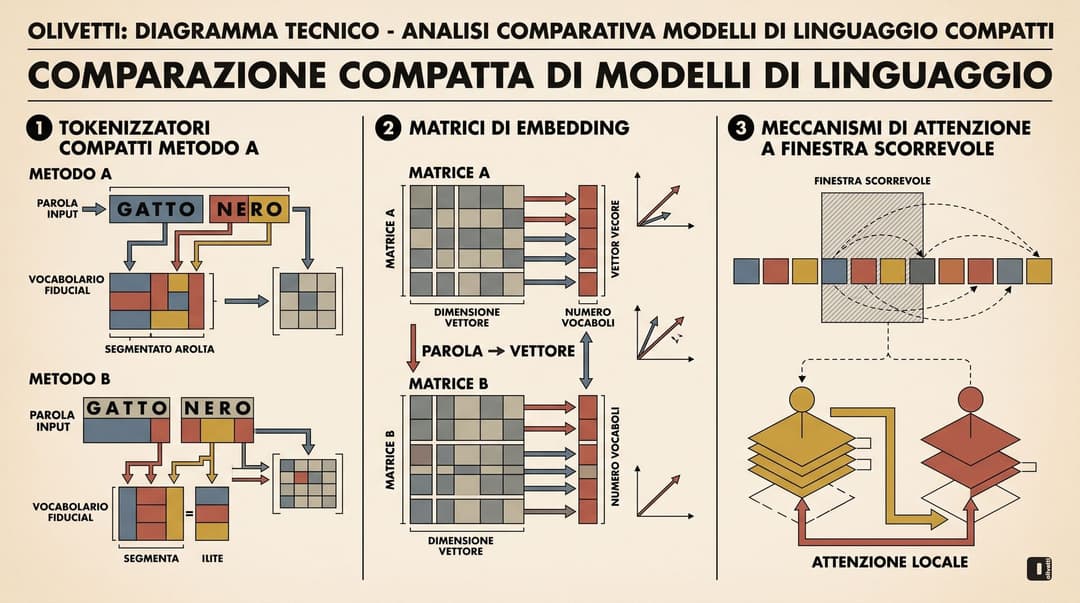
SmolLM2 uses a compact vocabulary of approximately 49,152 tokens and implements Grouped-Query Attention (GQA) with an 8,192 token context window, maximizing the parameter budget allocated to active feed-forward and attention layers rather than static token embeddings.
Qwen2.5-1.5B and Qwen2.5-3B (Alibaba Cloud)
Alibaba Cloud built the Qwen2.5 family on a pre-training foundation of 18 trillion tokens. The sub-3B variants (0.5B, 1.5B, and 3B) are dense architectures utilizing SwiGLU activation functions, RMSNorm, and Grouped-Query Attention.
Key architectural characteristics include:
- Extended Context: Native context length support up to 128,000 tokens with generation limits up to 8,192 tokens.
- Positional Encoding: Rotary Position Embeddings (RoPE) configured with a base frequency theta of 1,000,000.
- High-Capacity Tokenizer: A byte-level BPE vocabulary of 151,936 tokens designed for dense tokenization across code and multilingual text.
- Intermediate Layer Scaling: The 1.5B variant utilizes 24 layers with an intermediate hidden size of 8,960, while the 3B variant scales to 36 layers with a hidden size of 2,048.
Llama 3.2 1B and Llama 3.2 3B (Meta)
Meta designed the lightweight 1B and 3B Llama 3.2 models specifically for on-device deployment across mobile, edge, and ARM-based silicon (Qualcomm Snapdragon, MediaTek, Apple Silicon).
Rather than training purely from scratch, Meta utilized pruning and knowledge distillation from larger Llama 3.1 checkpoints (such as Llama 3.1 8B):
- Training Volume: Pre-trained on up to 9 trillion tokens with deep synthetic data generation and filtering.
- Layer and Head Configuration: The 1B variant features 24 transformer layers, 16 query heads, and 8 KV heads with GQA. The 3B variant scales to 28 layers with 24 query heads and 8 KV heads.
- Long Context: Full 128k token context window support, matching the context window of larger Llama 3.1 enterprise models.
- Vocabulary: 128,256 token vocabulary inherited from the Llama 3 tiktoken BPE tokenizer.
Gemma 2 2B (Google DeepMind)
Google DeepMind structured Gemma 2 2B (2.6B total parameters) as a compact student model trained primarily via knowledge distillation from a larger 27B teacher model.
Gemma 2 integrates unique architectural mechanics:
- Alternating Sliding Window Attention: Interleaves local sliding window attention (window size of 4,096 tokens) with global full attention (span of 8,192 tokens) every alternating layer, reducing quadratic attention overhead in half the layers.
- Logit Soft-Capping: Prevents logit divergence and gradient instability by capping logits via a scaled hyperbolic tangent function (
logits = soft_cap * tanh(logits / soft_cap)), setting the cap to 50.0 in attention layers and 30.0 in the final projection layer. - Massive Vocabulary: Inherits the 256,128 token Gemini vocabulary.
- Parameter Distribution: Due to the 256k vocabulary and tied embeddings, embedding parameters consume 590,118,912 weights (over 22% of total capacity), leaving approximately 2.02 billion non-embedding parameters across 26 layers with GeGLU activations.
Tokenizer Efficiency and Embedding Budget Trade-Offs
The choice of vocabulary size dictates a fundamental trade-off in sub-3B models. In models with billions of parameters, an embedding table represents a minor percentage of memory. In models under 3 billion parameters, vocabulary size directly competes with transformer depth and width.
- SmolLM2 (49k vocab): Dedicates minimal weight capacity to embeddings (~100M parameters), maximizing the proportion of weights performing non-linear transformation and reasoning in intermediate feed-forward layers.
- Llama 3.2 (128k vocab): Balances broad character coverage with moderate embedding overhead (~260M parameters in 1B, ~520M in 3B).
- Qwen2.5 (152k vocab): Provides exceptional token compression across non-English scripts and code syntaxes, reducing total generated tokens per prompt at the cost of higher static weight allocation.
- Gemma 2 (256k vocab): Dedicates nearly 600M parameters solely to token representations. While this delivers high compression across hundreds of languages, it reduces the remaining parameter budget available for transformer computation relative to same-sized peers.
Benchmark Profiles Across Reasoning, Code, and Instruction Following
Empirical evaluations across standardized benchmarks highlight distinct strengths for each architectural approach.
Code Generation and Mathematics
In coding and quantitative reasoning, Qwen2.5 models consistently lead their parameter bracket due to Alibaba's heavy emphasis on synthetic math and code pre-training:
- Qwen2.5-1.5B scores approximately 63.3% on GSM8K (5-shot) and 30.5% on HumanEval pass@1.
- Qwen2.5-3B achieves over 75% on GSM8K and over 40% on HumanEval, rivaling prior-generation 7B-13B models.
- SmolLM2-1.7B reaches 48.8% on GSM8K and 28.1% on HumanEval, outperforming Llama 3.2 1B (37.4% GSM8K, 33.5% HumanEval).
Instruction Following and Common Sense Reasoning
For general instruction following (IFEval), reading comprehension, and structured outputs:
- SmolLM2-1.7B demonstrates high instruction fidelity, scoring 56.7% on IFEval average, 66.1% on HellaSwag, and 74.4% on PIQA.
- Llama 3.2 3B provides robust multi-turn conversational alignment and summarization performance, scoring 58.0% on MMLU (5-shot) and 69.1% on ARC-Challenge.
- Gemma 2 2B leverages its 27B distillation signal to achieve high general knowledge retention and factual reasoning scores across MMLU benchmarks.
Edge Quantization, Latency, and Serving Economics
Sub-3B models are primarily deployed in environments constrained by memory bandwidth or hardware limits.
Memory Footprints Across Quantization Schemes
- 1.0B - 1.5B Models (Llama 3.2 1B, Qwen2.5-1.5B, SmolLM2-1.7B):
- FP16/BF16: 2.4 GB - 3.4 GB VRAM.
- INT8 / Q8_0: 1.2 GB - 1.8 GB VRAM.
- INT4 / Q4_K_M: 700 MB - 1.1 GB VRAM.
- 2.5B - 3.2B Models (Gemma 2 2B, Qwen2.5-3B, Llama 3.2 3B):
- FP16/BF16: 5.2 GB - 6.5 GB VRAM.
- INT8 / Q8_0: 2.8 GB - 3.5 GB VRAM.
- INT4 / Q4_K_M: 1.8 GB - 2.2 GB VRAM.
At Q4_K_M quantization, 1B-class models run comfortably within the unified memory of baseline mobile processors and single-board edge computers without triggering memory pressure.
Throughput and Time-to-First-Token (TTFT)
On modern edge hardware (Apple M-series unified memory, NVIDIA RTX 4090, or high-tier Qualcomm Snapdragon NPUs):
- Llama 3.2 1B (Q4_K_M) achieves over 220 tokens per second with sub-180ms TTFT under llama.cpp and MLC-LLM runtimes.
- Qwen2.5-1.5B and SmolLM2-1.7B deliver between 155 and 170 tokens per second.
- Llama 3.2 3B and Qwen2.5-3B sustain 95 to 110 tokens per second in 4-bit configurations.
Key-Value Cache Memory Overhead
While Llama 3.2 and Qwen2.5 support 128k token context windows, edge memory imposes physical limits. With Grouped-Query Attention (GQA), a 128k token sequence for a 1.5B model requires between 1.5 GB and 2.5 GB of KV cache memory in FP16, which often exceeds the size of the quantized model weights. In production edge deployments, context windows are typically capped at 8k to 32k tokens unless context compression or KV cache quantization (FP8/INT4) is applied.
Production Selection Guide
When selecting a sub-3B model for production architectures:
- Select Qwen2.5-1.5B or Qwen2.5-3B when the workload demands structured JSON generation, code execution, complex math, or multilingual text processing.
- Select SmolLM2-1.7B when requiring an open, unencumbered architecture with high parameter efficiency in intermediate layers and strong general instruction following.
- Select Llama 3.2 1B or 3B when deploying across mobile and embedded Qualcomm/MediaTek/ARM runtimes where pre-compiled execution kernels and 128k context support are prioritized.
- Select Gemma 2 2B when leveraging distillation-derived factual knowledge and when memory constraints benefit from alternating sliding window attention.
Sources
- SmolLM2: When Smol Goes Big: Data-Centric Training of a Small Language Model (Hugging Face / arXiv:2502.02737): https://arxiv.org/abs/2502.02737
- Qwen2.5: A Party of Foundation Models (Alibaba Cloud): https://qwenlm.github.io/blog/qwen2.5/
- Qwen2.5-Coder Technical Report (Alibaba Cloud / arXiv:2409.12186): https://arxiv.org/abs/2409.12186
- Llama 3.2: Revolutionizing Edge AI and Vision with Open, Customizable Models (Meta AI): https://ai.meta.com/blog/llama-3-2-connect-2024-vision-edge-mobile-devices/
- Gemma 2: Improving Open Language Models at a Practical Size (Google DeepMind / arXiv:2408.00118): https://arxiv.org/abs/2408.00118
