
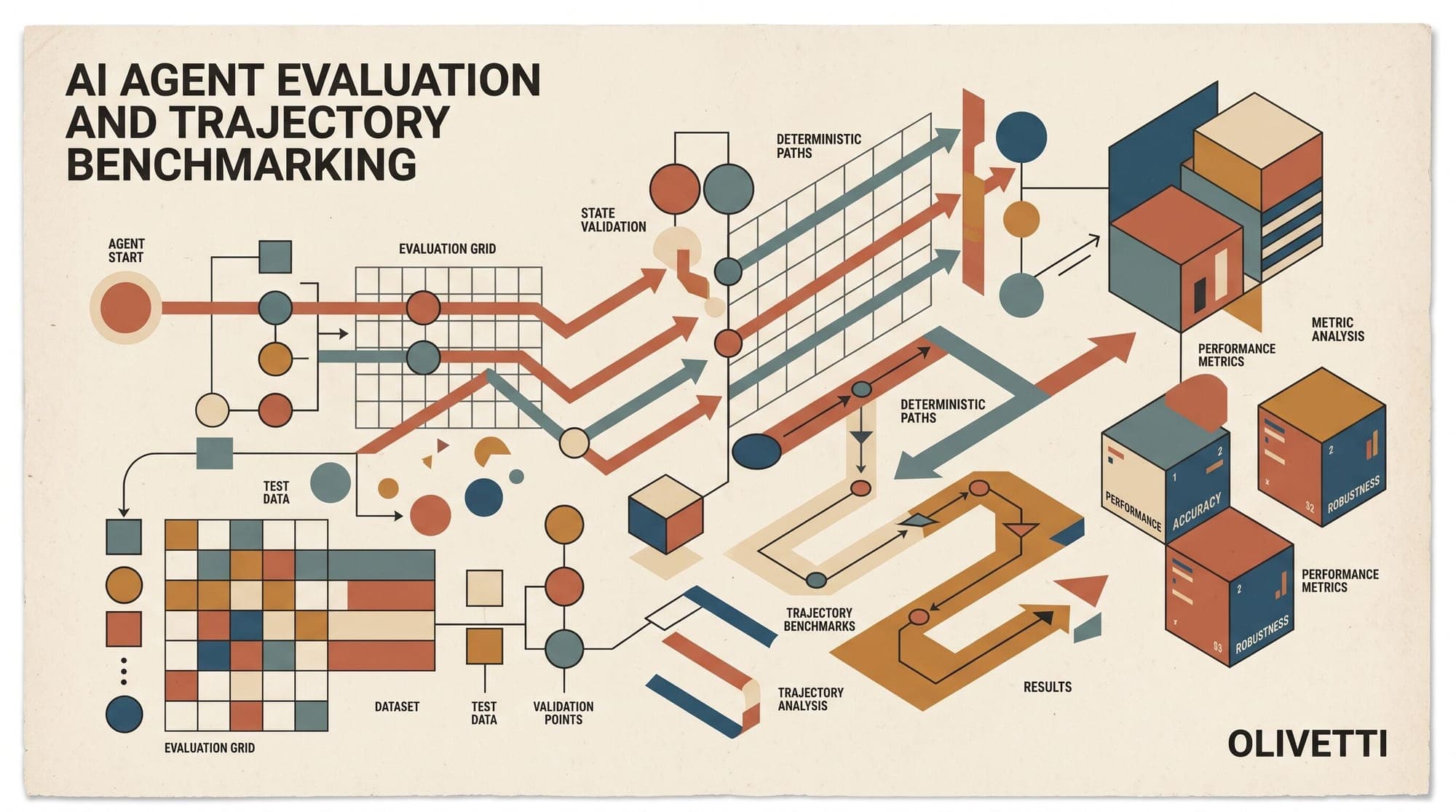
Evaluating standard large language models relies on static input-output pairs: a fixed prompt produces a completion that an automated script compares against reference strings or grades with a calibrated judge. Autonomous AI agents break this paradigm completely. An agent executes a multi-step trajectory consisting of planning, tool invocation, environment state observation, error recovery, and variable-length decision loops. Evaluating an agent requires testing not just the final string output, but the sequence of actions, environment state changes, security boundary adherence, and total resource consumption.
Production engineering teams transitioning from prompt engineering to agentic workflows face severe evaluation bottlenecks: benchmark contamination, non-deterministic execution flakiness, sandbox infrastructure overhead, and grading failures. Constructing a reliable agent evaluation harness requires distinct architectural layers, specialized benchmark selection, and rigorous metrics such as pass^k.
The Agent Benchmark Landscape
Standard QA benchmarks such as MMLU or GSM8K measure parametric knowledge and basic reasoning, but they provide near-zero correlation with an agent's ability to navigate complex execution environments. In production, four primary benchmark paradigms define capability evaluation:
- Software Engineering and Repository Mutation: SWE-bench (and its human-curated subset SWE-bench Verified) places agents in full Python codebases with real GitHub issues. The evaluation metric is strictly deterministic: the agent's generated patch must pass repository unit tests that failed prior to the fix without breaking existing test suites.
- General Multi-Modal Assistant Tasks: GAIA evaluates multi-step reasoning, tool usage (web browsing, file handling, Python execution), and multi-modal comprehension across 466 tasks. Tasks are designed to be conceptually straightforward for humans but difficult for AI systems, requiring precise fact retrieval and calculation with exact string or numerical match verification.
- Policy and Conversational Tool Adherence: Tau-bench (and its successor Tau2-bench) evaluates agents in dual-control customer service domains such as airline booking and retail. It measures whether an agent follows domain-specific business rules, handles API state mutations, and communicates effectively with a simulated user.
- Dynamic Environment and Computer Use: WebArena and OSWorld evaluate agents interacting with live, self-hosted web environments (e-commerce, GitLab, Reddit clones) and full operating system desktops. Evaluation checks end-state database states, filesystem artifacts, and visual interface states.

Core Architecture of an Agent Evaluation Harness
A production agent test harness differs fundamentally from a unit test runner. The harness must orchestrate isolated execution environments, mock external dependencies deterministically, trace every intermediate action, and evaluate system state.
1. Ephemeral Sandbox Isolation
Agents that execute arbitrary bash commands, install system dependencies, or modify databases cannot run directly on shared infrastructure. Production harnesses rely on containerized or microVM isolation:
- Container Sandboxes: Docker or Podman containers provisioned per test task, with strict CPU, memory, and disk quotas. Filesystems reset to a pristine snapshot after every evaluation run.
- MicroVM Sandboxes: Technologies like Firecracker or gVisor provide stronger kernel-level isolation when running untrusted or autonomously generated code.
- Network Partitioning: Network access must be strictly controlled. Unrestricted internet access leads to benchmark leakage, flaky external API dependencies, and non-reproducible web search results. Production harnesses route traffic through local caching proxies or deterministic record-and-replay mock layers.
2. Trajectory Tracing and Telemetry
Evaluating only the final outcome obscures intermediate failures, inefficient tool loops, and latent safety violations. The harness must capture a structured trajectory for every session:
- Call Graphs and Step Sequencing: Timestamps, input prompts, raw tool calls, parsed arguments, tool return payloads, and token consumption per step.
- Cost and Latency Budgets: Tracking cumulative input tokens, output tokens, cached prefix reads, and wall-clock time per step to establish operational cost envelopes.
- Error and Recovery Telemetry: Tracking parser errors, tool schema validation retries, hallucinated tool invocations, and recursion depth limits.
Grader Architectures: State Verification vs. Trajectory Judges
Grading agent performance requires balancing determinism, verification cost, and behavioral nuance. Production systems employ a multi-tiered grading hierarchy.
Deterministic State Verification
The gold standard for agent evaluation is environmental state assertion. Instead of asking an LLM whether the task was completed, the test harness inspects the environment directly:
- Unit Test Assertions: Running pre-written test suites against modified codebases (as in SWE-bench).
- Database State Inspection: Querying backend databases to confirm records were created, updated, or deleted matching the exact task specification.
- Filesystem and Artifact Validation: Verifying file existence, schema correctness, cryptographic hashes, or exact content extraction.
Deterministic state verification provides binary 0 or 1 scores with zero judge bias and zero token cost during grading.
Trajectory-Based Policy Checking
For tasks where end state alone does not capture compliance, harnesses evaluate trajectory constraints. In financial or regulated environments, how the agent reached the solution matters as much as the solution itself. Trajectory checkers evaluate:
- Tool Whitelisting and Blacklisting: Verifying unauthorized tools or sensitive parameters were never touched.
- Sequence Ordering: Ensuring confirmation prompts or security authorizations were verified prior to state-modifying actions.
- Information Boundary Integrity: Ensuring private tokens or secret environment variables were not leaked into external tool calls.
Calibrated LLM-as-a-Judge
When grading open-ended outputs (such as synthesized research reports or user communication), an LLM judge evaluates output quality against predefined rubrics. However, unconstrained LLM grading introduces positional bias, length bias, and self-enhancement bias. Mitigation requires few-shot rubric grounding, reference answer anchoring, and structured scoring schemas.
Managing Variance: The Mathematics of pass@k and pass^k
Agent execution is inherently stochastic. Even with temperature set to zero, distributed inference, floating-point non-determinism, and concurrent environment timings cause identical prompts to yield divergent trajectories.
To measure capability versus reliability, evaluation harnesses track two complementary metrics:
- pass@k (Capability Ceiling): The probability that at least one trajectory out of k independent attempts successfully completes the task. This metric measures the model's upper bound problem-solving capability given repeated sampling.
- pass^k (Production Consistency): The probability that an agent succeeds across all k consecutive attempts on a specific task. If an agent has an 80 percent single-run success rate on a task, its pass^3 reliability drops to 51.2 percent. For mission-critical workflows, pass^k reveals whether an agent is reliable enough to run autonomously without human supervision.
CI/CD Integration and Cost Optimization
Running comprehensive multi-step agent evaluations in continuous integration pipelines is resource-intensive. A single 500-task evaluation run with multi-step tool calls can easily consume tens of millions of tokens and dozens of compute hours.
Production teams optimize evaluation loops using three strategies:
- Tiered Evaluation Gates: Fast smoke tests (5 to 10 lightweight deterministic tasks) run on every pull request. Moderate suites (50 tasks covering core tool integrations) run on nightly builds. Comprehensive benchmarks (full SWE-bench or GAIA sweeps) run only on model version upgrades or major scaffolding refactors.
- Prompt and Prefix Caching: Structuring evaluation harnesses with immutable system prompt prefixes and deterministic environment schemas maximizes LLM prompt cache hit rates, reducing evaluation API costs by 40 to 80 percent.
- Tool and Network Mocking: Replacing live search engines and web scrapers with pre-recorded mock fixtures eliminates external API fees, cuts test runtimes by an order of magnitude, and guarantees exact run reproducibility.
Sources
- SWE-bench: Can Language Models Resolve Real-World GitHub Issues? - Jimenez et al., ICLR 2024
- GAIA: A Benchmark for General AI Assistants - Mialon et al., ICLR 2024
- Tau-bench: A Benchmark for Tool-Agent-User Interaction in Real-World Domains - Sierra Research / Bar-Tal et al.
- WebArena: A Realistic Web Environment for Building Autonomous Agents - Zhou et al., ICLR 2024
- OSWorld: Benchmarking Multimodal Agents on Open-Ended Operating System Tasks - Xie et al., NeurIPS 2024



