
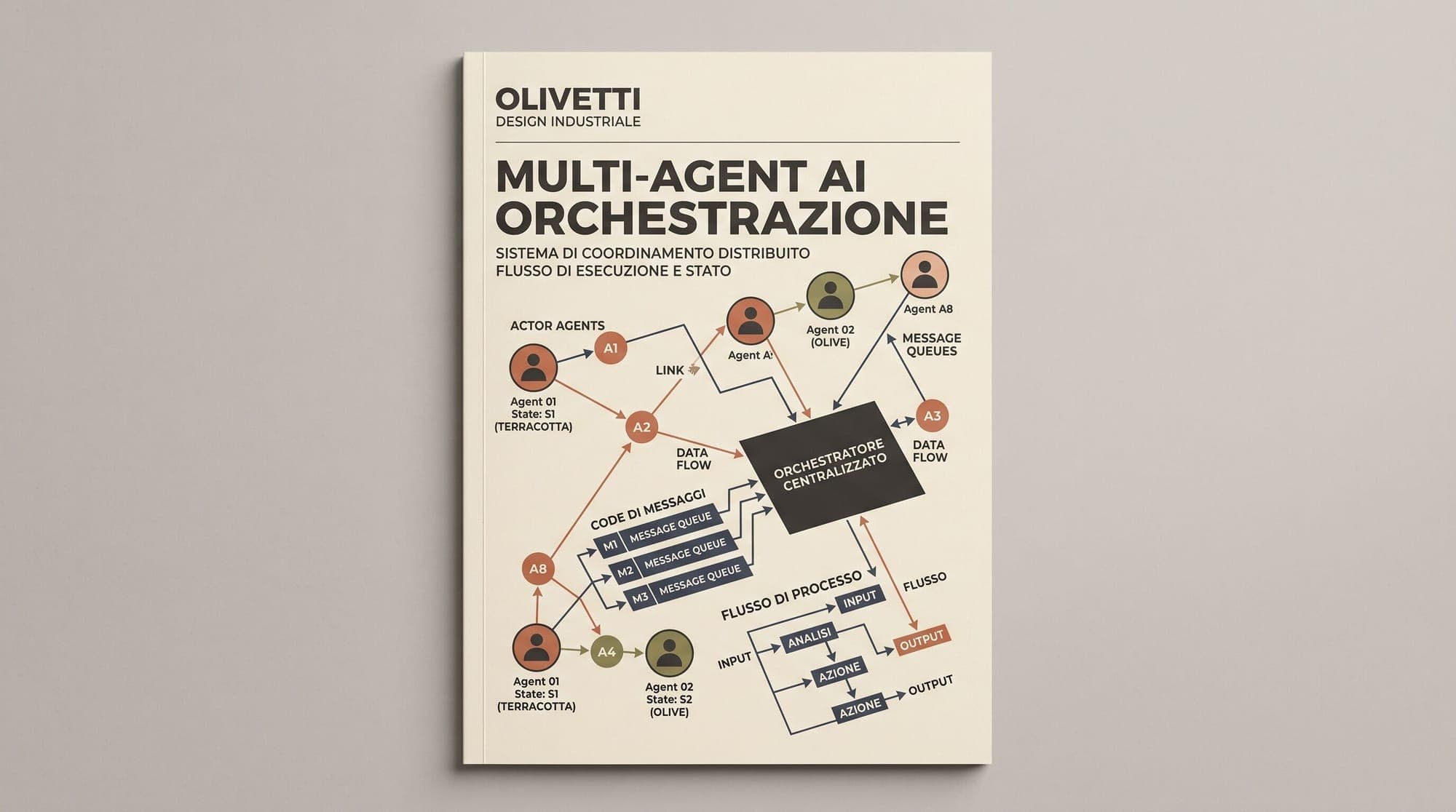
Deploying autonomous multi-agent systems in production requires shifting from simple input-output prompt chains to structured orchestration runtimes capable of handling non-deterministic language model outputs, cyclic reasoning loops, tool-call failures, and long-running state persistence.
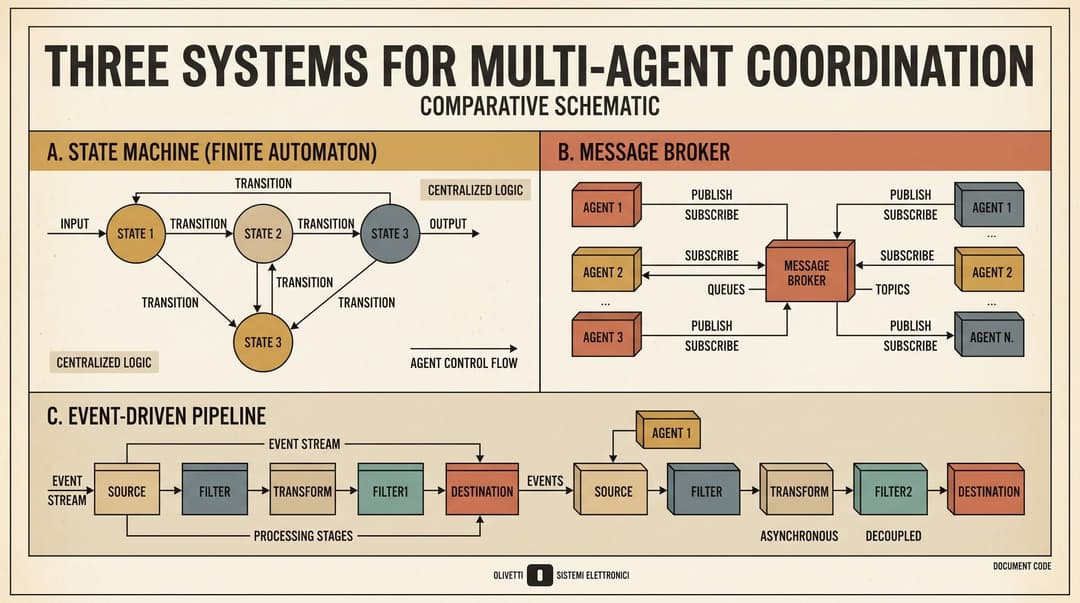
As enterprise workloads scale, four distinct architectural paradigms have emerged to coordinate agent interactions: the Bulk Synchronous Parallel state graph (LangGraph), the asynchronous Actor Model (Microsoft AutoGen v0.4 / AG2), role-based hierarchical task execution (CrewAI), and event-driven asynchronous step dispatch (LlamaIndex Workflows). Each runtime makes distinct trade-offs across execution topology, state mutability, debugging ergonomics, and fault tolerance.
1. Core Execution Models and Runtime Primitives
The primary differentiator across orchestration engines lies in how execution control flows between agent nodes and how computational steps synchronize.
LangGraph: Bulk Synchronous Parallel (BSP) State Graphs
LangGraph adapts Google's Pregel graph processing model to agent coordination. Workflows are defined as directed graphs where nodes represent discrete Python functions (agents, tool executors, or data transformers) and edges define conditional routing logic.
Execution proceeds in discrete "super-steps":
- Parallel Node Invocation: In each super-step, all active nodes execute concurrently over an immutable snapshot of the graph state.
- Channel Reducer Aggregation: Nodes return state updates rather than mutating state directly. Updates pass through user-defined reducer functions (such as
operator.addfor message lists or custom replacement logic) to resolve state changes. - Barrier Synchronization: The runtime waits for all active nodes in the super-step to finish before evaluating conditional edge predicates and computing the next set of active nodes.
This model natively supports cyclic graphs, enabling iterative refinement loops, multi-agent debate, and self-correction workflows without recursion stack overflows.
AutoGen v0.4: Asynchronous Actor Model
Microsoft rebuilt AutoGen v0.4 from the ground up around a pure Actor Model, abandoning synchronous conversational loops.
In AutoGen v0.4:
- Every agent is an isolated stateful actor (
RoutedAgent) running within a distributed-ready runtime environment. - Agents communicate strictly through asynchronous, strongly-typed message passing over a topic-based publish/subscribe message bus.
- The runtime is divided into three distinct layers:
autogen_core(the low-level event runtime managing actors, message delivery, and serialization),autogen_agentchat(high-level conversational abstractions), andautogen_ext(tool and model extensions).
By decoupling agents from shared memory, AutoGen v0.4 provides process-level isolation and non-blocking I/O, making it suitable for distributed deployments across multiple compute instances.
CrewAI: Role-Based Hierarchical Task Delegation
CrewAI structures multi-agent collaboration through an organizational management metaphor. Workflows are composed of autonomous Agent definitions (parameterized by role, backstory, and goal) assigned to discrete Task objects.
CrewAI supports two primary execution processes:
- Sequential Process: Tasks execute in a linear pipeline where each task consumes the output artifacts of preceding tasks.
- Hierarchical Process: A centralized manager agent (either an LLM supervisor or a rule-based controller) evaluates tasks, dynamically delegates execution to specialized worker agents, validates intermediate outputs, and orchestrates task re-assignment on validation failure.
Task handoffs are managed via structured prompt wrapping and tool delegation loops, reducing architectural boilerplate at the expense of deterministic execution control.
LlamaIndex Workflows: Async Event-Driven Step Dispatch
LlamaIndex Workflows avoids static graph compilation entirely, structuring agent execution around native Python asyncio and typed event routing.
In LlamaIndex Workflows:
- Steps are defined via
@stepdecorators that accept specific subclassedEventtypes and return downstreamEventinstances. - The workflow runtime dynamically resolves the execution topology at runtime by matching emitted events to step signature type hints.
- Steps synchronize dynamically via
ctx.collect_events(), which acts as an async barrier that waits until all required event classes arrive before triggering multi-input logic.
This design eliminates graph compilation overhead and provides minimal abstraction over standard asynchronous Python code.
2. State Management, Memory Hierarchies, and Persistence
State handling dictates how multi-agent runtimes maintain conversation history, coordinate tool outputs, and recover from infrastructure outages.
+------------------+-----------------------+------------------------+----------------------+----------------------+
| Dimension        | LangGraph             | AutoGen v0.4 (AG2)     | CrewAI               | LlamaIndex Workflows |
+------------------+-----------------------+------------------------+----------------------+----------------------+
| State Model      | Centralized Blackboard| Distributed Actor State| Layered Memory Store | Scoped Workflow Ctx  |
| Mutability       | Immutable Snapshots   | Isolated Actor State   | Mutable Store        | In-Memory KV Store   |
| Persistence      | Postgres / Redis Saver| Event Stream Replay    | SQLite / ChromaDB    | Custom Async Adapters|
| Debug Replay     | Time-Travel Checkpoint| Event Log Inspection   | Step Logs            | Stream Event History |
+------------------+-----------------------+------------------------+----------------------+----------------------+
LangGraph: Centralized Checkpointing and Time Travel
LangGraph enforces a centralized "blackboard" architecture where the entire system state is encapsulated in a single typed structure. At every super-step boundary, a persistent checkpointer (such as PostgresSaver or RedisSaver) serializes the state snapshot alongside a monotonic thread version hash.
This architecture enables deterministic "Time Travel":
- Developers can inspect the exact historical state at any previous super-step.
- Workflows can be forked from historical checkpoints to evaluate alternative tool outputs or prompt variations.
- State can be surgically patched mid-run (
update_state) to rectify erroneous agent trajectories without restarting entire execution pipelines.
AutoGen v0.4: Event Sourcing and Actor Mailboxes
AutoGen rejects centralized state storage. Each actor maintains its private internal state, protected from concurrent mutations by other actors. Cross-agent context sharing occurs exclusively through message payloads delivered to actor mailboxes.
Persistence is achieved at the runtime broker level via event log streaming. The state of an agent system at time T can be reconstructed by replaying the sequence of emitted message events across topics, matching distributed event-sourcing patterns.
CrewAI: Layered Memory Architecture
CrewAI bundles a three-tier memory subsystem into its runtime:
- Short-Term Memory: In-memory vector store (backed by ChromaDB) capturing recent task interactions and contextual tool outputs for immediate semantic retrieval.
- Long-Term Memory: Local SQLite database storing task completion histories, performance metrics, and multi-session learnings across runs.
- Entity Memory: Specialized entity extraction layer that tracks facts and relationships regarding named entities encountered across agent dialogues.
LlamaIndex Workflows: Context KV Store and Event Buffers
LlamaIndex Workflows utilizes a lightweight Context object passed to each step. The context provides an in-memory key-value store (await ctx.set(), await ctx.get()) alongside dedicated event buffers. State persistence across multi-turn sessions requires hooking custom storage handlers into workflow serialization hooks.
3. Human-in-the-Loop (HITL) and Gating Mechanisms
Production agent deployments require deterministic intervention mechanisms for privileged tool execution, policy compliance, and edge-case resolution.
                    [Agent Proposes Tool Call]
                                |
                                v
                   [HITL Interception Point]
                                |
             +------------------+------------------+
             |                                     |
    [Approve / Resume]                    [Reject / Edit State]
             |                                     |
             v                                     v
   [Execute Tool Action]                 [Inject Human Feedback]
             |                                     |
             +------------------+------------------+
                                |
                                v
                      [Continue Execution]
LangGraph Interrupt Semantics
LangGraph provides native runtime interrupts via interrupt(). When an agent encounters an action requiring authorization (such as executing a financial trade or updating a production database):
- The graph yields execution immediately and writes the full pending state to the checkpointer.
- The runtime exits the execution loop cleanly without blocking worker threads.
- An external application inspects the checkpoint, collects human approval or revised inputs, and resumes the graph using
Command(resume=payload).
Because the state is persisted at the exact interrupt boundary, human reviewers can take minutes or days to respond without consuming server memory.
AutoGen v0.4 Topic-Based Human Proxies
In AutoGen v0.4, human intervention is modeled as an asynchronous actor (UserProxyAgent or custom human-routed actors) subscribed to approval topics. When an agent emits a tool execution request, it publishes the event to an authorization topic and awaits a matching approval message. Human reviewers interact with the topic stream asynchronously through webhooks or messaging integrations.
CrewAI Task Gating
CrewAI provides task-level human intervention via a human_input=True flag on task definitions. When enabled, task completion is blocked until a human operator provides feedback via stdin or a configured UI callback. While simple to configure, this synchronous blocking pattern can introduce thread starvation in high-concurrency production servers.
LlamaIndex Workflows Event-Driven Gating
In LlamaIndex Workflows, human interaction is handled through custom event round-trips. A step emits a HumanReviewRequiredEvent and halts downstream dispatch. The host application captures this event from the event stream (stream_events()), displays it to the user, and injects a HumanResponseEvent back into the running workflow instance to trigger subsequent steps.
4. Fault Tolerance, Retries, and Error Recovery
System reliability in multi-agent orchestration depends on isolating failure domains and avoiding cascade collapses during API outages or malformed tool outputs.
LangGraph
- Super-Step Isolation: If a node fails during a super-step, the pending state update is discarded, leaving the base checkpoint uncorrupted.
- Node-Level Retry Policies: Built-in
RetryPolicyparameters support exponential backoff, jitter, and error-type filtering at the granularity of individual graph nodes. - Subgraph Encapsulation: Complex sub-systems can be compiled as independent subgraphs with isolated state schemas and error boundaries.
AutoGen v0.4
- Actor Crash Isolation: Because actors run in separate execution contexts, an unhandled exception in one agent does not directly crash sibling agents.
- Dead-Letter Handling: Messages that fail delivery or trigger unhandled actor exceptions can be routed to dead-letter queues for offline triage.
- Supervisory Routing: Custom supervisor actors can monitor topic activity and dispatch replacement tasks if an assigned worker fails to respond within defined deadlines.
CrewAI
- Task Retry Guardrails: Configurable retry counters on tasks automatically reprompt worker agents with validation error traces when output schemas fail validation.
- Hierarchical Fallback: In hierarchical mode, when a worker fails repeatedly, the manager agent can reassign the task to an alternative agent or adjust task constraints.
LlamaIndex Workflows
- Async Exception Propagation: Step failures propagate through standard Python
asynciotask groups, allowing standardtry...excepthandling within step definitions. - Dynamic Error Events: Steps can catch exceptions and return custom
ValidationErrorEventorRetryEventobjects that route back to previous steps for self-correction.
5. Architectural Comparison Matrix
+-----------------------------------+-----------------------------------+-----------------------------------+-----------------------------------+-----------------------------------+
| Architectural Dimension           | LangGraph                         | AutoGen v0.4 (AG2)                | CrewAI                            | LlamaIndex Workflows              |
+-----------------------------------+-----------------------------------+-----------------------------------+-----------------------------------+-----------------------------------+
| Primary Execution Model           | Bulk Synchronous Parallel Graph   | Asynchronous Actor Model          | Role-Based Hierarchical Process   | Async Event-Driven Step Dispatch  |
| Control Flow Topology             | Directed cyclic/acyclic graphs    | Topic-based pub/sub message bus   | Sequential or manager-routed trees| Dynamic event-matching step chains|
| State Synchronization             | Super-step barrier synchronization| Non-blocking async message passing| Synchronous task artifact passing | Dynamic ctx.collect_events()      |
| State Persistence Mechanism       | Centralized checkpointers (Postgre| Distributed event log replay      | Local SQLite and ChromaDB         | Scoped Context key-value store    |
| Time-Travel & State Forking       | Native first-class support        | Event log inspection              | Not natively supported            | Stream event replay               |
| Human-in-the-Loop Pattern         | Non-blocking interrupt() / Command| Asynchronous human actor routing  | Synchronous human_input blocking  | Custom review/response events     |
| Concurrency Primitives            | Concurrent node super-steps       | Distributed async actor mailboxes | Multi-threaded task execution     | Python native asyncio event loop  |
| Observability Integration         | Native LangSmith & OpenTelemetry  | OpenTelemetry & runtime event logs| OpenTelemetry (Langtrace, Phoenix)| Native OpenInference              |
| Code Structure Overhead           | Medium (state schemas, graphs)    | High (actors, topics, runtime)    | Low (declarative role/task config)| Low (standard async Python)       |
+-----------------------------------+-----------------------------------+-----------------------------------+-----------------------------------+-----------------------------------+
6. Production Framework Selection Criteria
Choosing an orchestration framework requires aligning system requirements with runtime characteristics:
- Select LangGraph when building mission-critical, multi-step enterprise workflows requiring strict deterministic routing, audit compliance, fine-grained state rollback, and non-blocking human approvals. It is the preferred choice for systems where engineers must inspect, debug, and fork state at arbitrary execution steps.
- Select AutoGen v0.4 when building highly distributed, long-running agent simulations, conversational debate systems, or multi-agent environments requiring decoupled compute nodes and actor-isolated failure domains.
- Select CrewAI for rapid enterprise prototyping, business workflow automation, and content generation pipelines where role-playing metaphors and hierarchical manager delegation cleanly map to the business domain.
- Select LlamaIndex Workflows for high-throughput, latency-sensitive data processing pipelines, document indexing systems, and Python-native microservices that require event-driven async parallelism without the overhead of heavy state-machine compilation.
Update (Oct 19, 2026)
- Status change: Microsoft has archived AutoGen and no longer maintains it; contributions are limited to bug fixes, security patches and documentation. Microsoft recommends its Microsoft Agent Framework for new projects and publishes a migration guide (AutoGen repository).
- Correction: AG2 is a separate project, not AutoGen v0.4. Its classic API (ConversableAgent, GroupChat) derives from the original AutoGen classes (AG2 repository). We removed "(AG2)" from the AutoGen v0.4 headings and the headline; the URL is unchanged.
- AutoGen's distributed runtime is GrpcWorkerAgentRuntime, coordinated by a GrpcWorkerAgentRuntimeHost (AutoGen docs).
- AutoGen AgentChat agents and teams expose save_state() and load_state() for exporting and restoring state (AutoGen docs).
- CrewAI runs tasks with Process.sequential by default. With Process.hierarchical, a manager set through manager_llm or manager_agent delegates tasks and validates the results (CrewAI docs).
- LangGraph's built-in checkpointers include InMemorySaver, SqliteSaver, and PostgresSaver or AsyncPostgresSaver (LangGraph docs); a Redis saver is available in langgraph-redis.
- LlamaIndex Workflows pause for a person by emitting an InputRequiredEvent and resume when a HumanResponseEvent arrives (LlamaIndex docs).
Sources
- LangGraph: Directed Graph Agent Runtime
- Pregel: A System for Large-Scale Graph Processing (Malewicz et al., ACM SIGMOD 2010)
- AutoGen v0.4: Reimagining the Foundation of Agentic AI for Scale and Extensibility (Microsoft Research)
- AutoGen: Enabling Next-Gen LLM Applications via Multi-Agent Conversation (Wu et al., 2023)
- CrewAI: Multi-Agent Orchestration Framework
- LlamaIndex Workflows: Event-Driven Agent Orchestration
- Microsoft AutoGen repository (archived; successor: Microsoft Agent Framework)
- AG2 repository
