Top mathematicians: LLMs are strong calculators, weak creative thinkers

Gowers, Sarnak, and a DeepMind researcher agree AI can combine known math but struggles to invent new ideas.

2 min
Top mathematicians: LLMs are strong calculators, weak creative thinkers

Leading mathematicians say large language models have become genuinely useful at mathematics but still cannot make the leaps that produce new theory.

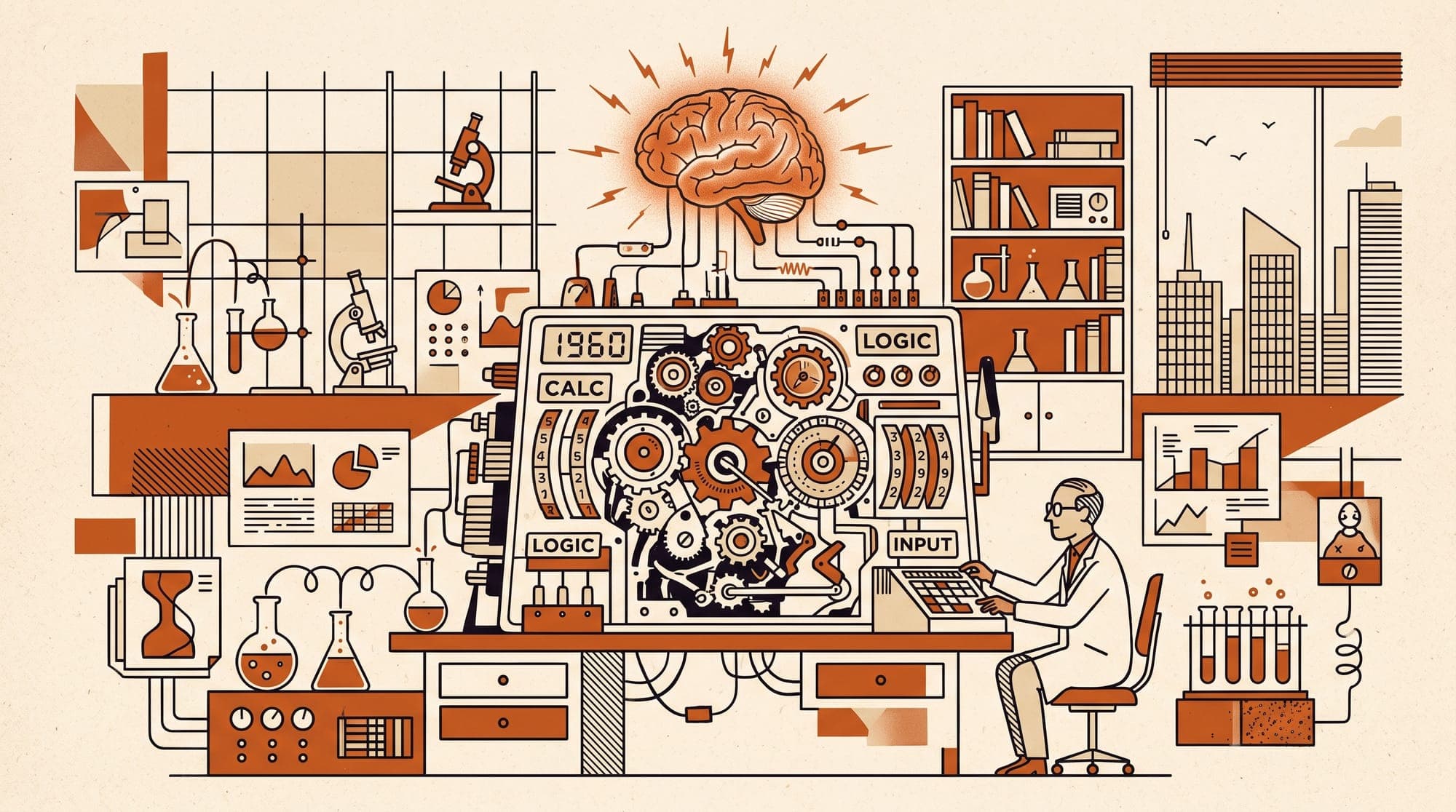
Illustration: a calculator with a closed door and a dim lightbulb

Timothy Gowers and Peter Sarnak, two of the most decorated names in the field, credit current models with real skill at combining established methods and exploring many lines of attack. In a blog post on August 12, 2026, Gowers wrote that today's models are good at recombining known techniques and testing many search paths, but lack the intuition to pick the few productive routes inside a vast space of possibilities.

Sarnak, writing in the July 2026 issue of the AMS Notices, reaches a similar verdict. AI can derive results from existing theory, he argues, yet fails to develop the abstractions that underpin major proofs when it starts from an elementary question.

DeepMind researcher Tom Zahavy framed the limit in a paper titled "LLMs Can't Jump." He locates the bottleneck in what he calls "manipulative abduction," the ability to invent new foundational assumptions that have no precedent in language. World models, he suggests, could be a path past the ceiling.

The assessments feed a wider argument over whether LLMs are becoming broadly more capable or simply getting better at benchmarks and familiar problem types. For now, the mathematicians agree the machine is a powerful calculator that has not yet learned to surprise them.

Sources

  • The Decoder: "Top mathematicians say LLMs are strong calculators but poor creative thinkers" (https://the-decoder.com/top-mathematicians-say-llms-are-strong-calculators-but-poor-creative-thinkers/)
  • Timothy Gowers: "What sort of maths are LLMs good at?" (https://gowers.wordpress.com/2026/08/12/what-sort-of-maths-are-llms-good-at/)
  • Peter Sarnak, AMS Notices, July 2026 (https://www.ams.org/journals/notices/202607/noti3373/noti3373.html)
  • Tom Zahavy, "LLMs Can't Jump" (https://the-decoder.com/language-models-cant-spark-scientific-revolutions-but-world-models-might/)

Written by

More to read

  • Model Merging in Large Language Models: How Task Arithmetic, TIES, and DARE Combine Checkpoints Without Training

    Fine-tuning foundation models for specialized tasks typically produces isolated checkpoints. A model adapted for mathematical reasoning retains high numerical precision but often degrades in general dialogue or code generation. Traditionally, unifying these capabilities required multi-task training: gathering mixed datasets, re-running optimization across multiple GPUs, and managing gradient conflicts during backpropagation. Model merging provides an alternative paradigm. By operating directly

    1 min
  • Harvey Introduces Tenet, Its First In-House Legal LLM Trained on Moonshot's Kimi K3

    Legal AI startup Harvey has announced Harvey Tenet, its first proprietary, in-house foundation model tailored for legal workflows. The release marks a strategic shift for the $11 billion legal tech company, which has historically relied on API access to third-party frontier models from OpenAI and Anthropic. Tenet is post-trained on top of Kimi K3, an open-weights model released in July 2026 by Chinese AI lab Moonshot AI. The initiative is part of a broader platform update titled Harvey II, whic

    1 min
  • Document Chunking Strategies for Production RAG: Fixed-Size, Semantic, Hierarchical, and Late Chunking Trade-Offs

    Document Chunking Strategies for Production RAG: Fixed-Size, Semantic, Hierarchical, and Late Chunking Trade-Offs In production retrieval-augmented generation (RAG), document chunking is often treated as a trivial preprocessing step. In practice, the method used to partition raw text directly dictates the upper bound of retrieval recall, embedding representation quality, and downstream generation accuracy. Retrieval systems face a fundamental tension. Dense vector search models perform best wh

    1 min