
Language Server Protocol (LSP) in AI Coding Agents: Architecture, Symbol Indexing, and Compiler Diagnostic Feedback Loops
Autonomous coding agents frequently fail at multi-file refactoring and codebase navigation when relying solely on string-matching heuristics or raw file ingestion. Text-based search tools such as ripgrep locate literal tokens but cannot resolve type hierarchies, overloaded function names, or cross-module call graphs. In contrast, feeding entire directories into large language model (LLM) context windows incurs severe token expenditure and degrades retrieval precision.
To solve this semantic bottleneck, agent harnesses such as Claude Code, Cursor, and GitHub Copilot CLI increasingly integrate the Language Server Protocol (LSP). By mediating between coding agents and compiler backends over JSON-RPC, LSP grants LLMs the same structural code intelligence that human developers utilize inside integrated development environments (IDEs): deterministic definition resolution, exact reference tracking, and sub-second compiler diagnostic feedback.
The Context Bottleneck: Text Heuristics vs. Semantic Resolution
Early autonomous coding architectures relied on two primary retrieval strategies, both of which encounter severe scaling ceilings in production codebases:
- Greedy Text Search (ripgrep / grep): When an agent searches for references to a method name like
process_payment(), regex matching returns dozens of identical string hits across tests, mocks, docstrings, and unrelated classes. The model must manually inspect each match, burning reasoning tokens to disambiguate scope. - Static AST Repo Maps: Systems utilizing Tree-sitter repository maps parse file-level Abstract Syntax Trees to build high-level symbol indexes. While lightweight, Tree-sitter operates per-file without type checking or cross-file symbol resolution. It cannot determine the exact concrete type of an inferred generic variable or trace dynamic imports across package boundaries.
LSP eliminates this ambiguity by offloading semantic indexing to dedicated language servers such as Pyright for Python, rust-analyzer for Rust, gopls for Go, and vtsls or typescript-language-server for TypeScript. The language server maintains an in-memory compilation graph, resolving every symbol to its precise definition coordinates and type signature.
LSP Architecture and State Synchronization
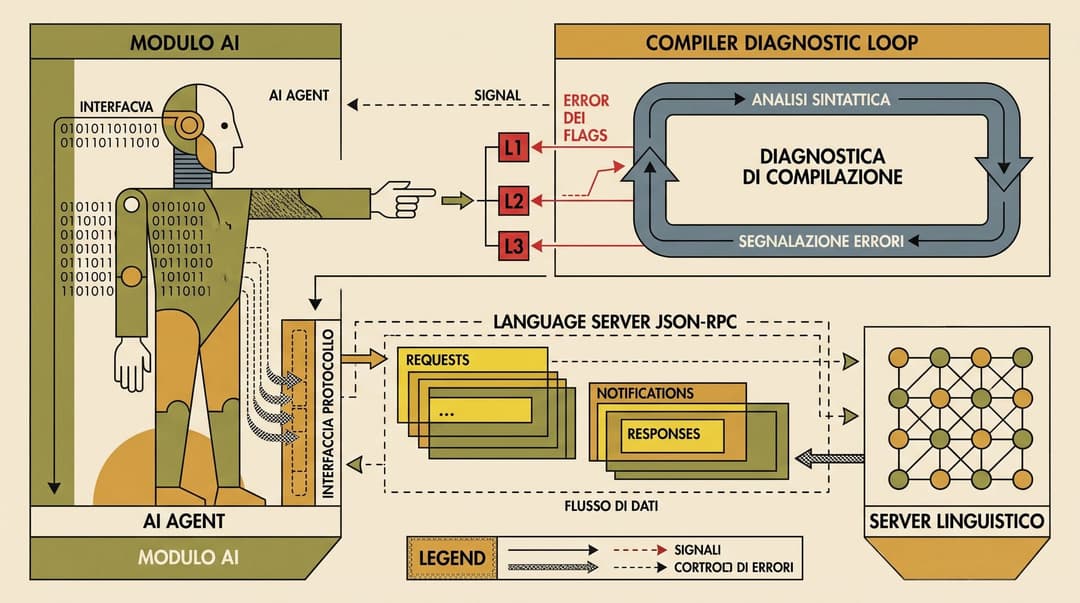
The Language Server Protocol operates on a client-server architecture, communicating via JSON-RPC messages over standard input/output (stdio) or Unix domain sockets.
Core Protocol Operations for Agents
When an agent interacts with a codebase, the harness translates LLM intent into standardized LSP method requests:
textDocument/definition&textDocument/typeDefinition: Resolves a symbol at a specific line and character offset directly to its declaration location, eliminating multi-file search loops.textDocument/references: Returns exact call sites and usages across the entire workspace, filtering out unrelated symbols sharing the same name.textDocument/documentSymbol&workspace/symbol: Extracts hierarchical outlines (classes, methods, fields) without requiring the agent to read full source files.textDocument/hover: Retrieves docstrings, parameter types, and return signatures on demand.textDocument/implementation: Traverses interface definitions to their concrete implementations across polymorphic codebases.
Document State Management: Virtual Buffers and Shadow Workspaces
Language servers track file states through lifecycle events defined in the LSP 3.17 specification:
Client (Agent Harness)                   Language Server (Pyright / rust-analyzer)
        |                                                 |
        | -------- initialize (capabilities, rootUri) --> |
        | <------- initialized response ----------------- |
        |                                                 |
        | -------- textDocument/didOpen ----------------> |
        |                                                 |
        | -------- textDocument/didChange (diff) -------> |
        | <------- textDocument/publishDiagnostics ------ | (push model)
        |                                                 |
        | -------- textDocument/diagnostic -------------> | (pull model)
        | <------- DiagnosticReport (errors/warnings) --- |
        |                                                 |
        | -------- textDocument/didSave ----------------> |
        | -------- textDocument/didClose ---------------> |
A critical architectural requirement for coding agents is shadow workspace execution. Before writing speculative edits directly to disk, agent runtimes can maintain virtual buffers using textDocument/didOpen and textDocument/didChange. This allows the language server to compute syntax and type validity on proposed patches entirely in memory.
Compiler Diagnostic Feedback Loops
The primary operational advantage of LSP integration is rapid, closed-loop error correction. Without LSP, an agent verifying a patch must invoke full build systems or test suites (such as cargo test, pytest, or npm test). In large repositories, build runs take tens of seconds to minutes and produce noisy, multi-page tracebacks.
Push vs. Pull Diagnostic Mechanics
LSP provides immediate compiler feedback via two distinct mechanisms:
- Push Diagnostics (
textDocument/publishDiagnostics): When the agent issues atextDocument/didChangenotification, the server background worker analyzes the change and broadcasts syntax errors, missing imports, and type mismatches back to the client. - Pull Diagnostics (
textDocument/diagnostic): Introduced in LSP 3.17, pull diagnostics allow the client agent to explicitly query diagnostics on demand when evaluating whether an edit is ready for commit.
The Sub-Second Self-Correction Cycle
When an LLM proposes a code modification, the agent harness passes the diff to the language server buffer and checks for new diagnostic messages. If the server reports an error (for example, Argument of type 'str' is not assignable to parameter of type 'int'), the harness injects the exact line number, column, and compiler error message directly into the model's next prompt turn.
Because compiler diagnostics isolate the exact failure location, the agent corrects syntax and type mistakes in a single follow-up inference pass before executing unit tests or committing files to disk.
Architectural Comparison: Text Search vs. Tree-sitter vs. LSP
The following table compares the operational trade-offs across codebase intelligence mechanisms in production agent systems:
| Dimension | Text Search (ripgrep) | Static AST (Tree-sitter) | Language Server Protocol (LSP) |
|---|---|---|---|
| Setup Overhead | Zero configuration | Minimal (grammar compilation) | High (requires runtime, dependencies, package managers) |
| Cold Start Latency | Milliseconds | Sub-second | 2 to 30 seconds (workspace indexing and type checking) |
| RAM Footprint | Low (< 50 MB) | Moderate (50 to 200 MB) | High (500 MB to 4+ GB per language server instance) |
| Cross-File Symbol Resolution | None (lexical matching) | None (file-scoped AST) | Exact (compiler-level cross-module type graphs) |
| Type & Signature Checking | None | None | Complete (static type inference and constraint validation) |
| Feedback Mechanism | None | Grammar parse errors only | Sub-second compiler diagnostics and quick-fix code actions |
| Token Efficiency | Poor (high manual filtering) | Moderate (symbol outline pruning) | Optimal (targeted symbol queries and precise slice retrieval) |
Production Integration Patterns
Modern developer tooling implements LSP support via two primary architectural patterns:
- Native Client Integration: Platforms such as Claude Code bundle or attach directly to host language servers via environment configuration (
ENABLE_LSP_TOOL=1), executing JSON-RPC calls over localstdiostreams. - Model Context Protocol (MCP) Middleware: Middleware servers such as
agent-lspexpose language server primitives as standardized Model Context Protocol (MCP) tool definitions. This decouples agent logic from JSON-RPC lifecycle management, allowing any MCP-compliant LLM to invoke tools likelsp_find_referencesorlsp_get_diagnosticsacross diverse language environments.
Practical Engineering Constraints
Deploying LSP within agent pipelines introduces specific operational hurdles:
- Dependency Pre-Warming: Language servers require installed project dependencies (
node_modules, Python virtual environments, Cargo locks). In containerized agent sandboxes, language servers report cascade errors if dependencies are not restored prior to indexing. - Server State Drift: Long-running agent sessions making rapid file modifications can cause out-of-sync state between the server's virtual memory and physical disk. Runtimes must explicitly handle
textDocument/didSavenotifications and periodic full-sync reconciliation. - Macro vs. Micro Tool Granularity: Exposing raw LSP methods individually can cause excessive tool-call round trips. Production systems bundle related queries into compound tools, such as extracting a function signature, its docstring, and its primary callers in a single coordinated tool invocation.
