

Israel's National Artificial Intelligence Directorate has released its five-year National AI Strategic Plan, outlining formal commitments to construct a sovereign infrastructure footprint spanning at least 100,000 advanced AI accelerators, a domestic quantum computer, and advanced semiconductor fabrication capabilities at 5 nanometers or below.
Operating under the Prime Minister's Office, the Directorate published the roadmap to implement Government Resolution 4255, originally approved by the Israeli cabinet on June 16, 2026. Rather than allocating state capital toward pre-training frontier general-purpose foundation models from scratch, the strategic plan concentrates national investment into rapid deployment across public infrastructure, cybersecurity systems, and physical robotics.
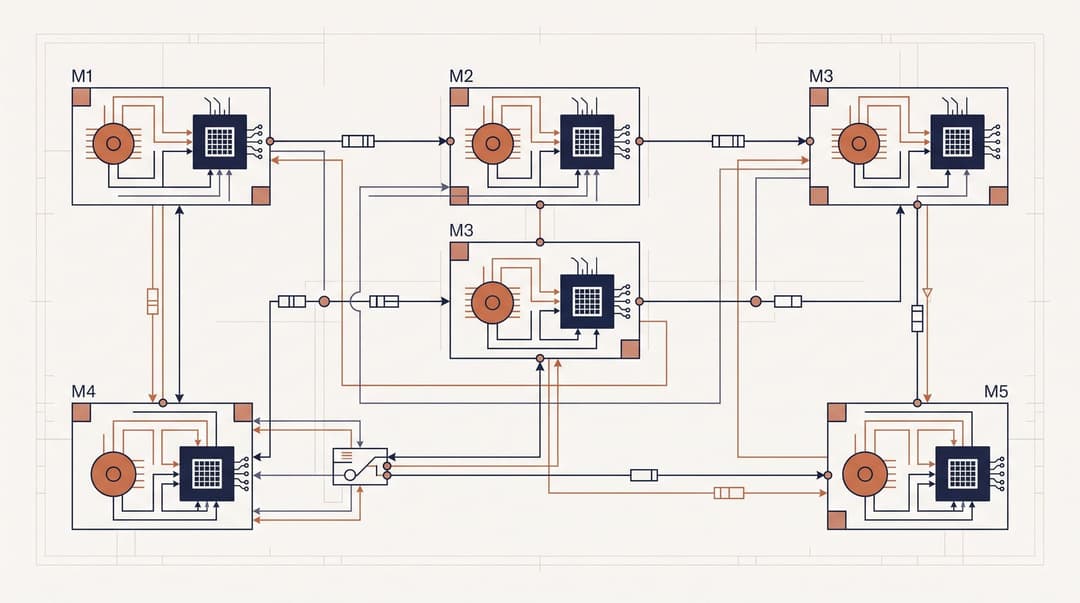
Infrastructure Buildout and Fabrication Targets
The plan defines five primary infrastructure commitments:
- Compute Horizon: Establishing a national footprint of at least 100,000 advanced AI accelerators, led primarily by private market deployments alongside an initial dedicated state buildout of 5,000 units.
- Domestic Semiconductor Fabrication: Developing onshore chip manufacturing at or below 5nm process nodes, incorporating statutory priority access rights for domestic workloads during supply constraints.
- Sovereign Quantum Computing: Building a domestic quantum computing installation under a "state as customer" procurement structure.
- Energy and Orbital Compute: Formulating dedicated power architectures for high-density data centers, integrating geothermal sources and I2U2 regional partnerships, while commissioning a feasibility study on orbital AI compute payloads with the Israel Space Agency.
- Workforce Reskilling: Deploying nationwide technical training programs targeting four million citizens.
Acceleration Reactors and Intellectual Property
The operational execution will be managed by the National Institute for Impact-Driven AI Applications (NIIA). The institute will establish five regional "acceleration reactors" paired with existing academic and technical centers of excellence, with at least two facilities situated in peripheral economic zones.
Each reactor pairs public agencies or enterprise leads with private implementation teams to execute projects across nine systemic focus areas, spanning healthcare, logistics, financial systems, and national security. Under the program framework, intellectual property developed within these reactors remains with the originating commercial teams, contingent upon broad operational deployment within Israel.
In parallel, the Directorate is establishing three joint laboratories with the National Cyber Directorate focused on model security, adversarial AI defense, and counter-synthetic forgery verification.
Regulatory Structure and Market Context
The policy blueprint introduces a regulatory posture termed the "right of way for AI." Under this doctrine, regulatory frameworks will not restrict automated AI processes that outperform human operational baselines unless material, demonstrable risks are proven, maintaining compatibility with the European Union General Data Protection Regulation (GDPR). An advisory National Ethics Council within the NIIA will oversee algorithmic transparency and human-in-the-loop governance.
The strategy builds upon Israel's existing cybersecurity sector, where domestic firms captured $3.8 billion in private funding in 2024 and supported total tech sector exit volumes of $58.8 billion in 2025. The Directorate has opened a formal public consultation period on implementation mechanisms running through September 6, 2026.
