
Identity Preference Optimization (IPO) is a closed-form preference alignment algorithm for large language models developed by researchers at Google DeepMind. Introduced by Azar et al. (2023) in A General Theoretical Paradigm to Understand Learning from Human Preferences, IPO addresses a fundamental failure mode in Direct Preference Optimization (DPO): empirical and theoretical overfitting caused by unbounded surrogate losses and rigid Bradley-Terry preference assumptions.
While DPO recasts reinforcement learning from human feedback (RLHF) as a binary classification problem over implicit reward differences, its loss function pushes log-likelihood ratios to positive infinity on deterministic or low-noise datasets. IPO unifies preference learning under a broader objective termed -Preference Optimization (-PO) and selects an identity mapping . This produces a mean-squared error regression loss on implicit reward margins, establishing an exact finite target margin that enforces strict regularization to the reference policy.
The Limits of RLHF and the Direct Preference Optimization Shortcut
Standard Reinforcement Learning from Human Feedback operates in two sequential stages:
- Reward Modeling: Fit a parameterized reward model to pairwise comparison data under the Bradley-Terry (BT) choice model:
The parameters minimize negative log-likelihood:
- Policy Optimization: Optimize policy to maximize expected reward while penalizing Kullback-Leibler (KL) divergence from a frozen reference model :
where controls the regularization strength.
The DPO Closed-Form Reparameterization
Direct Preference Optimization (Rafailov et al., 2023) analytically expresses the optimal policy under this constrained objective:
where $Z(x) = \sum_y \pi_\text{ref}(y \mid x) \exp\left( \frac{1}{\beta} r^*(x, y) \right)$ is the partition function. Inverting this relationship yields the ground-truth reward in terms of policy probabilities:
Substituting this identity into the Bradley-Terry pairwise likelihood eliminates and produces the DPO loss:
Why Direct Preference Optimization Overfits
Despite its simplicity, DPO suffers from structural vulnerabilities identified by Azar et al. (2023):
1. Unbounded Loss and Logit Explosion
Let the implicit reward margin be defined as:
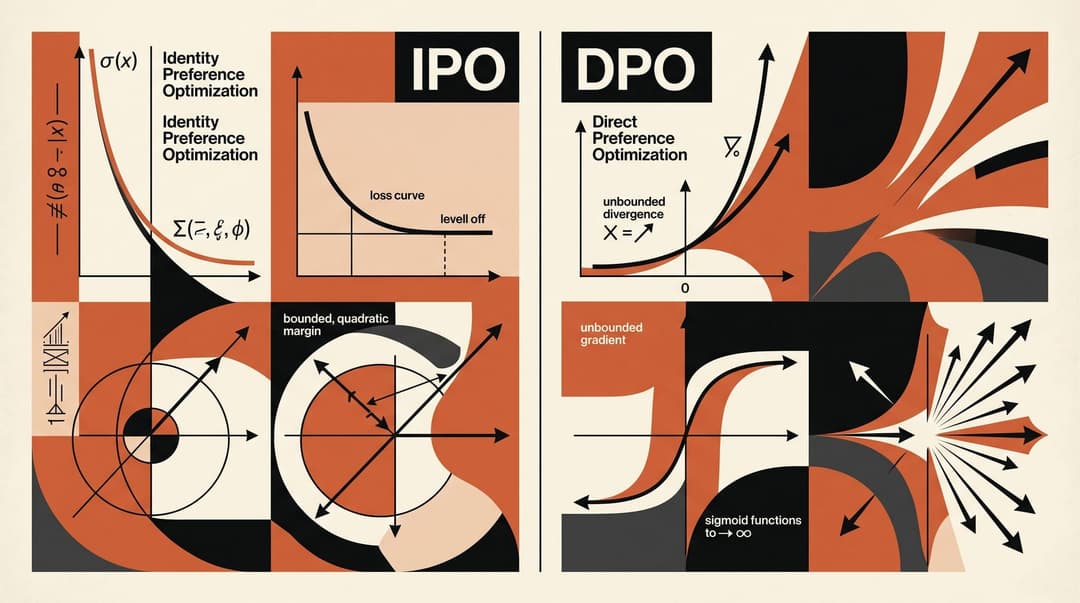
The DPO loss is . Because only as , minimizing DPO on any pairwise dataset incentivizes the model to push .
When human feedback is deterministic (that is, ) or when training extends beyond a single epoch, DPO continuously increases the probability ratio without bound. This drives far from , nullifying the implicit KL penalty and degrading general language generation metrics.
2. Sensitivity to Label Noise and Outliers
In real-world annotation pipelines, preference datasets contain label noise and contradictory ratings. Under the DPO objective, if a noisy pair is presented where is low quality, the gradient magnitude remains significant until dominates . This forces the policy to distort its probability distribution over rare tokens.
3. Violation of Bradley-Terry Assumptions
DPO relies strictly on the Bradley-Terry choice axiom, which assumes strong stochastic transitivity ( and ). Human preferences regularly violate transitivity due to multi-attribute trade-offs (e.g., conciseness vs. factual completeness). Fitting an intransitive preference distribution to a Bradley-Terry model creates systematic estimation bias.
The -Preference Optimization (-PO) Generalization
To analyze preference learning without relying on reward modeling or the Bradley-Terry assumption, Azar et al. introduced the -PO framework.
Let denote the true, non-parametric probability that response is preferred over given prompt . The generalized preference optimization objective is:
where:
- is a non-decreasing surrogate function mapping preference probabilities to real-valued utility.
- is a temperature hyperparameter controlling the balance between preference satisfaction and reference model drift.
Recovering Existing Methods
The behavior of -PO depends on the choice of functional form :
- Standard RLHF / DPO: Choosing the logit mapping recovers DPO under the assumption that $P^(y \succ y' \mid x) = \sigma(r^(x, y) - r^*(x, y'))$. Because , this formulation produces unbounded gradients on deterministic pairs.
- Identity Mapping (IPO): Setting treats preference probability directly as linear utility without passing through an unbounded log-odds transformation.
Identity Preference Optimization (IPO) Mathematical Formulation
By setting , the -PO objective becomes:
Because $P^(y \succ y' \mid x) + P^(y' \succ y \mid x) = 1$, maximizing is equivalent to maximizing the pairwise margin over arbitrary sample pairs.
Derivation of the Sampled Loss
Azar et al. demonstrated that under the identity mapping, the population objective can be optimized via a quadratic regression loss over preference pairs sampled from the dataset distribution:
In practice, this is implemented as:
where $\Delta h_\theta(x, y_w, y_l) = \left( \log \pi_\theta(y_w \mid x) - \log \pi_\text{ref}(y_w \mid x) \right) - \left( \log \pi_\theta(y_l \mid x) - \log \pi_\text{ref}(y_l \mid x) \right)$.
Target Margin Mechanics
The quadratic penalty fundamentally alters the optimization dynamics:
- Finite Target Margin: Rather than pushing the implicit reward difference toward infinity, IPO minimizes the squared distance between and the constant target value .
- Regularization Control: The parameter directly dictates the scale of the target margin. As (weaker KL regularization), the target margin . Conversely, smaller permits a larger gap between preferred and dispreferred response log-probabilities while maintaining a finite bound.
Gradient Dynamics: DPO vs. IPO
Examining the gradients with respect to model parameters illustrates why IPO prevents policy drift.
DPO Gradient
The gradient of the DPO loss is:
The weight factor is $w_\text{DPO} = \sigma(-\beta \Delta h_\theta) = 1 - \sigma(\beta \Delta h_\theta)$.
- When the model misclassifies the pair (), , producing large update steps.
- When the model correctly separates the pair (), remains strictly positive for all finite margins. Training continues to push larger, causing ongoing parameter drift.
IPO Gradient
The gradient of the IPO loss is:
The scalar coefficient has distinct behavioral regimes:
- Under-separated (): . The gradient increases the likelihood of and decreases the likelihood of .
- Equilibrium (): . The gradient vanishes, stabilizing the policy on that pair.
- Over-separated (): . The gradient reverses sign, pulling back toward the target margin.
This sign-reversing behavior functions as an automatic brake, ensuring that high-confidence pairs do not distort the policy distribution.
Comparison Across Direct Alignment Methods
The direct alignment landscape contains several reference-based and reference-free objectives:
- Direct Preference Optimization (DPO): Uses binary cross-entropy on sigmoid reward differences. Computationally simple, but prone to logit explosion and over-optimization on low-noise datasets.
- Identity Preference Optimization (IPO): Uses mean squared error targeting a fixed margin . Bypasses Bradley-Terry assumptions and maintains strict KL regularization even under infinite training steps.
- Kahneman-Tversky Optimization (KTO): Optimizes utility directly on unpaired binary signals (thumbs up / thumbs down) based on prospect theory value functions.
- Simple Preference Optimization (SimPO): Uses a reference-free formulation with length-normalized log-likelihood margins and a target margin hyperparameter , eliminating reference model memory overhead during training.
- Odds Ratio Preference Optimization (ORPO): Integrates preference alignment directly into supervised fine-tuning via an odds-ratio penalty, discarding the reference model.
Implementation Considerations
When applying IPO in alignment pipelines such as Hugging Face TRL or Axolotl:
- Hyperparameter Tuning: In standard implementations, is often parameterized as , making the target margin equal to . Typical practical values for range from 0.01 to 0.1, corresponding to . Setting too small results in over-regularization where the policy fails to distinguish preferred responses from dispreferred ones.
- Batch Size Sensitivity: Because IPO uses a mean-squared error loss rather than cross-entropy, outlier gradient steps can have larger variance early in training. Using warm-up schedules and normalized batch sizes stabilizes optimization.
- Evaluation Stability: Unlike DPO, which often exhibits a performance peak after 0.5 to 1.5 epochs followed by degradation, IPO training curves typically display monotonic convergence on evaluation benchmark suites (such as MT-Bench and AlpacaEval).
Sources
- A General Theoretical Paradigm to Understand Learning from Human Preferences (Azar et al., 2023 / AISTATS 2024)
- Direct Preference Optimization: Your Language Model is Secretly a Reward Model (Rafailov et al., 2023)
- Human Alignment of Large Language Models through Online Preference Optimization (Calandriello et al., 2024)
- Hugging Face TRL: Direct Preference Optimization and IPO Implementations
