
Autonomous AI agents interacting with real-world infrastructure frequently execute irreversible side-effects: charging payment methods, provisioning cloud servers, sending external webhooks, and modifying production databases. While traditional microservices rely on deterministic business logic and predictable retry policies, Large Language Model (LLM) agents operate probabilistically. An agent faced with a transient network drop, an HTTP 504 Gateway Timeout, or context window compaction can re-issue identical or slightly mutated tool calls, triggering duplicate execution, orphaned infrastructure, and financial losses.
Bridging probabilistic agent reasoning with deterministic transactional safety requires three classic distributed systems patterns: deterministic idempotency key derivation, transactional outboxes, and distributed sagas with compensating actions.
The Dual-Write Problem in Agentic Tool Execution
In standard agent runtimes, an execution step involves two concurrent operations across disparate state boundaries:
- The external side-effect: Invoking a third-party REST API, database mutation, or cloud provider call via a tool handler.
- The internal conversation state: Appending the tool call and its observation into the agent context memory.
When these operations are not atomic, failures introduce dual-write anomalies:
+------------------+         1. Execute Tool (e.g. Charge $500)
|                  | -------------------------------------------> +------------------+
|  LLM Agent Loop  |                                              | External Gateway |
|                  | < - - - - - - - - - - - - - - - - - - - - -  | (Success / 200)  |
+------------------+      2. Network Drops / Runtime Crashes      +------------------+
         |
         | (Amnesia: Context was never updated with ToolResult)
         v
+------------------+         3. Retry Charge $500 (Duplicate!)
|  Re-instantiated | -------------------------------------------> +------------------+
|    Agent Loop    |                                              | External Gateway |
+------------------+                                              +------------------+
If the runtime crashes after the external API successfully commits the charge but before the observation is recorded in the local database, the re-instantiated agent will observe that the charge was never completed. Due to autoregressive generation, the agent will decide to re-attempt the tool invocation, resulting in a duplicate financial charge.
A similar anomaly occurs during mid-execution context compression. As demonstrated in recent compaction studies, aggressive context pruning can eliminate intermediate execution records, inducing agent amnesia where the model repeats steps it previously finalized.
Deterministic Idempotency Key Derivation
The primary defense against duplicate side-effects is the HTTP Idempotency-Key header, formalized in the IETF HTTPAPI Idempotency-Key specification. When an API receives a request with an idempotency key it has already processed, it returns the cached original response without re-executing the underlying logic.
However, standard client applications generate client-side UUIDv4 tokens at call time. In an LLM agent architecture, generating dynamic UUIDs inside the tool execution handler fails because each probabilistic retry generates a new UUID, bypassing downstream deduplication.
Canonical Argument Hashing
To make idempotency functional for LLMs, the agent runtime must compute deterministic idempotency keys derived from the business intent and the agent execution DAG:
Key properties of this derivation include:
- Canonical JSON Normalization: LLMs frequently output keys in varying order or introduce non-semantic whitespace. The runtime must parse the tool arguments into an abstract syntax tree, sort all dictionary keys lexicographically, and serialize with uniform formatting before computing the digest.
- Stable Intent Identifiers: For multi-turn workflows, the key should link to a durable task ID rather than raw token offsets, ensuring that context compaction does not alter the hash seed.
State Transitions for Idempotency Records
The server-side idempotency store (typically Redis or DynamoDB with conditional writes) must implement a three-phase state machine:
   +-----------------------------------------------------------+
   |                                                           |
   v                                                           |
[EMPTY] ---> (SET NX PENDING, TTL 60s) ---> [PENDING]          | (Lease Timeout)
                                               |               |
                    +--------------------------+----------+    |
                    | (Execution Success)                 |    |
                    v                                     v    |
              [EXECUTED]                             [FAILED] -+
(Return Cached Body) (Permit Retry / Evict)- PENDING: An atomic lock acquired via
SET key token NX EX 60. If another concurrent agent worker attempts the same operation, it receives anHTTP 409 Conflictor blocks until completion. - EXECUTED: The operation finished successfully. The full response payload and status code are persisted under the key with a standard 24-hour TTL.
- FAILED: If the tool execution raised a recoverable exception, the record is transitioned to
FAILEDor evicted, permitting clean subsequent attempts.
The Transactional Outbox Pattern for Agents
Relying on direct tool execution from the model worker couples the LLM inference loop directly to external service availability. If an external service experiences latency spikes, the LLM worker remains blocked, consuming expensive GPU memory or server worker threads.
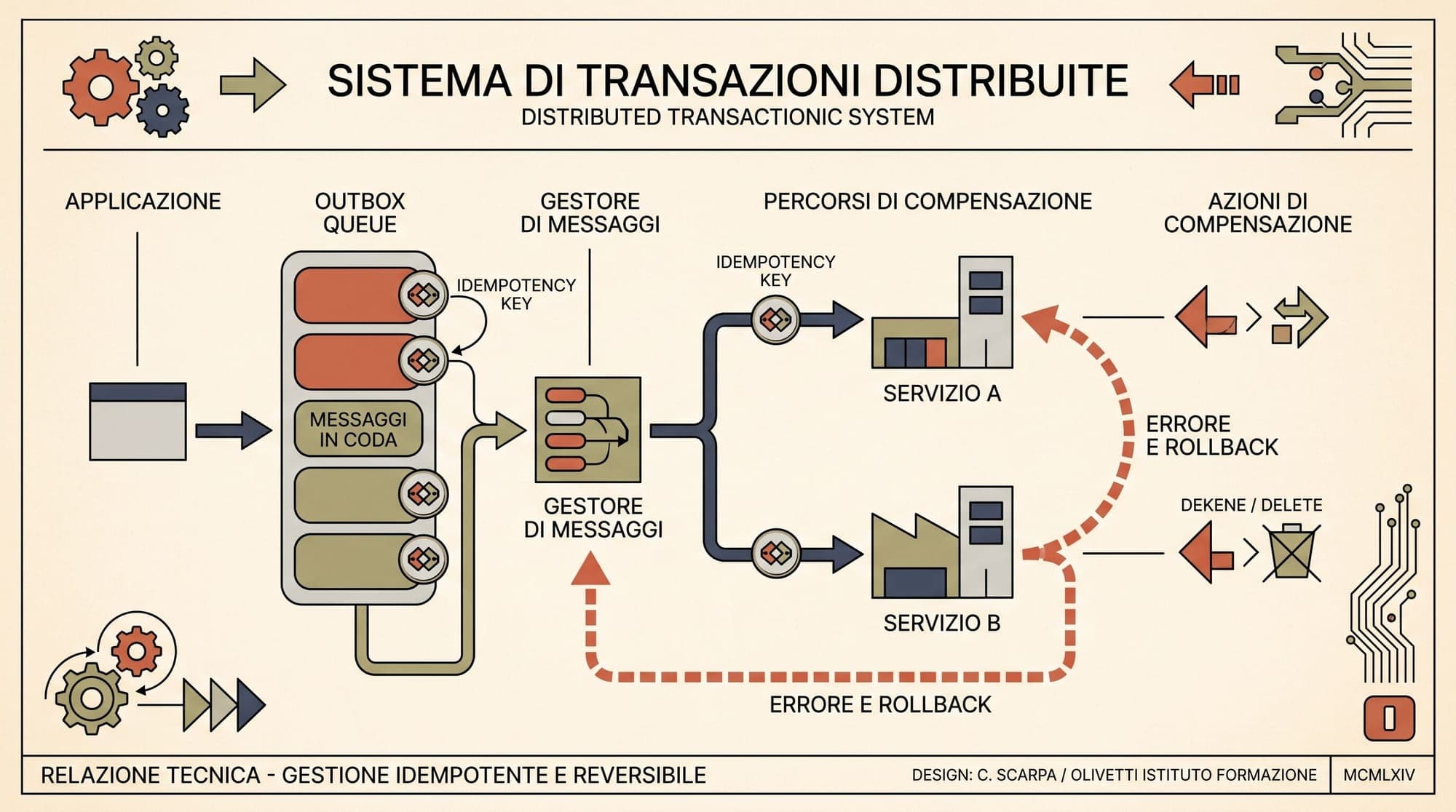
The Transactional Outbox pattern decouples the agent decision from external network transmission.
+-----------------------------------------------------------------------+
| Single Atomic Database Transaction (ACID)                             |
|                                                                       |
|  +--------------------------------+   +----------------------------+  |
|  | Agent State & Context Messages |   | Outbox Messages Table      |  |
|  | (Records prompt + tool intent) |   | (Records pending payloads) |  |
|  +--------------------------------+   +----------------------------+  |
+-----------------------------------------------------------------------+
                                   |
                         Polling or CDC Stream
                                   v
                      +--------------------------+
                      | Outbox Relay Worker      |
                      +--------------------------+
                                   |
                        Idempotent HTTP / RPC
                                   v
                      +--------------------------+
                      | External Target Service  |
                      +--------------------------+
Implementation Mechanics
- Atomic Local Commit: When the agent decides to invoke an external tool, the orchestrator writes the updated conversation log and an
outboxevent record into the local relational database in a single transaction. - Reliable Relay: A background relay process reads uncommitted outbox rows via transaction log tailing (Change Data Capture) or high-frequency polling (
SELECT ... FOR UPDATE SKIP LOCKED). - At-Least-Once Delivery: The relay sends the payload to the external service using the deterministic idempotency key. Because the external endpoint enforces idempotency, network timeouts and relay restarts can safely resend the event without risk of duplicate execution.
- Observation Injection: Once the relay confirms execution, it writes the
ToolResultback to the agent session store, waking up the LLM scheduler for the next reasoning step.
Distributed Sagas and Compensating Actions
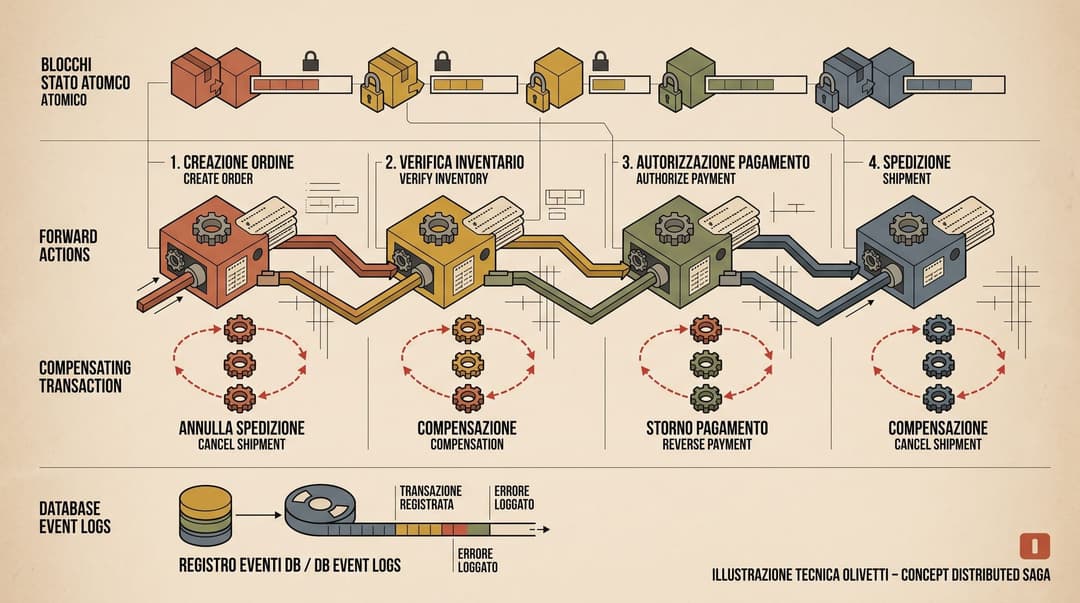
Real-world agent plans routinely span multiple sequential tools: reserving compute instances, configuring networking, cloning repositories, and deploying containers. If step 4 fails due to quota exhaustion, the resources provisioned in steps 1 through 3 remain active, creating resource leaks and billing waste.
Standard database transactions (Two-Phase Commit / 2PC) cannot span disparate SaaS APIs and cloud vendors. Autonomous agent runtimes must therefore adopt the Saga pattern formulated by Garcia-Molina and Salem (1987).
A saga represents a collection of forward transactions paired with corresponding compensating transactions .
Forward Recovery vs. Backward Compensation
Agent sagas operate under two primary recovery modes:
- Backward Recovery (Compensation): When a forward action fails irrecoverably, the orchestrator halts forward progress and executes compensating actions in reverse order to return the system to its baseline state.
- Forward Recovery (Retry / Alternative Routing): If a step fails, the agent router attempts an equivalent secondary provider (e.g., falling back from AWS to GCP for VM provisioning) rather than undoing prior work.
Tool Registration Contract
Every side-effecting tool registered in an agent runtime should expose both an execution handler and an explicit compensation interface:
interface AgentTool<TInput, TOutput, TContext> {
  name: string;
  description: string;

  // Forward execution
  execute(input: TInput, ctx: TContext): Promise<TOutput>;

  // Inverse compensation (must also be idempotent)
  compensate(input: TInput, result: TOutput, ctx: TContext): Promise<void>;

  // Declares if action can be semantically reversed
  isCompensatable: boolean;
}
Handling Non-Compensatable Actions
Not all real-world actions are compensatable. An email sent to a customer, an SMS notification, or a physical robotic actuator command cannot be rolled back.
Production agent orchestrators classify tools into three operational tiers:
- Compensatable: Operations with direct inverses (e.g.,
create_instanceterminate_instance,create_dns_recorddelete_dns_record). - Pivot Transactions: The single non-reversible commitment point in a workflow (e.g.,
capture_payment). Once the pivot transaction succeeds, subsequent steps must only use forward recovery. - Non-Compensatable with Semantic Correction: Actions where the original state cannot be restored, but a clarifying follow-up action is taken (e.g., sending an apology email stating that an order was cancelled due to inventory shortages).
For actions involving high blast-radius non-compensatable operations, the orchestrator must enforce human-in-the-loop authorization gates before queueing the outbox item.
Production Architectural Blueprint
The following state machine orchestrates an idempotent, outbox-backed agent tool execution cycle with automatic saga rollback:
import hashlib
import json
from dataclasses import dataclass
from typing import Any, Callable, Dict, List, Optional

@dataclass
class SagaStep:
    tool_name: str
    args: Dict[str, Any]
    result: Optional[Dict[str, Any]] = None
    status: str = "PENDING"  # PENDING, COMPLETED, FAILED, COMPENSATED

class AgentSagaCoordinator:
    def __init__(self, session_id: str, db_connection, redis_client):
        self.session_id = session_id
        self.db = db_connection
        self.redis = redis_client
        self.execution_log: List[SagaStep] = []

    def derive_idempotency_key(self, step_index: int, tool_name: str, args: Dict[str, Any]) -> str:
        canonical_args = json.dumps(args, sort_keys=True, separators=(',', ':'))
        raw_seed = f"{self.session_id}:{step_index}:{tool_name}:{canonical_args}"
        return hashlib.sha256(raw_seed.encode("utf-8")).hexdigest()

    def execute_saga(self, steps: List[tuple[str, Dict[str, Any], Callable, Callable]]):
        for idx, (tool_name, args, forward_fn, compensate_fn) in enumerate(steps):
            idem_key = self.derive_idempotency_key(idx, tool_name, args)
            step_record = SagaStep(tool_name=tool_name, args=args)
            self.execution_log.append(step_record)

            # 1. Acquire distributed lock / idempotency reservation
            if not self.redis.set(f"idem:{idem_key}", "PENDING", nx=True, ex=120):
                cached = self.redis.get(f"idem:{idem_key}")
                if cached and cached != "PENDING":
                    step_record.result = json.loads(cached)
                    step_record.status = "COMPLETED"
                    continue

            try:
                # 2. Execute forward tool action
                result = forward_fn(args, idempotency_key=idem_key)
                step_record.result = result
                step_record.status = "COMPLETED"
                self.redis.set(f"idem:{idem_key}", json.dumps(result), ex=86400)
            except Exception as exc:
                step_record.status = "FAILED"
                self.redis.delete(f"idem:{idem_key}")
                self.rollback_saga(idx - 1, steps)
                raise RuntimeError(f"Saga aborted at step {idx} ({tool_name}): {exc}")

    def rollback_saga(self, failed_index: int, steps: List[tuple]):
        # Execute compensating transactions in reverse order
        for idx in range(failed_index, -1, -1):
            tool_name, args, _, compensate_fn = steps[idx]
            step_record = self.execution_log[idx]
            if step_record.status == "COMPLETED" and compensate_fn:
                comp_key = f"comp:{self.derive_idempotency_key(idx, tool_name, args)}"
                try:
                    compensate_fn(args, step_record.result, idempotency_key=comp_key)
                    step_record.status = "COMPENSATED"
                except Exception as comp_exc:
                    # Log to dead-letter queue for operator intervention
                    print(f"CRITICAL: Compensation failed for step {idx}: {comp_exc}")
Architectural Failure Modes and Mitigations
| Failure Mode | Root Cause | Architectural Mitigation |
|---|---|---|
| Duplicate API Writes | LLM non-deterministically re-issues identical tool calls after network timeout. | Canonical JSON argument hashing and HTTP Idempotency-Key headers backed by Redis reservation locks. |
| Orphaned Infrastructure | Multi-step agent workflow crashes midway through provisioning. | Distributed Saga orchestrator executing reverse compensating transactions (). |
| Agent Context Amnesia | Context compression drops prior tool observations. | Transactional outbox pattern tying conversation history commits to durable event log tables. |
| Compensation Deadlocks | Compensating transaction fails due to secondary downstream dependency outage. | Persistent compensation outbox with exponential backoff retries and human-in-the-loop dead-letter queues. |
| Phantom Invocations | Stale background worker completes tool execution after orchestrator timed out. | Strict lease timeouts on outbox rows with optimistic locking via version numbers. |
Operational Guidelines
- Enforce Canonical Serialization: Never hash raw LLM tool output strings directly. Parse JSON objects, remove non-semantic formatting, and sort keys before computing idempotency digests.
- Set Defensive Lock Leases: When setting
PENDINGstates in your idempotency store, ensure lease timeouts account for the 99th percentile execution latency of downstream tools to prevent duplicate executions from concurrent workers. - Persist State Before Network I/O: Never dispatch network calls inside the same execution block as local database writes without an outbox. Commit intent first, relay second.
- Design Tools for Invertibility: Require developers registering new agent tools to provide explicit compensation hooks, or flag tools as non-compensatable to enforce appropriate confirmation prompts.
