
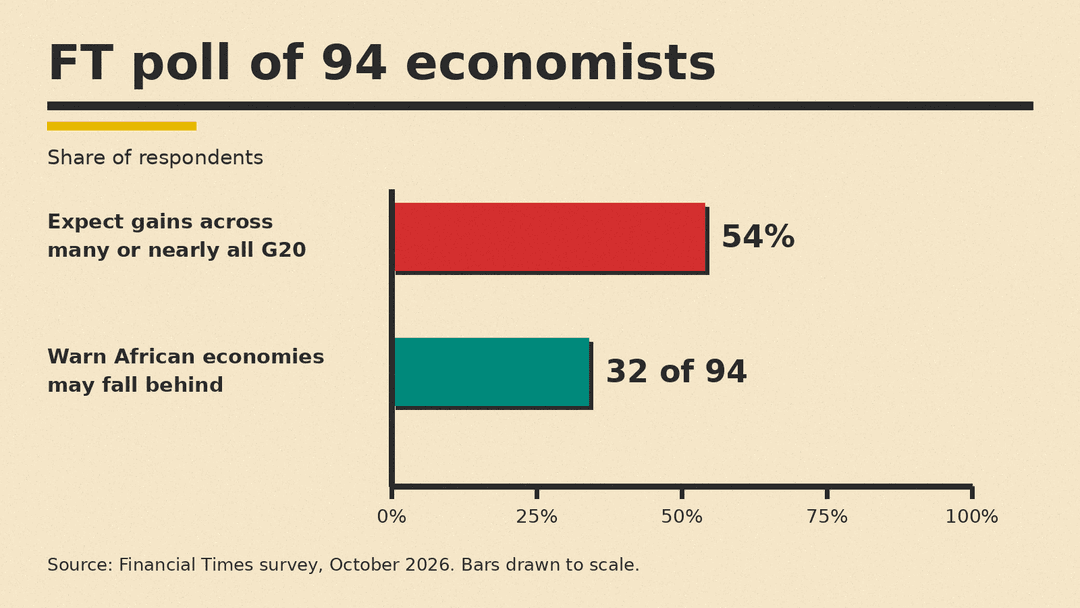
A majority of economists polled by the Financial Times expect the economic gains from AI to spread well beyond the US and China over the next decade, without leading to mass job losses. The FT survey of 94 economists across Asia, the US and Europe found that 54% expect many or nearly all G20 countries to see significant economic and productivity gains from AI. The FT describes the result as a strikingly optimistic assessment.
The same poll points to who may miss out. Thirty-two respondents said weak infrastructure puts African economies at particular risk of falling behind, according to the FT as summarized by AI Weekly.
What the economists expect
Beyond the headline 54%, the median forecast puts AI's contribution at roughly 1.5% added to annual global output, AI Weekly reports from the FT findings. According to the FT, as summarized by AI Weekly, most respondents did not foresee sustained unemployment, even as administrative, customer service and junior professional roles come under pressure.
The optimistic case rests on adoption rather than invention. Several economists argued that countries do not need to build frontier AI systems to benefit, because gains can come from using AI at work, importing AI-enabled goods and services, and knowledge spillovers, according to the FT as summarized by AIDirectory. The FT compared this to how the benefits of electricity and computers eventually reached places far from where those technologies were first developed.
Among the named respondents, according to AI Weekly's account of the FT piece:
- Vanguard chief economist Jumana Saleheen said economies that adopt and expand AI use would benefit beyond the places developing the technology.
- Martin Beck of WPI Strategy said gains can come through adoption, AI-enabled imports, knowledge spillovers and cheaper goods.
- Diane Coyle of the University of Cambridge said AI would change the character of jobs but did not expect a collapse in employment.
Who could fall behind
According to the FT, as summarized by AI Weekly, the 32 economists who flagged African economies cited weak infrastructure, naming Nigeria, Somalia and Ethiopia. AIDirectory's summary describes the infrastructure in question as reliable power and internet.
A second group of countries was flagged for a different reason. The FT reported, per AI Weekly, that the Philippines, Mexico and Indonesia were flagged as vulnerable because they rely on labor cost advantages in sectors exposed to automation, such as routine services. According to the FT findings as summarized by AIDirectory, respondents warned that places relying on outsourced work like call centers and routine office tasks could face faster disruption, even if overall unemployment does not rise sharply.
Some respondents quoted by the FT expect the gap between early and late adopters to widen, according to AI Weekly's account. Lea Dauphas of TAC Economics argued that faster productivity growth among early adopters could increase their capacity for further AI investment and compound the gap. Philipp Lausberg of the European Policy Centre warned AI could erode existing comparative advantages faster than countries can develop new ones. Luis Garicano of the London School of Economics said restrictions on adoption and Europe's limited presence across the AI supply chain leave Europe vulnerable.
Why it matters for business
For companies, the survey is a read on where AI demand and AI-driven cost pressure are likely to show up. If the consensus holds, the market for AI tools and services is broad across the G20 rather than concentrated in the two countries building most frontier models. That favors vendors selling adoption, such as cloud platforms, enterprise software and integrators, over a narrow set of model builders.
The downside is concentrated in a specific business model: offshore delivery of routine services. Countries whose export industries are built on lower labor costs for customer service and back office work are the ones respondents flagged. Any company that buys or sells that kind of work has a direct stake in how fast automation substitutes for it.
The poll is a set of forecasts, not a measurement. A 54% majority also means close to half of respondents did not expect gains to spread to many or nearly all G20 members. The results still offer a counterweight to the warnings of profound risk that the FT says the findings clash with. They will be tested against productivity data over the coming years.
