
Deterministic Replay for Production AI Agents: Architecture, Event Sourcing, and State Playback
Debugging multi-step autonomous AI agents in production is notoriously difficult. Unlike traditional deterministic software systems where a stack trace and a fixed set of inputs reproduce an error, autonomous agent workflows suffer from compound non-determinism across multiple infrastructure layers. A failure occurring at step 24 of a coding or research agent cannot reliably be reproduced simply by re-running the initial prompt.
To make agentic systems debuggable, auditable, and testable in continuous integration (CI) pipelines, engineering teams are adopting deterministic replay architectures. By combining event sourcing, tool virtualization, and environment snapshotting, deterministic replay allows engineers to step through past agent trajectories, isolate failure points, and test interventions without triggering unwanted external side effects or incurring repeated model inference costs.
The Non-Determinism Problem in Agent Systems
Autonomous agents operate as closed-loop feedback systems: the model generates reasoning traces and tool calls, the environment executes those actions and returns observations, and the updated context feeds into subsequent model invocations. Non-determinism enters this loop through three distinct mechanisms:
1. Model-Level Variance
Even when sampling parameters are set to greedy decoding (temperature=0), production language models do not exhibit guaranteed bitwise reproducibility. As demonstrated by Ouyang et al. (2024), inference engines running across distributed GPU clusters exhibit numerical instability due to:
- Floating-point non-associativity: In parallel reduction algorithms (such as FlashAttention or batched matrix multiplication), floating-point additions performed in varying thread order yield minute numerical differences: .
- Dynamic batching: Varying batch compositions across concurrent requests alter the parallel scheduling of CUDA thread blocks and tensor core operations.
- Kernel tie-breaking: When two tokens share near-identical top logit values, floating-point drift can flip the argmax selection, causing trajectory divergence.
2. Environment and Tool Volatility
External tools interact with mutable state:
- REST API responses change over time (e.g., search engine index updates, fluctuating inventory or pricing).
- Databases undergo concurrent writes and schema migrations.
- File systems, git repositories, and network latencies evolve asynchronously.
3. Cascading Trajectory Drift
Because agent prompts accumulate historical context over time, a single token difference or altered tool response early in a run alters the key-value cache and attention distribution across all subsequent steps. A 1% divergence at step 3 frequently cascades into complete task failure by step 15.
Core Architecture: Event Sourcing for AI Agents
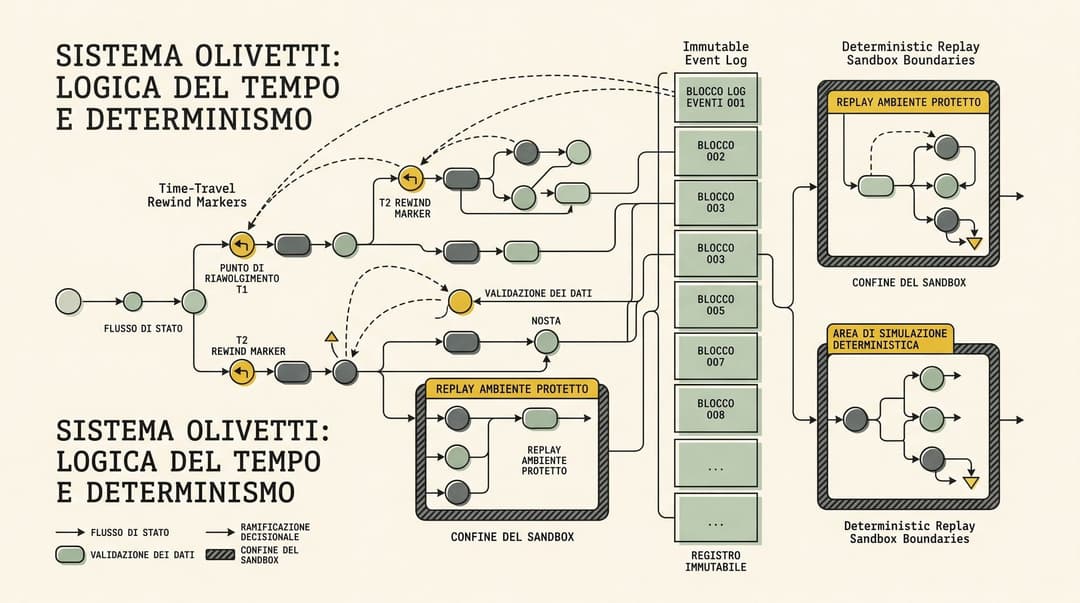
The architectural foundation of deterministic replay is event sourcing. Rather than storing only the mutable current state of an agent, the system records an immutable, append-only ledger of every discrete state transition and external interaction.
+-------------------------------------------------------------------------+
|                        Agent Execution Runtime                          |
+--------------------+-------------------------------+--------------------+
                     |                               |
             [Prompt Assembly]               [Tool Dispatch]
                     v                               v
+--------------------+-------------------------------+--------------------+
|               Interception & Virtualization Middleware                  |
+--------------------+-------------------------------+--------------------+
                     |                               |
             (Record / Replay)               (Record / Replay)
                     v                               v
+--------------------+-------------------------------+--------------------+
|                         Immutable Event Ledger                          |
|  - seq_id: 104                                                          |
|  - run_id: run_8f9a2b                                                   |
|  - event_type: ToolInvocation                                           |
|  - input_hash: sha256(...)                                              |
|  - payload: { tool: "fetch_api", args: {...}, result: {...} }           |
+-------------------------------------------------------------------------+
Event Schema Design
Each event record must capture sufficient context to reconstruct the exact execution state without invoking live external services. A standard event record schema includes:
{
  "seq_id": 104,
  "run_id": "run_8f9a2b1c-9012-4c5e-b567-8e9a0f123456",
  "parent_span_id": "span_4a2d81",
  "timestamp": "2026-08-21T02:14:05.128Z",
  "event_type": "ToolInvocation",
  "state_checksum": "e3b0c44298fc1c149afbf4c8996fb92427ae41e4649b934ca495991b7852b855",
  "model_config": {
    "model": "claude-3-7-sonnet-20250219",
    "temperature": 0.0,
    "seed": 42
  },
  "context_snapshot": {
    "system_prompt_hash": "a1b2c3d4...",
    "token_count": 8420
  },
  "payload": {
    "tool_name": "execute_sql_query",
    "arguments": {
      "query": "SELECT status, count(*) FROM orders WHERE created_at > '2026-08-01' GROUP BY status;"
    },
    "result": {
      "columns": ["status", "count"],
      "rows": [["completed", 1420], ["pending", 84], ["failed", 12]]
    },
    "error": null,
    "duration_ms": 38.4
  }
}
By storing the complete payload (input arguments, output structures, and execution status), the replay engine can satisfy future read requests directly from the ledger.
Replay Execution Modes
A production replay system supports three distinct operational modes, depending on whether the objective is post-mortem debugging, regression testing, or counterfactual intervention analysis:
| Dimension | Full Mock Replay | Checkpoint Resumption | Forked Counterfactual Replay |
|---|---|---|---|
| Primary Use Case | Post-mortem bug inspection, CI regression suites | Fast recovery from transient failures | Prompt and tool schema optimization |
| Model Invocations | Mocked (from ledger) | Live (post-checkpoint) | Live (post-mutation) |
| Tool Execution | Mocked (from ledger) | Live (post-checkpoint) | Live / Hybrid |
| External Side Effects | Zero | Active | Controlled / Sandboxed |
| Inference Cost | Zero | Proportional to remaining steps | Proportional to downstream steps |
| Determinism Guarantee | 100% Bitwise Reproducible | Non-deterministic downstream | Non-deterministic downstream |
1. Full Mock Replay (Zero-Intrusion Playback)
During full mock replay, both the LLM client and the tool execution client are replaced with virtualization proxies:
- When the agent constructs a prompt at step , the proxy looks up the pre-recorded model completion corresponding to that step or prompt hash.
- When the agent invokes a tool, the proxy intercepts the call, validates the input arguments against the recorded event, and immediately returns the recorded output.
- This allows an engineer to attach standard debuggers (such as
pdbor Chrome DevTools), inspect variables, evaluate intermediate token representations, and verify state machine transitions locally without network connectivity or API spend.
2. Checkpoint Resumption (State Branching)
As described by Sakura Sky (2025) and implemented in orchestrators like LangGraph, checkpoint resumption restores the agent's memory and working context up to step , but re-enables live model and tool execution from that point forward. This is utilized when recovering long-running workflows that suffered transient network outages or rate-limit errors.
3. Forked Counterfactual Replay (Time-Travel Debugging)
In counterfactual analysis, an engineer modifies a prompt instruction, a tool schema, or a mock tool response at step . The engine executes steps via mock replay, injects the modification at step , and switches to live execution for steps . This enables empirical measurement of how specific prompt adjustments alter downstream trajectory branching.
Tool and Environment Virtualization
Replaying an agent that manipulates a local filesystem, code repository, or external database requires sandboxing primitives to prevent state corruption.
+-------------------------------------------------------------------------+
|                       Sandbox Isolation Layer                           |
+-------------------------------------------------------------------------+
|  [OverlayFS Base Layer (Step 0)] -> Immutable Production Snapshot      |
|                                                                         |
|  [OverlayFS Upper Layer (Step k)] -> Copy-on-Write Delta               |
|                                                                         |
|  [VCR Proxy] -> Matches (ToolName, Hash(Args)) -> Cached Response       |
+-------------------------------------------------------------------------+
1. The VCR Pattern for Agent Tools
Similar to HTTP record/replay libraries (such as vcrpy or Polly.js), tool virtualization wraps all agent tool interfaces. When recorded, every call produces a deterministic cache key computed from the SHA-256 hash of the serialized arguments.
During replay, if the agent issues a tool call whose arguments do not match the expected hash, the replay engine raises a DivergenceError, indicating that changes to the agent's code or prompts caused its execution path to deviate from the recorded trace.
2. Filesystem and Workspace Snapshotting
For coding agents operating on source repositories, replaying tool calls like git commit or write_file requires copy-on-write (CoW) filesystem isolation:
- OverlayFS / Btrfs Snapshots: Creating lightweight, sub-millisecond snapshots of the workspace directory at each step boundary.
- Git Worktree Isolation: Checking out a detached worktree for replay sessions to ensure production repositories remain untouched.
- MicroVM Sandboxes: In environments executing untrusted agent code, hypervisors like Firecracker allow instant snapshotting and restoration of complete VM memory and disk state at specific step checkpoints.
Divergence Analysis in CI/CD Pipelines
Deterministic replay enables teams to build automated regression suites for non-deterministic AI workflows. By maintaining a library of "golden trajectories" (canonical runs verified for correctness), CI pipelines can detect regressions introduced by prompt updates, model fine-tuning, or codebase refactors.
Divergence Detection Pipeline
- Replay Execution: The CI runner executes the test suite in mock replay mode using recorded golden traces.
- Trajectory Alignment: The engine compares the newly generated sequence of actions against the golden sequence .
- Step-Level Assertion:
- Exact Match: Verifies that tool names and structured parameter schemas match identically.
- Semantic Similarity: For open-ended text outputs, embedding similarity or AST structural comparison checks whether the generated code or rationale remains functionally equivalent.
- Root-Cause Attribution: If divergence occurs at step , the framework flags the exact delta in prompt context, tool arguments, or state variables, localizing the defect to a single decision boundary.
As noted by Tianpan (2026) and Augment Code (2026), moving from opaque black-box logging to deterministic event replay reduces mean time to resolution (MTTR) for complex multi-agent failures from hours of manual inspection to automated step-level regression tests.
Sources
- Non-Determinism of "Deterministic" LLM Settings (Ouyang et al., 2024)
- Deterministic Replay: How to Debug AI Agents That Never Run the Same Way Twice (Tianpan, 2026)
- Trustworthy AI Agents: Deterministic Replay (Sakura Sky, 2025)
- How to Debug Parallel AI Agents Without Going Insane (Augment Code, 2026)
- LangGraph Persistence and Time Travel Architecture (LangChain)
