China warns of Claude Code security risk as Alibaba bans Anthropic tools

# China warns of Claude Code security risk as Alibaba bans Anthropic tools China's cybersecurity authority has formally warned that Anthropic's Claude Code contains a "back-door" vulnerability, escalating a dispute that already prompted Alibaba to ban employees from using the AI coding tool. The Chinese Ministry of Industry and Information Technology (MIIT) issued the warning on July 8 through its national cybersecurity threat platform. The statement said Claude Code versions 2.1.91 through 2.

2 min
China warns of Claude Code security risk as Alibaba bans Anthropic tools

# China warns of Claude Code security risk as Alibaba bans Anthropic tools

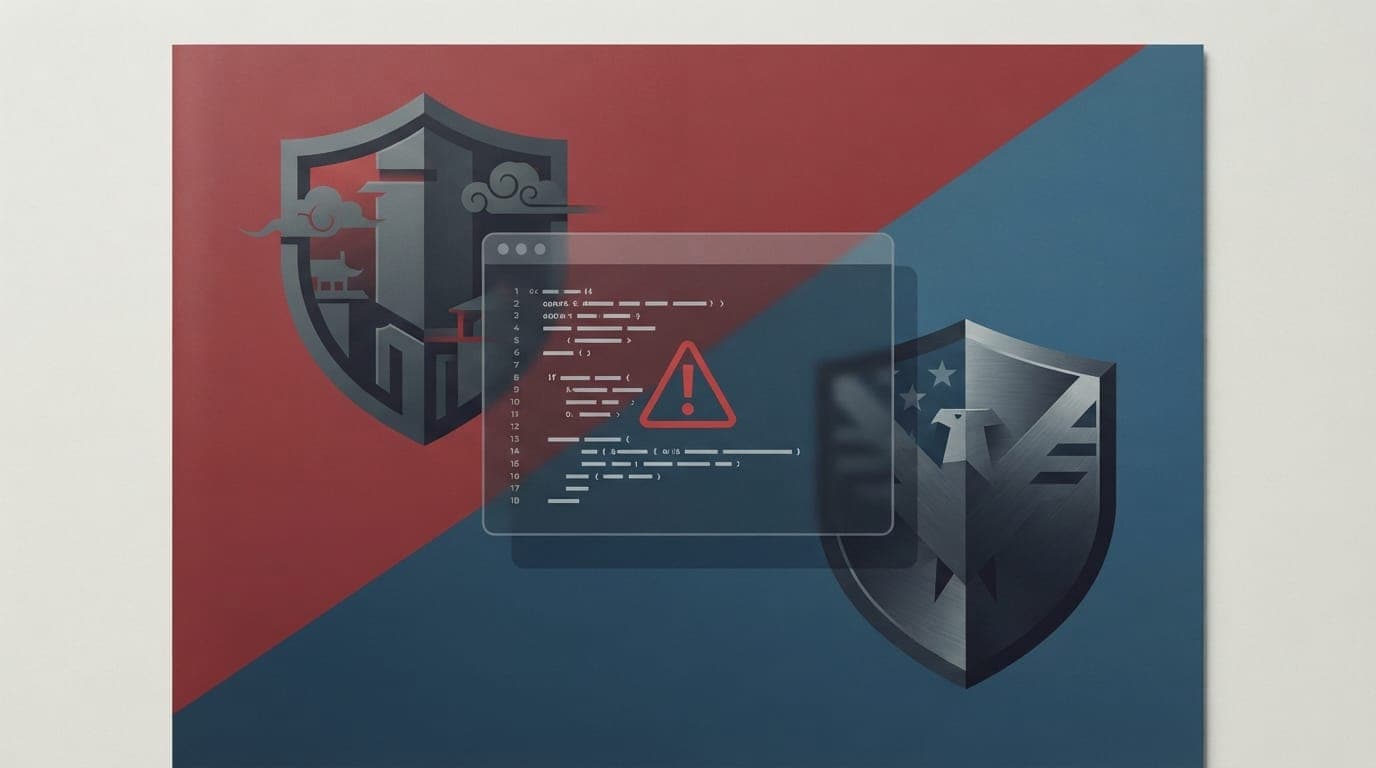
China's cybersecurity authority has formally warned that Anthropic's Claude Code contains a "back-door" vulnerability, escalating a dispute that already prompted Alibaba to ban employees from using the AI coding tool.

The Chinese Ministry of Industry and Information Technology (MIIT) issued the warning on July 8 through its national cybersecurity threat platform. The statement said Claude Code versions 2.1.91 through 2.1.196 could transmit sensitive user information, including location and identity data, to a remote server without consent. Users were advised to uninstall or upgrade from the affected versions, which were released between April 2 and June 29.

Anthropic responded that the flagged feature was an experiment designed to detect and prevent unauthorized distillation of its models, not a security backdoor. The company noted that its terms of service already prohibit use by entities majority-owned by organizations headquartered in China and other restricted regions.

The warning came one day after CNBC reported that Alibaba had placed Claude Code on a high-risk software list and ordered all employees to stop using Anthropic tools for work purposes effective July 10. Alibaba staff were directed to uninstall Anthropic products and switch to the company's own AI assistant, Qoder.

The bans follow Anthropic's June accusation that Alibaba conducted what it called the largest known distillation attack against its models to date. In a letter to the U.S. Senate Committee on Banking, Housing, and Urban Affairs, Anthropic alleged that Alibaba had "brazenly" and "illicitly" attempted to extract its AI capabilities. Alibaba declined to comment at the time.

According to the Financial Times, Ant Group, the fintech affiliate of Alibaba, had provided employees with corporate Claude accounts accessed through its Singapore-based entity. ByteDance, which operates TikTok, reportedly started a reimbursement program allowing employees to use AI tools independently, though it does not formally facilitate Claude access.

Anthropic is now moving to close loopholes that have allowed Chinese companies to access Claude through third-country entities, the FT reported.

The clash highlights the tension between U.S. AI companies trying to restrict access to their models and Chinese firms determined to use frontier tools despite geopolitical barriers. It also underscores the growing role of coding agents like Claude Code as contested infrastructure in the U.S.-China tech rivalry.

## Sources

- [China warns about AI risks with Anthropic's Claude Code - CNBC](https://www.cnbc.com/2026/07/08/china-anthropic-ai-claude-code-backdoor-security-threat.html) - [China's Alibaba bans Anthropic AI for employees after 'distillation attack' accusation - CNBC](https://www.cnbc.com/2026/07/06/alibaba-anthropic-ai-ban-claude-china.html) - [Anthropic accused Alibaba of distillation campaign - CNBC](https://www.cnbc.com/2026/06/24/anthropic-alibaba-distillation-campaign.html)

Written by

More to read

  • Prompt Compression and Context Pruning Engines in Production: Comparing LLMLingua-2, LongLLMLingua, Selective-Context, and RECOMP

    Prompt Compression and Context Pruning Engines in Production: Comparing LLMLingua-2, LongLLMLingua, Selective-Context, and RECOMP Every non-obvious claim below links to a source. Benchmarks are from the papers as cited; the comparative numbers are taken directly from the LLMLingua-2 paper and the RECOMP paper, not synthesized from prose. The context window paradox is real: modern LLMs accept 128k to 1M tokens, but API cost scales linearly with input length, attention compute scales quadratical

    1 min
  • Low-Rank Adaptation (LoRA) and QLoRA: Mathematical Foundations, Intrinsic Rank Dynamics, NF4 Quantization, and Parameter-Efficient Fine-Tuning

    Full fine-tuning of large language models requires updating every parameter matrix across all transformer blocks. In production architectures spanning tens to hundreds of billions of parameters, the computational and memory footprint of updating billions of weights with first-order and second-order optimizer states becomes prohibitive. Low-Rank Adaptation (LoRA) and its quantized counterpart QLoRA provide mathematically grounded parameter-efficient fine-tuning (PEFT) frameworks. By decomposing

    1 min
  • Google Releases Gemini 3.5 Transcribe with Disfluency Filtering and Task Delegation

    Google has launched Gemini 3.5 Transcribe, a dedicated speech-to-text model designed for real-time streaming, automated disfluency cleanup, and agentic task delegation. The release introduces two API interfaces alongside integration across Google developer tooling and consumer operating system surfaces. Dual API Architecture for Live and Batch Audio Gemini 3.5 Transcribe is split into two operational endpoints tailored for distinct latency profiles: * Real-time streaming (gemini-3.5-transcr

    1 min