
AI weather models are heading into a season with little precedent in their training data. On October 19, Techmeme carried a Financial Times story with this summary: "AI's ability to forecast extreme weather faces a major test in the coming months amid a historic El Niño, as some scientists question the tech's accuracy." The FT's subhead, as shown in Techmeme's excerpt, says the technology "is being used to anticipate everything from forest fires to futures contracts. Some fear that's a mistake."
The FT article is paywalled. This explainer builds on primary sources instead: what the models are, which agencies and companies run them, what NOAA says about the El Niño itself, and what the published research says about how AI forecasts behave when the weather leaves the range of their training data.
Where El Niño stands
NOAA's Climate Prediction Center issued its latest ENSO Diagnostic Discussion on 8 October 2026. The alert status is "El Niño Advisory." The synopsis reads: "El Niño continues to strengthen, with a strong-to-very strong El Niño likely through January-March 2027 (remaining greater than an 83% chance)."
The details explain the "historic" label:
- Niño-3.4 reached +2.1°C, Niño-3 +3.0°C and Niño-1+2 +3.9°C. Sea surface temperature anomalies exceeded +4.0°C in parts of the eastern equatorial Pacific.
- CPC says chances "remain high for a historic event that would exceed the strength of previous El Niño events dating back to 1950 (+2.5°C or more for a 3-month RONI value)": 54% for September-November, 83% for October-December and 70% for November-January.
- CPC adds that with an event this large, the chances of El Niño-type impacts "are larger, though not guaranteed."
The next discussion is scheduled for 12 November 2026.
RONI is a relative index. As ECMWF's Tim Stockdale explained in an April 2026 ECMWF blog post, CPC now measures Niño-3.4 relative to sea surface temperature across the tropics, since a warming ocean makes large raw anomalies easier to reach.
How an AI weather model works
A traditional forecast, known as numerical weather prediction, starts from physics equations and solves them on a supercomputer. An AI model learns how the atmosphere evolves from past data instead.
Google DeepMind's GraphCast, the base of NOAA's AI models, takes two inputs, the state of the weather 6 hours ago and the current state, and predicts the state 6 hours ahead. It then feeds its own output back in, step by step, to reach 10 days. DeepMind trained it on four decades of ECMWF's ERA5 reanalysis, a reconstruction of past weather built from observations with a traditional model filling the gaps. A 10-day forecast takes under a minute on a single Google TPU v4 machine, compared with hours on a supercomputer for a conventional forecast, according to DeepMind.
GenCast, DeepMind's next model, is a diffusion model that produces an ensemble of 50 or more possible weather trajectories out to 15 days. Each 15-day member takes 8 minutes on one Google Cloud TPU v5. DeepMind notes that traditional models remain essential because they "supply the training data and initial weather conditions" these AI models need.
That matters for El Niño. Most AI models start from an analysis of today's atmosphere and ocean produced by a physics-based system, then project forward using patterns learned from the past.
Who runs which model
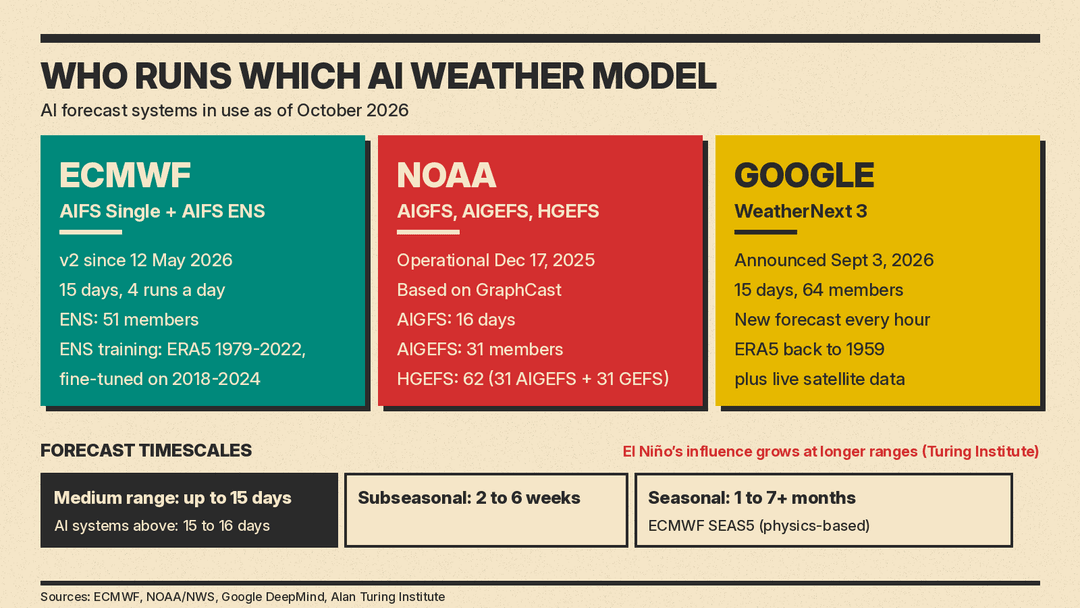
ECMWF (Europe). The European Centre for Medium-Range Weather Forecasts runs the Artificial Intelligence Forecasting System. The deterministic AIFS Single has been operational since 25 February 2025 and the ensemble AIFS ENS since 1 July 2025. Both moved to version 2 on 12 May 2026. They forecast in 6-hour steps out to 15 days, four times a day, on a grid of about 0.25 degrees. AIFS ENS v2 has 51 members. According to its model card, it was pre-trained on ERA5 data from 1979 to 2022 and fine-tuned on ECMWF operational analyses from 2018 to 2024. With the May upgrade, ECMWF stopped running its experimental runs of Aurora, FourCastNet, GraphCast and Pangu-Weather. AIFS output is open data under a CC-BY-4.0 licence.
NOAA (United States). On December 17, 2025, NOAA put three AI systems into operation, per its news release and service change notice:
- AIGFS, a deterministic global model. NOAA says a 16-day forecast uses 0.3% of the computing resources of the traditional GFS and finishes in about 40 minutes. NOAA said version 1.0 showed a degradation in tropical cyclone intensity forecasts, to be addressed in future versions.
- AIGEFS, a 31-member AI ensemble that NOAA says needs 9% of the computing of the traditional GEFS ensemble.
- HGEFS, a 62-member "grand ensemble" combining 31 GEFS members with 31 AIGEFS members. NOAA says it consistently outperforms both parents across most major verification metrics.
AIGFS and AIGEFS started from GraphCast, fine-tuned on NOAA's own Global Data Assimilation System analyses. HGEFS blends AIGEFS with the physics-based GEFS. An AIGFS v1.1 upgrade on July 27, 2026 changed the loss function and fine-tuning process, which NOAA says improves tropical cyclone intensity and precipitation forecasts and reduces blurring at longer lead times.
Google. WeatherNext 3, announced on September 3, 2026 by Google DeepMind and Google Research, ingests live geostationary satellite data and issues a new forecast every hour, with key surface variables at 5 km resolution. Its technical paper describes 15-day, 64-member ensemble forecasts, training on ERA5 data reaching back to 1959, and a real-time version trained on data through June 30, 2026. Google says the model now powers weather in Search, the Gemini app and Maps. The WeatherNext page describes its Weather Lab as "an experimental research platform" and directs users to local meteorological agencies for official forecasts and warnings. (We covered Gemini's own launch in our Gemini 4 Argon explainer.)
What El Niño actually tests
Test 1: the timescale
Every AI system listed above is a medium-range model, forecasting out to 15 or 16 days. El Niño acts mostly on longer horizons. Scott Hosking of the Alan Turing Institute wrote in an August 2026 blog post that El Niño "has little bearing on tomorrow's weather but a much more significant impact on the large-scale atmospheric weather patterns over weeks and months." He lays out the ranges as medium-range (up to 15 days), subseasonal (2 to 6 weeks) and seasonal (1 to 7+ months), and argues that "it is the longer-range forecasts that will be tested most."
The seasonal outlooks that track El Niño itself still come from physics. ECMWF's SEAS5 seasonal system runs a 51-member ensemble up to seven months ahead, built on its Integrated Forecasting System. CPC's official outlook "synthesizes multiple models from North America and abroad." In subseasonal forecasting, ECMWF's AI Weather Quest found in March 2026 that a post-processing entry beat ECMWF's physics model on all variables and lead times, while the best fully data-driven and hybrid entries showed "limited significant improvements" except for precipitation.
In other words, the direct test this season is whether AI medium-range forecasts handle the storms, heat and rain that El Niño helps set up, not whether they predict El Niño.
Test 2: out-of-distribution weather
AI models learn from the range of weather they have seen. Hosking writes that they are trained "primarily covering the past four decades" and that a super El Niño "falls well outside anything in that record." By CPC's measure, an event of this strength would have no equal anywhere in a training record that starts in 1979.
The main peer-reviewed evidence of the risk is a 2026 Science Advances paper by Zhongwei Zhang, Erich Fischer, Jakob Zscheischler and Sebastian Engelke. They tested GraphCast, Pangu-Weather and FuXi against ECMWF's physics-based HRES on 2018 and 2020 weather that broke records set in ERA5 data from 1979 to 2017, a period that coincides with the training data of almost all the AI models tested. Their findings:
- HRES outperformed the AI models on record-breaking heat, cold and wind at nearly all lead times, with the gap largest at short lead times.
- The AI models "tend to underestimate both the frequency and intensity of record-breaking events." Errors grew almost linearly with how far a record was exceeded, which the authors describe as an "implicit (soft) cap" near the most extreme training value.
- The authors conclude that more verification is needed before AI models "can be solely relied upon for high-stakes applications such as early warning systems."
The paper also cites earlier work in which a seasonal AI model struggled with North Atlantic Oscillation values outside its training distribution.
Test 3: which kind of AI model, and how you score it
The picture is contested. A preprint by Jakob Wessel and colleagues at Leipzig University and the University of Exeter, posted on October 14, 2026, compared probabilistic AI ensembles (GenCast in its operational WeatherGen form, and WeatherNext 2) with ECMWF's physics ensemble for heat extremes over land in 2022. The AI ensembles came out ahead, including on records. Between 39% and 45% of observed records lay above every IFS ensemble member, compared with 9% to 17% for WeatherNext 2 and 11% to 21% for WeatherGen.
The authors argue that comparing a deterministic AI forecast, which estimates an average outcome, with a single physics run like HRES is "not like-for-like." They also note that their results "do not rule out limitations of AIWP models in extrapolating beyond the training distribution," they cover one year and one variable, and whether AI can forecast tropical cyclones or extreme precipitation beyond the historical record "remains open." It is a preprint.
The practical reading: deterministic and ensemble AI models may behave differently at the extremes, and the paper finds rankings depend on the verification data.
Test 4: what past El Niños taught, and what they did not
ERA5-trained models have seen past El Niño years. The question is whether those years are a good guide to this one. Two cautions from forecasters:
- Hosking writes that in 2023-24 "the ocean forecast was broadly right, but the atmospheric response was far weaker than the ocean anomaly implied," because record warmth in the Indian and Atlantic Oceans suppressed the Pacific rainfall that drives El Niño's global reach.
- Stockdale notes that a warmer climate background means "impacts of future El Niño events may differ in some ways from past impacts." He describes ECMWF's seasonal models as physics-based and "designed to cope with the climate system moving into uncharted territory," while noting their own imperfections.
Why this matters beyond meteorology
The FT subhead lists forest fires and futures contracts as uses. Google pitches WeatherNext 3 to solar farms, grid operators and renewables developers, and ECMWF's AIFS output can be used commercially with attribution. For these users, a fast forecast that understates a record event is a costly miss. (For a forecasting model outside weather, see our post on Mistral's Timestral time-series models.)
The agencies are hedging. NOAA runs a hybrid AI and physics ensemble. ECMWF runs AIFS alongside its physics-based IFS and relies on physics for seasonal outlooks. The Turing Institute is working on adding climate context that historical training data cannot supply. The Science Advances authors write that it "remains vital to fund and run physics-based NWP and AI weather models in parallel."
What to watch
- CPC's next ENSO discussion on 12 November 2026 and its weekly updates.
- How NOAA's AIGFS, AIGEFS and HGEFS handle any winter storms and atmospheric rivers tied to El Niño, compared with GFS.
- Whether ECMWF publishes AIFS verification for record-breaking events this season.
- Peer review of the Wessel preprint, and any follow-up from the Zhang group.
Sources
- Financial Times: AI's ability to forecast extreme weather faces a major test (paywalled)
- Techmeme excerpt of the FT story, October 19, 2026
- NOAA Climate Prediction Center: ENSO Diagnostic Discussion, 8 October 2026
- NOAA: NOAA deploys new generation of AI-driven global weather models
- NWS Service Change Notice 25-89: AIGFS, AIGEFS and HGEFS
- NWS Service Change Notice 26-68: AIGFS v1.1
- ECMWF: AIFS Machine Learning data
- ECMWF: Implementation of AIFS ENS v2
- ECMWF AIFS ENS v2 model card on Hugging Face
- ECMWF: Seasonal forecasts (SEAS5)
- ECMWF blog: How confident should we be in a prediction of El Niño? (Tim Stockdale, April 10, 2026)
- ECMWF blog: The AI Weather Quest (March 13, 2026)
- Google DeepMind: GraphCast
- Google DeepMind: GenCast
- Google: Introducing WeatherNext 3
- Google DeepMind: WeatherNext 3 page
- arXiv: WeatherNext 3 technical paper
- Alan Turing Institute: A super El Niño is forming (Scott Hosking, August 25, 2026)
- Science Advances: Physics-based models outperform AI weather forecasts of record-breaking extremes
- arXiv: Probabilistic AI models outperform numerical weather prediction models on record breaking heat extremes
