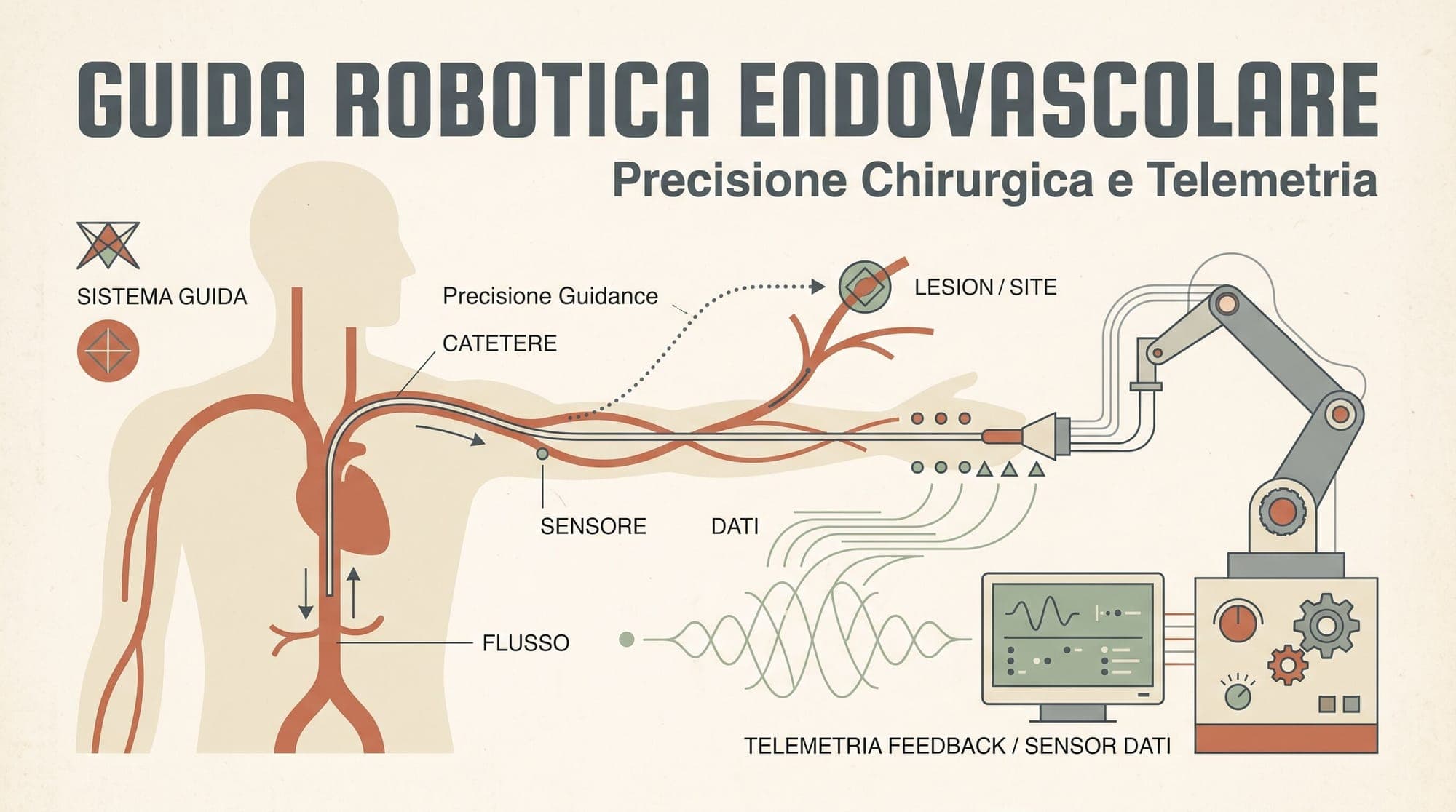
Lithuanian medical robotics company Sentante has initiated commercial deployment of its CE-marked endovascular robotic platform, launching revenue clinical operations across European vascular surgery and interventional radiology departments.
The platform is designed to perform catheter-and-guidewire vascular interventions while capturing synchronized procedural telemetry to train downstream physical AI navigation models.

Teleoperated Architecture and Standard Tool Interoperability
Sentante's system addresses common procedures including peripheral arterial interventions, embolization, and interventional oncology. Rather than relying on proprietary single-use disposable instruments, the bedside robotic unit actuates standard, commercially available catheters and guidewires already stocked in hospital catheterization laboratories.
Surgeons operate the robotic unit from an external console outside the ionizing radiation zone. Key technical specifications include:
- 1:1 Motion-Mimicking Control: An ergonomic interface translates operator hand movements directly into mechanical catheter manipulation without requiring proprietary clinical retraining.
- Force and Torque Feedback: Integrated sensing at the drive mechanism delivers real-time tactile resistance feedback to the operator during vessel navigation.
- Embedded Edge Compute: The latest generation hardware incorporates NVIDIA Jetson AGX edge computing modules, developed using the NVIDIA Isaac for Healthcare robotics framework.
Physical AI Data Substrate
Sentante treats routine clinical cases as an active multimodal data collection pipeline. During each operation, the system records continuous force profiles, torque vectors, mechanical kinematics, and time-aligned fluoroscopic imaging streams.
Because the robotic manipulator mediates every movement, the resulting dataset captures fine-grained representations of expert technique across varied vascular anatomies. The company intends to leverage this procedural data to progressively deploy autonomous assistance layers and safety boundaries.
The European commercial rollout follows clinical validation in the Baltic region through the ESSENTIAL first-in-human study, which demonstrated technical success with zero device-related complications and zero staff radiation exposure. In the United States, Sentante holds an FDA Breakthrough Device Designation granted in September 2025 for remote neurovascular stroke interventions.