
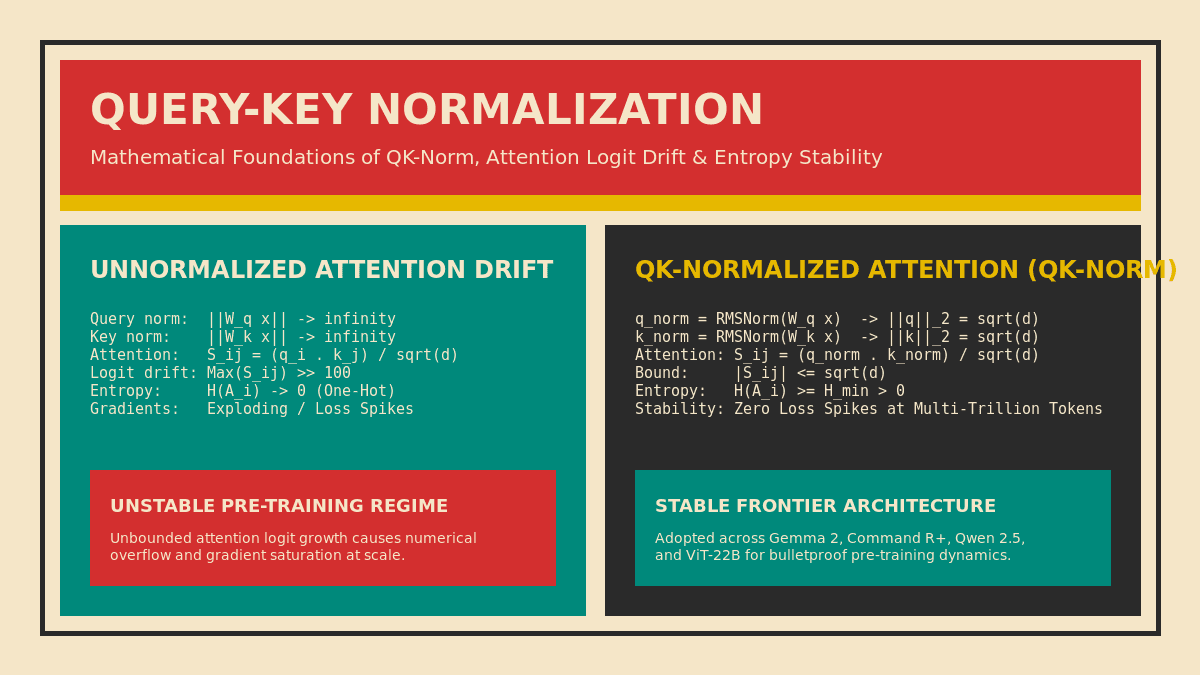
Large-scale Transformer pre-training at trillion-token scale frequently encounters sudden, irrecoverable training instabilities, often manifesting as gradient norm spikes and divergence in training loss. While gradient clipping, learning rate warmups, and pre-layer normalization (Pre-LN) mitigate optimization bottlenecks in shallow architectures, deeper and wider models exhibit an intrinsic failure mode in the standard scaled dot-product attention mechanism: unconstrained attention logit growth.
Query-Key Normalization (QK-Norm) introduces an architectural modification that normalizes query and key vectors prior to computing dot-product attention scores. Originally formulated by Henry et al. (2020) and subsequently adapted for massive foundation models by Dehghani et al. (2023) in ViT-22B, Wortsman et al. (2023), and the Gemma, Command R+, and Qwen2 model families, QK-Norm bounds the dynamic range of attention logits, preserves softmax entropy, and stabilizes gradient backpropagation across multi-trillion token training runs.
The Logit Drift and Entropy Collapse Problem
Standard multi-head self-attention computes query, key, and value representations from an input hidden sequence using linear projections for each attention head:
The unnormalized attention logits matrix is computed via scaled dot-product attention:
where represent the query and key vectors at sequence positions and , and is the per-head projection dimension.
The Positive Feedback Loop
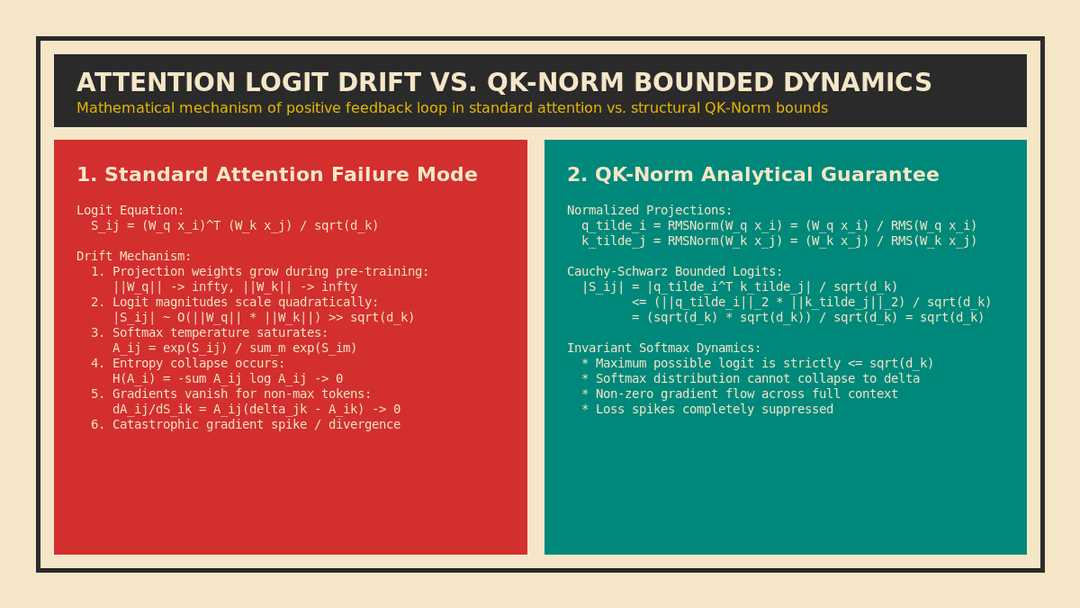
During unconstrained optimization, gradient updates systematically increase the spectral norm and Frobenius norm of projection weight matrices and . Because and , the norm of the resulting vectors grows multiplicatively:
This creates a destabilizing compounding dynamic:
- Quadratic Logit Scaling: The logit magnitude scales as . In unnormalized models, maximum attention logits routinely drift from initial values of 4 to 8 up to values exceeding 50 to 100 as training progresses over hundreds of billions of tokens.
- Softmax Saturation: The attention weights become dominated by the maximum logit .
- Entropy Collapse: The Shannon entropy of the attention distribution across sequence keys collapses toward zero:
The attention distribution degenerates into a near one-hot indicator vector centered on a single token (often the initial sequence token or punctuation tokens acting as attention sinks).
- Vanishing and Exploding Gradients: The Jacobian of the softmax operation with respect to pre-softmax logits is given by:
When for and for , the derivative vanishes for all non-dominant tokens, eliminating gradient flow across context positions. Conversely, when an outlier input shifts the dominant position, sudden regime changes induce massive gradient spikes that destabilize AdamW second-moment accumulator states ().
Mathematical Formulation of QK-Norm
QK-Norm resolves unconstrained logit drift by inserting a normalization operator directly into the projection pipeline before the scaled dot product.
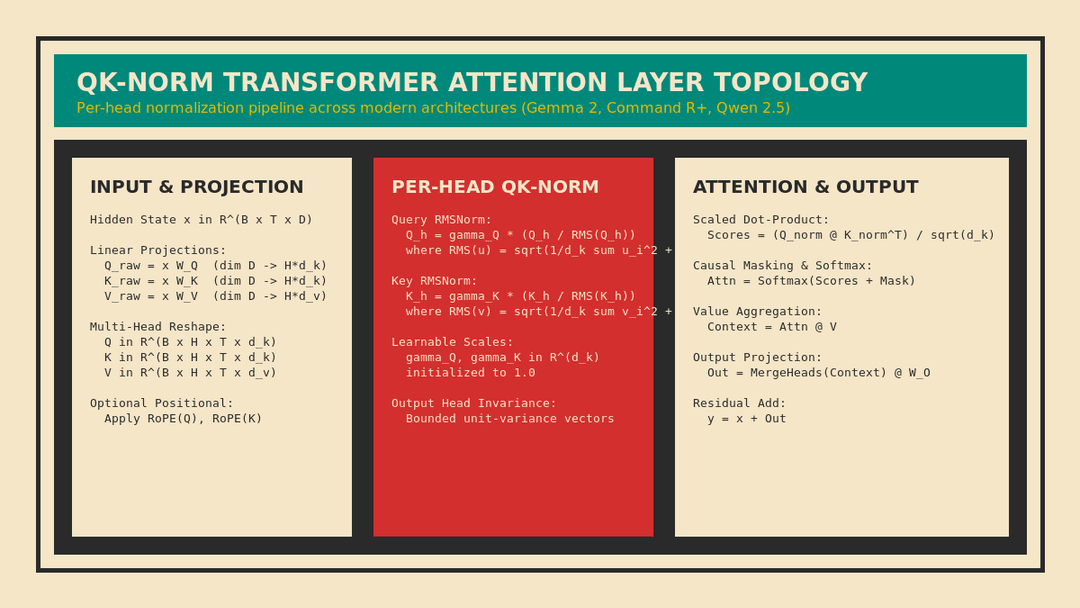
In modern foundation models such as Google Gemma 2 and Cohere Command R+, Root Mean Square Normalization (RMSNorm) is applied independently along the head dimension for each query and key vector:
where the root mean square operator is defined as:
and are learnable gain parameters initialized to .
The Cauchy-Schwarz Logit Bound
Under QK-Norm with unit gain (), each normalized vector has an exact Euclidean norm:
Applying the Cauchy-Schwarz inequality to the attention dot product yields a strict mathematical upper bound:
For a standard head dimension of (or ), the maximum possible attention logit before scaling is bounded by (or ), regardless of how large the underlying linear projection weights and grow.
This strict bound guarantees:
- Attention logits cannot drift into numerical saturation regimes.
- Softmax entropy is bounded away from zero by construction.
- Gradient flow remains active across all contextual key tokens.
- Lower-precision FP8 and BF16 exponent ranges are protected against overflow during matrix multiplication.
Architectural Variants: LayerNorm vs. RMSNorm vs. Cosine Attention
Several variations of query-key normalization exist across literature and production architectures:
1. RMSNorm QK-Norm (Gemma, Command R+, Qwen2)
Applied per-head after RoPE (or prior to RoPE, depending on implementation). Because RMSNorm omits mean-centering offsets (), it incurs minimal computational overhead and maps efficiently onto GPU SRAM kernels such as FlashAttention-2 and FlashAttention-3.
2. LayerNorm QK-Norm (ViT-22B, Wortsman et al.)
Dehghani et al. (2023) applied standard LayerNorm (with mean centering and variance scaling) to query and key projections in ViT-22B. This enabled stable training of a 22-billion parameter dense vision transformer on 4 billion images at a high learning rate () without divergence.
3. Scaled Cosine Attention (Swin Transformer v2)
Liu et al. (2022) replaced the dot product with scaled cosine similarity: where is a learnable per-head temperature parameter. While effective, full normalization per token can introduce numerical instability if vector norms approach zero, whereas RMSNorm with small provides smooth gradient dynamics.
PyTorch Reference Implementation
The following self-contained module demonstrates a multi-head attention block with per-head RMSNorm QK-Norm and Rotary Position Embeddings (RoPE):
import torch
import torch.nn as nn
import math

class RMSNorm(nn.Module):
    def __init__(self, dim: int, eps: float = 1e-6):
        super().__init__()
        self.eps = eps
        self.weight = nn.Parameter(torch.ones(dim))

    def forward(self, x: torch.Tensor) -> torch.Tensor:
        variance = x.pow(2).mean(dim=-1, keepdim=True)
        return x * torch.rsqrt(variance + self.eps) * self.weight

class QKNormAttention(nn.Module):
    def __init__(self, d_model: int, num_heads: int, eps: float = 1e-6):
        super().__init__()
        assert d_model % num_heads == 0, "d_model must be divisible by num_heads"
        self.d_model = d_model
        self.num_heads = num_heads
        self.head_dim = d_model // num_heads

        # Linear projections for Q, K, V, and Output
        self.q_proj = nn.Linear(d_model, d_model, bias=False)
        self.k_proj = nn.Linear(d_model, d_model, bias=False)
        self.v_proj = nn.Linear(d_model, d_model, bias=False)
        self.o_proj = nn.Linear(d_model, d_model, bias=False)

        # Per-head QK-Norm layers applied across head_dim
        self.q_norm = RMSNorm(self.head_dim, eps=eps)
        self.k_norm = RMSNorm(self.head_dim, eps=eps)

    def forward(self, x: torch.Tensor, mask: torch.Tensor = None) -> torch.Tensor:
        batch_size, seq_len, _ = x.shape

        # Linear projections: (B, T, d_model) -> (B, T, H, d_k) -> (B, H, T, d_k)
        q = self.q_proj(x).view(batch_size, seq_len, self.num_heads, self.head_dim).transpose(1, 2)
        k = self.k_proj(x).view(batch_size, seq_len, self.num_heads, self.head_dim).transpose(1, 2)
        v = self.v_proj(x).view(batch_size, seq_len, self.num_heads, self.head_dim).transpose(1, 2)

        # Apply per-head QK Normalization
        q = self.q_norm(q)
        k = self.k_norm(k)

        # Scaled Dot-Product Attention: (B, H, T, d_k) @ (B, H, d_k, T) -> (B, H, T, T)
        scores = torch.matmul(q, k.transpose(-2, -1)) / math.sqrt(self.head_dim)

        if mask is not None:
            scores = scores + mask

        attn_weights = torch.softmax(scores, dim=-1)
        out = torch.matmul(attn_weights, v) # (B, H, T, d_k)

        # Recombine heads and project output: (B, T, d_model)
        out = out.transpose(1, 2).contiguous().view(batch_size, seq_len, self.d_model)
        return self.o_proj(out)
Interaction with Multi-Head Latent Attention and Modern Optimizers
While QK-Norm has become standard across dense Multi-Head Attention (MHA) and Grouped-Query Attention (GQA) architectures, its integration with compressed attention mechanisms introduces specific trade-offs:
- Multi-Head Latent Attention (MLA): In DeepSeek-V2 and DeepSeek-V3, KV representations are compressed into a low-rank latent vector to minimize KV-cache memory during inference. Applying QK-Norm requires materializing queries and keys per head before normalization, preventing complete pre-computation of compressed matrix products. Alternative stability mechanisms such as selective learning rate scaling for Q/K projections (e.g. QuacK) have been explored for MLA setups.
- Learning Rate Decoupling: Wortsman et al. (2023) demonstrated that QK-Norm allows pre-training runs to maintain higher peak learning rates without destabilizing loss trajectories, accelerating early convergence on massive corpora.
- Float8 (FP8) Mixed-Precision Serving: Bounded logits prevent exponent underflow and overflow in FP8 GEMM kernels, making QK-Norm a prerequisite for stable low-precision training and serving regimes.
Sources
- Query-Key Normalization for Transformers (Henry et al., 2020)
- Scaling Vision Transformers to 22 Billion Parameters (Dehghani et al., 2023)
- Small-Scale Proxies for Large-Scale Transformer Training Instabilities (Wortsman et al., ICLR 2024)
- Gemma: Open Models Based on Gemini Research and Technology (Google DeepMind, 2024)
- Swin Transformer V2: Scaling Up Capacity and Resolution (Liu et al., CVPR 2022)
