

Selecting an open-source code generation model for production environments requires balancing task-specific accuracy, context window length, inference latency, memory footprint, and licensing terms. While general-purpose frontier models handle code generation reasonably well, dedicated code models optimize parameter density and token economics for developer workflows such as real-time autocomplete, fill-in-the-middle (FIM) editing, repository-wide reasoning, and automated test generation.
Four prominent open-weight code families dominate self-hosted infrastructure: Alibaba's Qwen2.5-Coder, DeepSeek's DeepSeek-Coder-V2, Mistral AI's Codestral 22B, and BigCode's StarCoder2. Each takes a distinct architectural approach to scaling code intelligence.
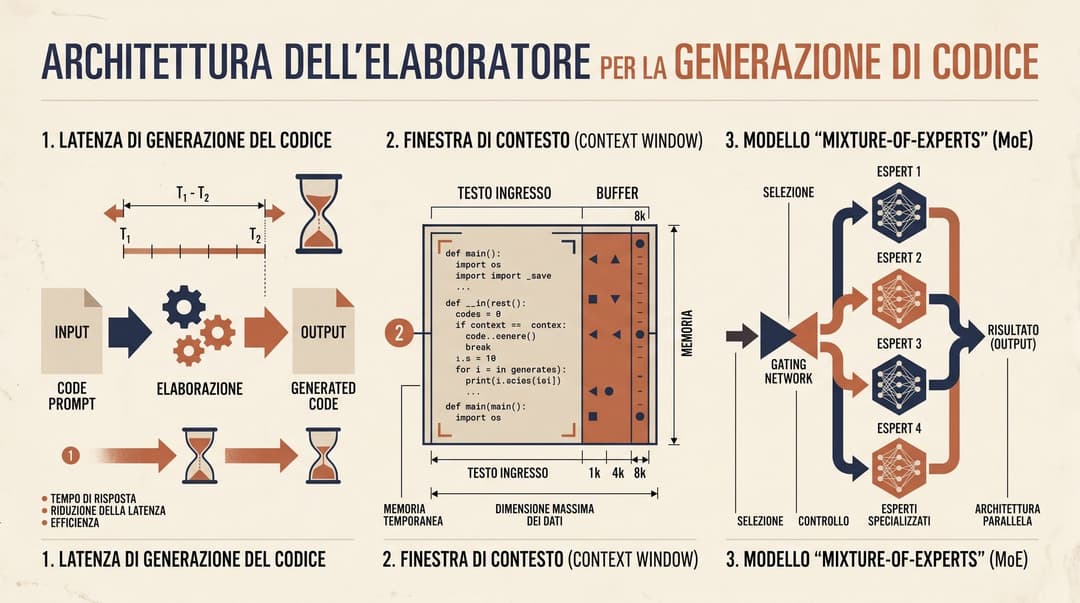
Architectural Design and Parameter Allocation
The four model families represent different trade-offs across dense parameters, mixture-of-experts (MoE) routing, and attention mechanics:
- Qwen2.5-Coder (0.5B to 32B dense): Built on dense Transformer foundations with SwiGLU activations, Rotary Position Embeddings (RoPE), and Grouped-Query Attention (GQA). Trained on 5.5 trillion tokens covering 92 programming languages, the family scales from sub-billion edge models up to the flagship 32B parameter variant. Native context support extends to 128,000 tokens.
- DeepSeek-Coder-V2 (16B and 236B MoE): Built on the DeepSeekMoE backbone with Multi-Head Latent Attention (MLA). The architecture replaces standard multi-head attention with low-rank key-value projections to compress KV cache memory overhead. The 16B Lite variant activates 2.4B parameters per token across 64 routed experts, while the 236B variant activates 21B parameters across 160 routed experts (plus shared experts). Both support 128,000 tokens via YaRN context extension and cover 338 languages.
- Codestral 22B (22B dense): A single dense 22-billion-parameter architecture optimized for developer tooling and IDE integration. Trained across 80+ programming languages, Codestral provides a 32,768-token context window with native fill-in-the-middle support.
- StarCoder2 (3B, 7B, 15B dense): Developed by the BigCode consortium (ServiceNow, Hugging Face), StarCoder2 uses Grouped-Query Attention combined with a 16,384-token context window and sliding window attention (4,096 tokens). Trained on 3.3T to 4.3T tokens from The Stack v2 across 619 languages, the model focuses on clean data lineage and Software Heritage compliance.
Benchmark Performance Across Code Synthesis and Reasoning
Standard code evaluation suites measure isolated function synthesis (HumanEval, MBPP), execution-based correctness (EvalPlus), multi-language synthesis (MultiPL-E), and repository-level tasks (RepoBench, SWE-bench).
Key benchmark results across the four model families:
- Qwen2.5-Coder-32B: Dense 32B architecture with 128,000 context tokens. Scores 92.7% on HumanEval (pass@1), 90.2% on MBPP, 51.1% on LiveCodeBench, 32.8% on RepoBench completion, and 18.0% on SWE-bench Lite across 92 supported languages.
- DeepSeek-Coder-V2 (236B MoE): Mixture-of-experts architecture with 21B active parameters per token and 128,000 context tokens. Scores 90.2% on HumanEval, 76.2% on MBPP+ (EvalPlus), 43.4% on LiveCodeBench, 31.5% on RepoBench completion, and 12.7% on SWE-bench across 338 supported languages.
- Codestral 22B: Dense 22B architecture with 32,768 context tokens. Scores 81.1% on HumanEval, 78.2% on MBPP, 34.0% on LiveCodeBench, 34.0% on RepoBench completion, and 8.2% on SWE-bench Lite across 80+ supported languages.
- StarCoder2-15B: Dense 15B architecture with 16,384 context tokens. Scores 46.3% on HumanEval, 60.3% on MBPP, 19.4% on LiveCodeBench, and 21.3% on RepoBench completion across 619 supported languages.
Across standalone synthesis benchmarks, Qwen2.5-Coder-32B and DeepSeek-Coder-V2 (236B) compete closely with closed-source frontier models like GPT-4o. On execution-verified benchmarks like LiveCodeBench and complex patch generation in SWE-bench, Qwen2.5-Coder-32B holds an edge over pure MoE routing, driven by its 5.5T token synthetic and multi-turn instruction tuning mixture.
Codestral 22B maintains a distinct advantage on repository-level code completion (RepoBench at 34.0%), where its dedicated FIM training objective and low-latency dense execution provide strong next-line predictions. StarCoder2-15B lags behind modern instruction-tuned baselines on raw algorithmic generation, but functions as a transparent foundational base for domain fine-tuning.
In-IDE Latency and Fill-in-the-Middle (FIM) Capabilities
For latency-critical IDE autocomplete, the primary requirements are sub-100ms time-to-first-token (TTFT) and native support for FIM tokens.
- Single-line and Multi-line Autocomplete: Codestral 22B and Qwen2.5-Coder-7B are the strongest candidates for real-time editor completion. Codestral was tuned explicitly with FIM permutations, achieving 91.6% on HumanEval-FIM benchmarks. Qwen2.5-Coder incorporates prefix-suffix format training across all model scales (0.5B, 1.5B, 7B, 14B, 32B), allowing smaller variants (1.5B and 7B) to serve low-latency completions locally on consumer hardware.
- Repository-Level Understanding: When providing multi-file context via Language Server Protocol (LSP) indexing or RAG embeddings, context length and retrieval precision determine output quality. DeepSeek-Coder-V2 and Qwen2.5-Coder support 128k context windows without quality degradation, while Codestral's 32k window is sufficient for single-project module imports but constrains full-monorepo indexing.
Production Serving Economics and Hardware Requirements
Inference costs and VRAM footprints determine deployment viability across bare-metal GPU clusters and edge machines.
VRAM Requirements by Precision
- Qwen2.5-Coder-32B: Requires ~64 GB VRAM in FP16/BF16 (single 80GB A100/H100 or 2x 48GB A6000/L40S). In INT4/AWQ quantization, it fits within 20-24 GB VRAM, enabling deployment on a single NVIDIA RTX 4090 or RTX 6000 Ada with 12-18 tokens/sec generation throughput.
- DeepSeek-Coder-V2 (236B MoE): Requires ~480 GB VRAM in BF16 (8x 80GB GPUs). When quantized to FP8 or INT4, it requires at least 140-160 GB VRAM (2x 80GB GPUs). Although it routes only 21B active parameters per token, all 236B parameters must reside in GPU memory, creating a high memory threshold despite low compute per token.
- DeepSeek-Coder-V2-Lite (16B MoE): With 2.4B active parameters, the Lite model requires ~32 GB VRAM in BF16 and ~10-12 GB in INT4/AWQ, serving at high token velocities on single consumer GPUs.
- Codestral 22B: Requires ~44 GB VRAM in BF16 and ~14-16 GB VRAM in INT4 quantization, fitting comfortably on a single 24GB RTX 4090 or 16GB VRAM server card.
- StarCoder2-15B: Requires ~30 GB VRAM in BF16 and ~10-12 GB in INT4. Grouped-Query Attention and sliding-window KV caching keep memory growth predictable across extended generation lengths.
Licensing and Governance
Licensing constraints significantly affect enterprise deployment decisions:
- Qwen2.5-Coder: Models up to 7B are released under Apache 2.0. The 14B and 32B checkpoints use the Qwen License Agreement, granting royalty-free commercial rights for applications with fewer than 100 million monthly active users.
- DeepSeek-Coder-V2: Released under the permissive DeepSeek License, permitting both commercial use and research fine-tuning without per-seat royalties.
- Codestral 22B: Released under the Mistral Non-Production License (MNPL), restricting self-hosted weights to non-commercial research and testing. Commercial deployment requires either licensing terms directly from Mistral AI or accessing the model via Mistral's hosted API endpoints.
- StarCoder2: Released under the BigCode OpenRAIL-M v1 license. It provides royalty-free commercial usage while maintaining data attribution standards and opt-out exclusions from The Stack v2.
Deployment Trade-Offs
- Best Overall Quality and Agentic Coding: Qwen2.5-Coder-32B provides the strongest combination of benchmark accuracy, reasoning depth, and self-hosted practicality. It operates effectively within agentic frameworks (SWE-bench, Aider) while fitting into affordable GPU configurations.
- Best Enterprise Cluster Scale (High Throughput / Multi-Language): DeepSeek-Coder-V2 (236B) delivers frontier-class capabilities across 338 programming languages. Its Multi-Head Latent Attention architecture reduces KV cache growth during high-concurrency serving, provided the host cluster has sufficient VRAM to hold the full 236B weights.
- Best Local Autocomplete and IDE Tooling: Qwen2.5-Coder-7B and Codestral 22B offer fast fill-in-the-middle completion. For commercial on-premise environments, Qwen2.5-Coder-7B avoids the licensing restrictions of Codestral while delivering competitive single-line latency.
- Best Open Governance and Training Lineage: StarCoder2-15B is the preferred choice for organizations requiring strict training data audits, copyright compliance guarantees, and domain-specific pre-training.
