

In modern enterprise AI systems, uniform model dispatch, sending all incoming user traffic to a single frontier large language model, is one of the most common architectural inefficiencies. Frontier models like GPT-4o and Claude 3.5 Sonnet provide industry-leading reasoning and code generation capabilities, but their inference costs range between $2.50 and $15.00 per million tokens. Conversely, smaller open-weights or distilled models, such as Llama 3.1 8B or GPT-4o-mini, execute at a fraction of the cost ($0.15 to $0.60 per million tokens) with significantly lower time-to-first-token (TTFT) latencies.
Production workload analysis consistently reveals that 70% to 85% of incoming queries do not require frontier-tier reasoning. Tasks such as entity extraction, JSON restructuring, classification, summarization of plain text, and basic conversational chit-chat can be answered by smaller models without observable quality degradation. However, routing all traffic to a small model degrades performance on complex multi-step reasoning, advanced mathematical derivation, and difficult software debugging.
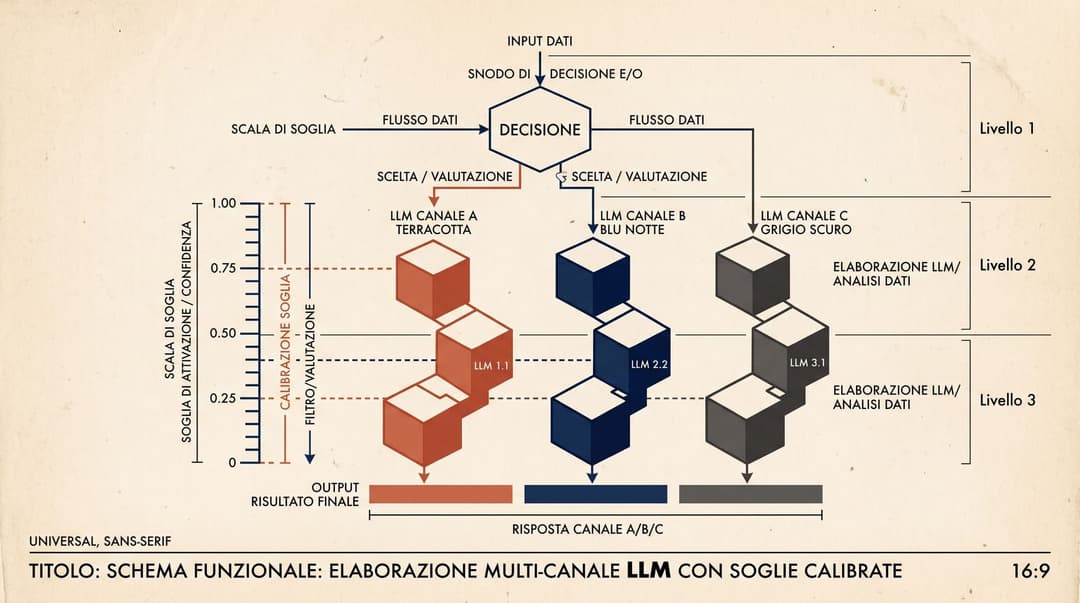
To balance inference budgets against output fidelity, production engineering teams deploy dynamic model routing and cascade systems. These architectures evaluate query complexity either before or during inference, dispatching requests dynamically across a heterogeneous pool of language models to optimize the cost-quality Pareto frontier.
The Three Core Routing Paradigms
Production routing architectures generally fall into three categories, each trading off operational complexity, latency overhead, and routing accuracy.
+-----------------------------------------------------------------------------+
|                             Incoming User Query                             |
+-----------------------------------------------------------------------------+
                                      |
         +----------------------------+----------------------------+
         |                            |                            |
         v                            v                            v
+------------------+        +--------------------+       +--------------------+
|  1. Rule-Based   |        |  2. Single-Shot    |       |  3. Sequential     |
|     Heuristics   |        |     Predictive     |       |     Cascade        |
| (Regex, Headers, |        | (MF / Embeddings / |       | (FrugalGPT Style / |
|  Metadata Tags)  |        |  Classifier Head)  |       |  Verify & Fallback)|
+--------+---------+        +---------+----------+       +---------+----------+
         |                            |                            |
         v                            v                            v
+------------------+        +--------------------+       +--------------------+
| Deterministic    |        | Single Model Call  |       | Tiered Execution   |
| Endpoint Target  |        | Selected Upfront   |       | (Weak -> Strong)   |
+------------------+        +--------------------+       +--------------------+
1. Rule-Based and Metadata Heuristics
Static routing relies on deterministic criteria, such as user subscription tier, target API endpoint, system prompt metadata, or explicit regular expression matching. While rule-based systems incur zero model evaluation overhead, they fail to adapt to unpredictable prompt phrasing or subtle variations in query difficulty.
2. Single-Shot Predictive Routing
Predictive routers analyze the input prompt prior to model inference. By processing prompt text or vector embeddings through a lightweight scoring model, the router estimates the probability that a cost-effective smaller model can satisfy the user request. The system immediately routes the prompt to either the weak or strong model in a single network round-trip.
3. Sequential Model Cascades
Pioneered by frameworks like FrugalGPT (Chen et al., 2023), sequential cascades dispatch prompts to the lowest-cost model first. The returned generation is subsequently evaluated by a scoring function (such as logit perplexity, self-consistency checks, or a discriminator model). If the output meets a predefined quality threshold, it is returned to the user; otherwise, the query falls back to a progressively more capable (and expensive) model.
Single-Shot Predictive Routing Architectures
Single-shot predictive routers are popular in low-latency production applications because they eliminate the serial invocation delays inherent in multi-model cascades. The primary router architectures examined in academic and industrial benchmarks include:
1. Matrix Factorization (MF) Routers
Developed in the RouteLLM framework by Ong et al. (2024), Matrix Factorization routers map user queries and model identifiers into a shared latent embedding space.
The router projects a dense query embedding alongside learned model representation vectors . A bilinear interaction computes a continuous preference score:
When trained on human pairwise preference datasets (such as the LMSYS Chatbot Arena), the MF router learns which geometric regions of semantic space require frontier reasoning. Inference requires only a single vector embedding generation followed by a dot product, executing in under 10 milliseconds.
2. Supervised Classifier Heads (BERT / RoBERTa)
In this design, a pre-trained encoder model is fine-tuned as a binary classifier on preference data. The classifier takes the input prompt and directly outputs a calibrated probability . While classifier heads provide slightly higher accuracy on domain-specific benchmarks, they incur higher memory usage and slightly greater inference overhead than linear projection layers.
3. Lightweight Causal SLM Evaluators
A small generative language model (such as a 1B to 3B parameter SLM) evaluates the input query using structured prompts to categorize task complexity. While flexible, causal SLM routers add 100 to 300 milliseconds of pre-routing latency and consume substantial GPU memory, making them less suitable for high-throughput gateway proxies.
4. Embedding Similarity (k-NN) Routers
Embedding similarity routers store vector representations of historical queries labeled with difficulty scores. When a new query arrives, the router computes the cosine distance to the top-k nearest neighbors in the vector index. If the nearest neighbors historically required frontier model capabilities, the query is escalated to the strong model.
Sequential Model Cascades and Generation Scoring
Sequential cascading optimizes for output verification rather than upfront intent prediction. Instead of guessing whether a query is difficult, the system lets a cheap model generate a candidate response and evaluates the artifact directly.
Incoming Query ---> [ Weak Model (e.g., Llama 3 8B) ]
                                |
                                v
                     [ Candidate Generation ]
                                |
                                v
                     < Quality / Acceptance Test >
                       /                       \
             Score >= Threshold          Score < Threshold
                    /                             \
                   v                               v
        [ Accept & Return ]            [ Fallback to Strong Model ]
The efficacy of a cascade depends entirely on its scoring function:
- Self-Consistency and Agreement: The system samples multiple outputs from the weak model at non-zero temperature. If generations converge on identical facts or code blocks, the response is accepted.
- Logit Uncertainty and Entropy: High token entropy or low average log-probability across key generation spans triggers escalation to the frontier model.
- Discriminator Reward Models: A compact reward model scores the generation against the prompt for factual coherence and constraint adherence.
Latency Trade-Offs in Production
The fundamental drawback of sequential cascades is tail latency. For queries where the weak model fails the acceptance test, the end user experiences the cumulative delay of both models:
In interactive user-facing chat applications, this multi-second tail latency is often unacceptable. Consequently, sequential cascades are predominantly used in offline batch pipelines, asynchronous agent execution loops, and automated evaluation harnesses.
Empirical Economics: Benchmark Results
Empirical evaluations across standard benchmarks show that learned routing drastically shifts the cost-performance boundary.
RouteLLM Benchmark Findings
The RouteLLM study (Ong et al., 2024) benchmarked routers across Chatbot Arena, MT-Bench, GSM8K, and Arena-Hard (Li et al., 2024), pairing weak models (such as Mixtral-8x7B or Llama 3 8B) with GPT-4:
- Cost Reduction: Matrix Factorization routers achieved cost reductions exceeding 50% to 85% while preserving 95% of standalone GPT-4 quality win rates.
- Out-of-Distribution Transferability: Routers trained on Chatbot Arena preference data maintained high routing efficiency when transferred to unseen model pairs (e.g., routing between Claude 3.5 Sonnet and open-weights models) without retraining.
- Threshold Calibration (): Engineering teams can adjust the routing threshold parameter () to smoothly traverse the trade-off curve between budget savings and response quality.
Quality Retention (%)
  100 |                                  * Frontier Model (100% cost)
   95 |                  * Learned Router (15-30% cost)
   90 |             *
   85 |        *
   80 |   * Weak Model (5% cost)
      +---------------------------------------------------
      0       20       40       60       80      100
                         Relative Inference Cost (%)
FrugalGPT Findings
In the original FrugalGPT evaluation (Chen et al., 2023), combining three API models (such as GPT-3.5, J1-Jumbo, and GPT-4) in an adaptive cascade matched GPT-4 accuracy with up to a 98% reduction in aggregate API expenses across headline question-answering datasets.
Production Implementation and Operational Pitfalls
Deploying dynamic routing within enterprise AI infrastructure introduces several architectural considerations:
1. Interaction with Prompt Caching
Modern LLM API providers offer significant cost discounts (typically 50% to 80%) for prompt caching on static system prompts and long context prefixes.
If a multi-tenant application routes consecutive turns of a conversation between different model providers, prefix caches are broken. Routing an ongoing conversation from Model A to Model B forces Model B to process the entire conversation history as an uncached prompt, which can erase the anticipated cost savings of the cheaper model. Effective production routers enforce session-level stickiness or restrict routing decisions to initial turn dispatch.
2. Router Cold Start and Domain Drift
Router models trained on generic conversational preference datasets often misjudge domain-specific difficulty. For example, a legal discovery query containing dense statutory references may appear syntactically standard to a general-purpose BERT router, causing it to incorrectly dispatch the query to a weak model. Production deployments require continuous logging of user feedback and periodic fine-tuning of router weights on enterprise-specific traffic.
3. Gateway Architecture and Circuit Breaking
Enterprise routing logic is typically hosted within dedicated AI Gateway layers (such as LiteLLM, Envoy AI Gateway filters, or Portkey). In addition to complexity-based routing, the gateway manages provider-level resilience:
- Automatic 429 / Rate Limit Fallback: If the primary frontier provider encounters capacity limits, the gateway cascades traffic to equivalent backup models.
- SLA-Driven Routing: High-priority enterprise tiers bypass routing algorithms entirely to guarantee frontier model access, while standard traffic is routed via cost-optimized thresholds.
Dynamic model routing and cascading architectures convert language model selection from a static development-time decision into an automated, runtime operational control. By deploying predictive routers at the API gateway layer, engineering teams can cut inference costs by more than half while preserving frontier-tier response quality.
Sources
- RouteLLM: Learning to Route LLMs with Preference Data (Ong et al., 2024)
- FrugalGPT: How to Use Large Language Models While Reducing Cost and Improving Performance (Chen et al., 2023)
- Arena-Hard: Automated Evaluation of LLMs with High Hardness and Quality (Li et al., 2024)
- LMSYS Chatbot Arena Leaderboard and Benchmarks
